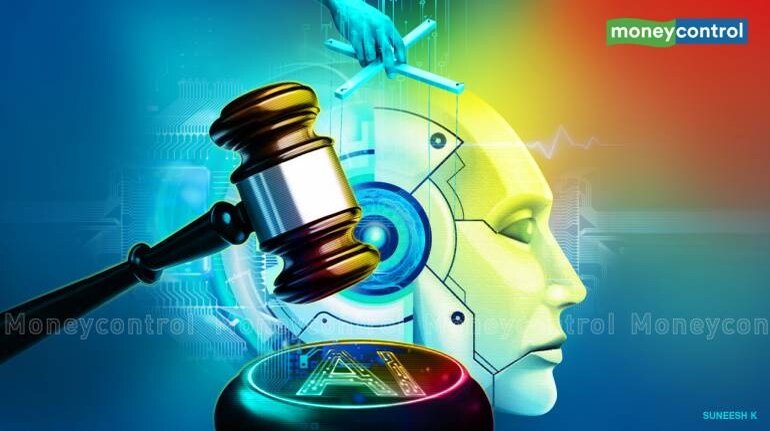
In 2023, artificial intelligence (AI) captured our collective attention, going from a futuristic buzzword to the hottest topic on every boardroom agenda, economic forecast, and policy debate.
Yet, the spotlight on AI is not without its shadows. The rise of AI has brought forth pressing concerns, ranging from the impending threat of job losses, to the urgent need for regulatory frameworks and heightened considerations for user safety.
Impact on jobsAI is set to revolutionise the nature of work as it can replace specific tasks and reshape traditional job profiles across various industries.
The introduction of generative AI tools, capable of generating not only text but also images, music, and code, heightened worries about the potential loss of jobs. This concern even led to strikes by Hollywood writers and actors, along with legal challenges from artists and authors.
In November, tech billionaire Elon Musk, in conversation with British Prime Minister Rishi Sunak, expressed the belief that "there will come a point when no jobs are needed."
The fear of job losses due to the mainstream adoption of AI tools has also surfaced in India, with the founder of SaaS major Zoho sounding an alarm in April.
He said that the rapid growth of AI, particularly in recently developed conversational AI platforms like ChatGPT and GPT-4, poses a threat to the workforce, particularly programmers.
However, there is a differing perspective on this situation from AI pioneer and founder of DeepLearning.AI, Andrew Ng.
"The number of jobs that is being said will be taken away by AI, is much less than what is being talked about. In many professions, AI will make you more efficient. Training and education is very important in this context," Ng said during the Global AI Conclave earlier this month.
Deepfakes and user safetyGovernments are closely watching the use of AI systems, particularly in the context of issues such as data scraping and the emergence of deepfakes.
The rise of deepfakes poses a significant challenge, contributing to the spread of misinformation. This has become particularly evident in instances where differentiating between authentic and manipulated war footage, as seen in Gaza, has become increasingly difficult.
Also read: AI can be a major threat to humanity, deepfakes create disturbances in society: Ashwini Vaishnaw
At a domestic level, concerns about deepfakes gained prominence following incidents involving prominent film stars and key personalities. In response, the government has initiated discussions with online platforms, urging them to come up with actionable plans to address the challenges posed by deepfakes.
"Today, some of the deep fakes, and misinformation which is created using AI – all these things can actually create huge disturbances in society, our social institutions, and institutions like marriage," IT Minister Ashwini Vaishnaw told Moneycontrol in an interview.
Earlier this month, India hosted a three-day Global Partnership for Artificial Intelligence (GPAI) Summit where member countries unanimously adopted the New Delhi Declaration on AI.
The declaration laid special emphasis on the risks of AI, specifically misinformation, disinformation, personal data, threats to human rights and democracy.
On the issue of deepfakes, Union Minister of State for Electronics and Information Technology, Rajeev Chandrasekhar, said, "If you have not taken my consent to do a deepfake of me and you put it out there, irrespective of whether it is harmless or a satire, I can be aggrieved and have the right to complain”.
"Even if you make me look good in the deepfake, I can still be aggrieved. If I take you to court, you may argue that no harm was caused. And I will argue that some kind of harm was caused," he added.
Also read: All you need to know about how the government is planning to regulate deepfakes
Chandrasekhar also said that such content could be subject to action under the current IT Rules, particularly Rule 3(1)(b), which mandates the removal of 12 types of content within 24 hours of receiving user complaints.
The Indian government also made it clear that it will restrict access to its datasets to only those AI models that are trusted.
"We have seen that data has been misused by certain geographies and countries. We are putting brakes on that... There should be a conversation globally that models are built on trusted datasets," Chandrasekhar had said.
The race to regulate AIIn 2023, even as AI made notable advancements, lawmakers worldwide were swift in their efforts to formulate regulations for this evolving technology.
A major milestone in global AI regulation for 2023 is the advancement of the European Union's AI Act. EU lawmakers reached a provisional deal on the world's first comprehensive set of rules governing the use of AI.
Also read: Key features of European Union's 'historic' AI legislation
The proposed legislation places a strong emphasis on improving regulations related to data quality, transparency, human oversight, and accountability.
The European Parliament is scheduled to vote on the proposed AI Act early next year, and the legislation is expected to be in effect by 2025.
In October, US President Joe Biden signed a long-awaited executive order on AI. Biden's executive order, invoking the Defense Production Act previously used during the Covid-19 pandemic, encompasses a wide range of objectives, such as enhancing AI safety and security, establishing standards and tests, and protecting citizens’ privacy, among others.
Just two days after Biden signed the executive order on AI, the UK hosted the inaugural AI Safety Summit in November. During this summit, India, along with 27 other nations, including the US, the UK, and the European Union, signed the Bletchley Declaration. This commitment entails collaborative efforts in evaluating the risks associated with AI.
India’s AI planIndia, on the other hand, has chosen a cautious approach to regulating the technology, with junior IT Minister Chandrasekhar emphasising the positive potential of AI while acknowledging the need for regulation.
He said that AI should not be demonised but regulated to prevent harmful effects. Chandrasekhar outlined India's perspective on AI, focusing on openness, safety, trust, and accountability during the AI Safety Summit in the UK.
"Words like 'AI for good' are something I don't understand. Is there an AI for bad? We certainly don't think there should be any doubt that the future of technology must always be for the good," he said.
Chandrasekhar had said in November that the aim of the Digital India Act (DIA) 2023 is to deal with the ill effects of AI.
"To regulate AI as an ecosystem, the Digital India Act will have to be enacted, which will deal with all the harms of AI," Chandrasekhar had said.
Meanwhile, during the recently concluded GPAI summit, Prime Minister Narendra Modi announced that the government would launch an AI Mission that aims to bring computing power into the hands of start-ups and innovators in the country. This initiative will enable them to tackle problems in areas such as healthcare, agriculture, and education.
The announcement followed the government's adoption of a report by an expert panel, recommending the creation of computing infrastructure consisting of 24,500 graphics processing units (GPUs) at 17 centres. This infrastructure is intended to foster innovation in the emerging tech field in the country by supporting start-ups and academia.
Under the proposal, about 14,500 GPUs have been recommended for training AI models and high-performance storage, while the remaining 10,000 are designated for AI inferencing (making predictions or solving problems using the data stored).
Highlighting the harmful side of AI and describing it as capable of "destroying the 21st century," PM Modi called on countries to collaborate on a global framework that would provide guardrails around AI and make it more responsible.


Discover the latest Business News, Sensex, and Nifty updates. Obtain Personal Finance insights, tax queries, and expert opinions on Moneycontrol or download the Moneycontrol App to stay updated!
Find the best of Al News in one place, specially curated for you every weekend.
Stay on top of the latest tech trends and biggest startup news.