-
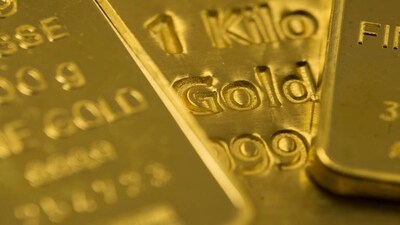
Gold prices edge higher as US dollar, Treasury yields slip
Spot gold edged up 0.2% to $2,027.85 per ounce, as of 0612 GMT, after hitting its lowest level since Jan. 25 on Monday.
-

Shares, yields edge higher as market awaits Powell policy guidance
Stocks across Europe surged but the major U.S. indices traded little changed after some Fed officials on Tuesday stressed further rate hikes are possible if inflation doesn't decelerate closer to the U.S. central bank's 2% target.
-
Treasury yields cool off, TCS to kickstart Q2 earnings season, oil prices in focus | Market Minutes
In this episode of Market Minutes, Shailaja Mohapatra talks about the global market setup in context of slight cool off in treasury yields. Tata Consultancy Services will be keenly tracked today, ahead of results. Bank of Baroda is in focus due to an RBI directive. Also, catch Ajay Vora of Nuvama Asset Management on Voice of the day segment. Market Minutes is a morning podcast that puts the spotlight on hot stocks, keys data points and developing trends.
-
Bond investors brace for supply freight train before fed confab
The highest long-term Treasury yields in years are headed for a major hearing next week as investors place their bids for two risky auctions — right before the Federal Reserve’s potentially game-changing annual gathering at Jackson Hole.
-
Global stocks drop, Treasury yields rise after Fitch downgrades US credit rating
On Wall Street, the Dow Jones Industrial Average fell 0.67% to 35,393.68, the S&P 500 lost 1.37% to 4,514.09, and the Nasdaq Composite dropped 2.47% to 13,931.70.
-
Global stocks make little progress with Treasury yields choppy in holiday-shortened session
After earlier gains, European shares pulled back and on Wall Street, while the Dow was up slightly, the S&P 500 and the Nasdaq were struggling to decide on a direction in a shorter trading day ahead of the U.S. July 4 holiday.
-
Wall Street mixed, Treasury yields rise on solid US economic data
Financials led the gainers after the Federal Reserve's stress test showed U.S. lenders have adequate capital to weather an economic storm.
-
Wall Street ends lower, Treasury yields climb as debt ceiling talks in spotlight
While all three major U.S. stock indexes ended down, the tech-heavy Nasdaq's losses were held in check by momentum megacaps including Amazon.com, Alphabet Inc and Microsoft Corp.
-
Wall Street dips, Treasury yields climb on mixed data; debt ceiling talks take spotlight
All three major U.S. stock indexes were in the red, with tech and communications services limiting the Nasdaq's decline.
-
Wall Street advances, Treasury yields rise as debt-ceiling debate rolls along
While all three major U.S. stock indexes ended green, market participants appeared to show little conviction as first-quarter earnings season winds down, leaving few market-moving catalysts, aside from a disappointing Empire State manufacturing report from the New York Federal Reserve.
-
Wall Street gyrates, Treasury yields fall amid mixed data, earnings
The S&P 500 and the Dow were modestly higher but Amazon.com pulled the Nasdaq into negative territory, with each index poised to notch modest weekly gains.
-
Recession, yes. But markets cling to hope crisis will be avoided
Across markets, the most convincing sign of a recession is the plunge in Treasury yields. Sinking further Friday, the downturn was led by shorter-dated bonds, which took the entire yield curve below 4 percent as banking turmoil led traders to price in more Federal Reserve rate hikes
-
Wall Street advances, Treasury yields dip on jobless claims data
Data released on Thursday showed U.S. jobless claims jumped by 11% last week - the largest increase in five months - while planned layoffs for February jumped four-fold, year-on-year.
-
Wall Street sends stocks higher as Treasury yields, dollar ease
In morning trading, the Dow Jones Industrial Average rose 0.22%, to 33,076.7, the S&P 500 gained 0.40%, to 3,997.22, and the Nasdaq Composite added 0.5%, to 11,520.06.
-
Wall Street dips as Treasury yields rise after auction
Yields on the U.S. 30-year note rose after the Treasury Department saw weak demand for a $21 billion sale, the final sale of $96 billion in coupon-bearing supply this week. In a note to clients, Jefferies said "the buyside bid failed to come together."
-
Wall Street fluctuates, Treasury yields rise after data deluge
All three major U.S. stock indexes were mixed in the wake of Thursday's sharp sell-off as a raft of indicators pointed to economic softening, evidence that the Federal Reserve barrage of interest rate hikes were having their intended effect.
-
Gold set for second weekly fall as Fed hawks lift Treasury yields
Spot gold was flat at $1,627.20 per ounce, as of 0118 GMT, and lost 0.8% so far for the week.
-
Wall Street oscillates, Treasury yields climb on cautious corporate guidance and recession worries
The three major U.S. stock indexes wavered between red and green out of the starting gate, while the benchmark Treasury yield shot up to touch a new 14-year high.
-
Wall Street wavers following surprisingly strong jobs report
Stocks are swinging between small gains and losses as Wall Street works out what to make of surprisingly strong data on the US jobs market released July 9.
-
Wall Street suffers biggest weekly loss since January after hot CPI data
Following the inflation report, two-year Treasury yields , which are highly sensitive to rate hikes, spiked to 3.057 percent, the highest since June 2008. Benchmark 10-year yields reached 3.178%, the highest since May 9
-
Gold prices steady as easing Treasury yields lift appeal
Spot gold was steady at $1,847.49 per ounce, as of 0036 GMT. U.S. gold futures were up 0.2% to $1,851.40.
-
Gold hits over one-week low as firm Treasury yields, dollar dim appeal
Spot gold was down 0.3% at $1,944.77 per ounce, as of 0206 GMT, after hitting its lowest since April 11. U.S. gold futures fell 0.6% to $1,947.70.
-
Wall Street stumbles as surging Treasury yields slam growth stocks
All three major U.S. stock indexes ended deep in negative territory, with tech and tech-adjacent stocks pulling the Nasdaq down the most.
-
Gold slips as rising Treasury yields bolster dollar
Spot gold was down 0.2 percent at $1,941.95 per ounce, as of 0452 GMT, after hitting a more than one-week high of $1,949.32 earlier in the day. US gold futures were flat at $1,945.70.
-
Asia shares start cautiously, Treasury yields keep climbing
A holiday on China made for sluggish trading, and MSCI's broadest index of Asia-Pacific shares outside Japan dipped 0.1%.