-
Growing e-waste an opportunity for manufacturers: Tech product makers
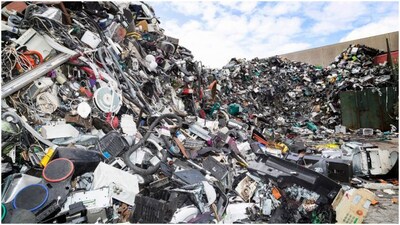
E-waste is an electronic product that is no longer needed, worn out, not working, or nearing the end of its utility for the user. These include wires to devices.
-

India processed only 33% of e-waste it generated in FY22; Haryana, Uttarakhand lead in collection and processing
The country currently has 567 e-waste processing facilities with a total annual capacity of around 17.23 lakh tonnes. Smaller states lead in processing.
-
Risky Rubbish: E-waste collectors, handlers at risk due to lack of safety practices
PV modules and batteries contain reusable metals such as silicon, aluminium, copper, nickel, iron, and rare metals like cobalt and lithium. Handling these without proper guidelines can cause health problems.
-
Car restoration expert creates vehicle installations using e-waste
The installations will be exhibited at Auto Expo 2023 at Greater Noida from January 13.
-
Attero expects 65% of $2 billion revenue target in 5 years to come from Lithium-Ion recycling
Attero Recycling's CEO and Co-Founder Nitin Gupta told PTI that the company is in process of setting up its first lithium-ion (Li-Ion) plant in Europe, which is expected to be operational by September 2023.
-
European Union gives final approval for USB Type-C common charger directive
This will mean the USB Type-C port will be mandatory for a whole range of electronic devices from 2024
-
Hulladek plans to recycle 50,000 tonnes of e-waste by 2025
The country generated 3.2 million tonnes of e-waste in 2020. Its recycling is now a Rs 1,600-crore industry.
-
Nearly 25 lakh tonne e-waste generated in country in past 3 years: Govt
Responding to a query, Minister of State for Environment Babul Supriyo told the Lower House that for the 21 types of notified Electrical and Electronic Equipment (EEE), an estimated 7.08 lakh tonne e-waste was generated in 2017-18, while the respective figures for the next two financial years were 7.71 lakh tonnes and 10.14 lakh tonnes.
-
Podcast | Digging Deeper - From trash to cash: Can India manage its e-waste responsibly?
With some hand-holding from local authorities, the world’s biggest technology manufacturers can transform e-waste management into a feasible revenue source.
-
Government plans to set up e-waste recycling unit in Bengaluru
As India’s technology capital, Bengaluru produces an estimated one lakh tonne of electronic waste a year
-
In a bid to curb e-waste, Rajasthan govt to buying it from people
Rajasthan government has launched a scheme under which they will buy computers, desktops, routers and other electronic wastes from people, in a bid to curb increasing e-waste.
-
India among top 5 nations in e-waste generation: Report
Among states, Maharashtra contributes the largest e-waste of 19.8 per cent but recycles only about 47,810 tonne per annum (TPA), the report released by Assocham and NEC today said ahead of the Environment Day on June 5.
-
E-waste on Ramganga banks: NGT imposes Rs 10 lakh environment compensation on UP govt
A bench, headed by Acting NGT Chairperson Justice U D Salvi, took exception over the state government's inaction in the matter and observed that nothing has been done till date.
-
DATA STORY: Every year India loses gold worth Rs 6,347 crore as part of e-waste
In 2016, India disposed of 728 kilotonnes (kt) Iron, 96.8 kt copper, 110.6 kt Aluminium, 71 tonnes silver, 22 tonnes gold and 9 tonnes palladium. That means, the country discarded gold and silver worth Rs 6,347 crore and Rs 300 crore
-
Par panel asks govt to evolve mechanism for e-waste management
Referring to a Central Pollution Control Board (CPCB) estimate that India generated 16.4 lakh MT of e-waste in 2014, the committee noted that merely notifying rules is not enough until there is a strong and effective implementation.
-
India likely to generate 52 lakh MT of e-waste by 2020: Study
The global volume of e-waste generated is expected to reach 130 million tonnes (MT) in 2018 from 93.5 MT in 2016 at a compound annual growth rate of 17.6 percent from 2016 to 2018, it said.
-
India fifth largest producer of e-waste in world: study
The telecom equipment alone accounting for 12 percent of the e-waste, a joint study by Assocham-KPMG said.
-
Want to go green? Recycle your old gadgets
Not everyone is aware that electronic devices contain valuable and harmful elements that are difficult to dispose off but can be reused by sending them away for recycling.
-
I‘ll take a smartphone in any colour as long as it is green
What I am interested in is making sure that the phone I buy has a low carbon footprint and has no blood in its circuits. So, if you are listening, Samsung, LG, Apple, Nokia and others, heres my wish-list for the perfect smartphone.
-
Don't recycle; these gadgets dissolve inside you
As consumers we want our electronic gadgets to be durable. But as patients, we might want them to dissolve - inside our bodies....
-
Nokia India announces Create To Inspire programme
Nokia India has introduced its "Create to Inspire" fellowship program in a bid to get the nation's youth on the track of ...