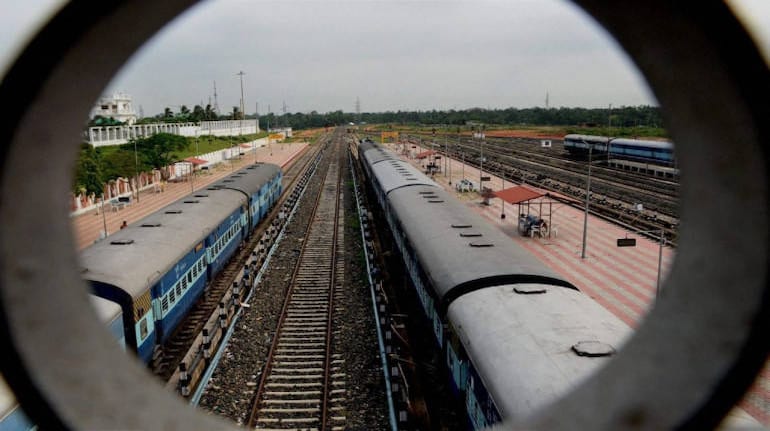
The Indian Railways is well on its course for a turnaround. For long considered a doddering, not-so-efficient public sector monolith, the railways have set a target to be the best in the world in another 10 years and would like to become a nimble-footed, socially responsible utility provider. It has pledged to help the government in its clean energy drive and to strive to make train journeys as smooth and safe as possible for passengers.
These are welcome, if daunting, tasks. Only last week railway minister Piyush Goyal had reiterated the government’s commitment to fully electrify railway tracks as part of its effort to reduce the carbon footprint. Speaking at a business conclave on August 29, the railway minister also said he would like to see Indian Railways running on renewable energy in the next 10 years. As and when it happens, this will have a double salutary effect — it will lead to a cleaner environment as well as help cut the country’s crude import bill.
That the railways have gained traction after Goyal took charge of the ministry mid-way through the first term of the NDA government is evident from many of the transformative changes that are sweeping through the country’s largest employer. It should be kept in mind that his predecessor Suresh Prabhu had quit following a spate of train accidents. Soon after taking charge, rail safety was put on top of the agenda and statistics say the efforts are paying off — between April and December last year, the railways recorded the lowest accident figures in the last three decades, with 45 incidents; the comparable number was 54 during the same period in 2017.
With road and air transportation breathing down its neck, the Indian Railways, in recent times, has tried its best to improve the travel experience by making services better. Not only did the railways try to improve trains and railway stations but they are also working on making train ticket booking, cancellation, refund or enquiry smoother. For example, the railways have started providing TTEs (travelling ticket examiners) hand-held terminal devices that allow faster re-allocation of vacant berths and seats.
But a better travel experience is not enough to keep passengers hooked to rail travel. In today’s world where time is a premium commodity, people are eager to reach their destinations as fast as possible. Hence trains need to run fast. Keeping this is mind, Mission Raftaar had already been launched. This is a multi-pronged strategy for running high-speed trains (with a speed of over 300 kmph/bullet trains), semi-high speed trains (between 160 to 200 kmph), increasing the speed of existing trains and introducing train sets similar to Train-18.
To support the rail ministry’s transformational drive, Goyal has also pledged to convert the Modern Coach Factory (MCF) in Raebareli into the world’s largest in the next few years. The plan is to increase its production to 5,000 units in the next few years. The factory was planned at a cost of Rs 3,192 crore, with annual production capacity of 1,000 coaches. In 2017-18, it manufactured 711 coaches, which increased to 1,425 coaches in 2018-19.
Of course, implementing these plans will require massive investment. Speaking after the presentation of the Union budget on July 5 this year, the railway minister had said, “the government envisages investment of ₹50 lakh crore by the year 2030 in railways to make it the world’s best railway which will include safety of passengers, expansion of network, and increase in freight share”.
It is a no-brainer that it will not be possible for the railways to fund such a huge investment on its own. That is why the government is open to the idea of allowing private investment in setting up high-speed and semi-high speed lines. In her maiden budget speech, finance minister Nirmala Sitharaman too had said the national transporter would be encouraged to have private investment in several key areas, including delivery of passenger and freight services, tracks and rolling stock manufacturing.
In fact, as part of its 100-day road map in the second stint of the NDA government, the Indian Railways has decided to offer two trains to the Indian Railway Catering and Tourism Corporation, which in turn will approach the private sector for on-board services.
While the intent to change the manner in which the railways have chugged along for decades is encouraging, careful monitoring by the railway authorities is essential for the initiatives to bear fruit. All too often, grandiose plans have stumbled on the nitty-gritty of implementation. For example, the ambitious bullet train project between Mumbai and Ahmedabad, at an investment of Rs 1.1 lakh crore, is facing some land acquisition issues. Goyal himself has admitted that a solution needs to be found out “in a sensitive way”. As far as private participation is concerned, it must be remembered that public-private partnership works well only under an effective revenue- and cost-sharing model.
For the railways, Mission Raftaar should not just be about launching fast-running trains but it should strive to impart speed to the railway ministry’s various initiatives so that they can reach their targeted destinations.
Abhijit Kumar Dutta is a freelance writer. Views expressed are personal.Discover the latest Business News, Sensex, and Nifty updates. Obtain Personal Finance insights, tax queries, and expert opinions on Moneycontrol or download the Moneycontrol App to stay updated!
Find the best of Al News in one place, specially curated for you every weekend.
Stay on top of the latest tech trends and biggest startup news.