






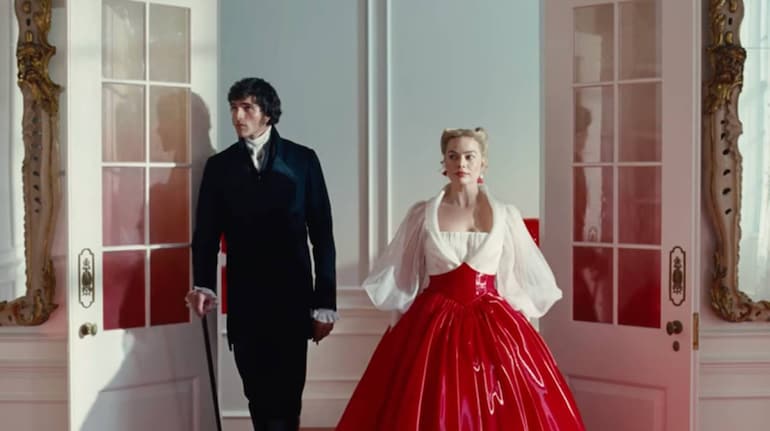
Emerald Fennell’s 2026 adaptation of ‘Wuthering Heights’ has stormed the box office, grossing $92 million worldwide in its opening week against an $80 million production budget. Emily Brontë’s novel is far more than Gothic romance: it is a quiet yet ferocious feminist-economic treatise.
Beneath the storms of passion lies a precise calculus of women’s constrained “agency” and the optimal choices she makes within. Fennell’s maximalist, sensual reimagining, starring Margot Robbie as Catherine Earnshaw and Jacob Elordi as Heathcliff, refuses to soften this anatomy. Released near Valentine’s Day, the film transforms Brontë’s insight into a luminous interrogation of how raw desire collides with material cages.
From the Moors to Brutal Reality
Fennell opens not with moorland ghosts but with auditory cues of strange ecstasy yielding to a public hanging—a stark deviation from the book, but one that immediately signals the brutal outer world of violence and indifference. Linus Sandgren’s precise, almost documentary cinematography renders this world viscerally real. From it, Mr Earnshaw plucks a nameless orphan. Young Heathcliff arrives scarred, already marked as negative human capital in a rigid class and gender order.
One of the film’s most tender sequences follows. The distrustful boy hides beneath a bed, its wooden frame his fragile sanctuary. The camera stays low, honouring his terror. Young Cathy appears with childhood’s unselfconscious grace. She crouches, speaks directly, “I will be kind to you”—and names him Heathcliff. He clutches her ankle in desperate trust. This luminous moment of recognition amid trauma echoes the honest child portrayals in Mira Nair’s Salaam Bombay! or Martin Scorsese’s Hugo.
Feminist-Economic Insights
Cathy tries to make Heathcliff literate, but those tense moments when he struggles to learn, read and write, and Cathy’s patient attempts until the last grain of her endurance, are superb manifestations of the book. Fennell adopts brilliant brevity on what to retain from the classic literature. As the director candidly admits, it is difficult to adapt such composite works. The movie distils Brontë to Fennell’s deeply personal “feeling” when she read the book, with all its brilliance and limitations.
The moors themselves, photographed with patient beauty, become an extension of the tension—beautiful yet unsettling. Charli XCX’s throbbing score pulses like a hidden heartbeat beneath Victorian restraint, amplifying the tension between inner longing and outer constraint. This music evokes Brontë’s writing style of “frame composition,” layering continuous space within space and continuous form within form.
Love, Loss, and Strategic Decisions
Fennell condenses childhood trauma into one visceral shot of drunken abuse by Mr Earnshaw, stripping away the cruel Hindley and the novel’s full intergenerational revenge arc. Her focus is laser-sharp on the central love story: a love denied. Any later cruelty by Heathcliff is traced unapologetically to formative loss and exclusion.
Robbie crafts a Catherine of magnetic volatility and acute strategic awareness. This is no passive heroine but a woman engaged in constrained optimisation, weighing choices within patriarchal property regimes. After tasting sophistication at Thrushcross Grange with her new friends Isabella and Edgar, Cathy articulates the stakes to Nelly Dean with brutal clarity: “It would degrade me to marry Heathcliff.”
Through a feminist-economic lens, Cathy’s choice of Edgar Linton is not romantic caprice but rational risk aversion, minimising vulnerability. Her love for Heathcliff remains unconditional, “I am Heathcliff”—yet she recognises the transaction she must enter. We cannot write off Cathy as selfish. Her regret arrives swiftly, but Heathcliff has already vanished, heartbroken.
The Economics of Othering
Jacob Elordi’s Heathcliff personifies exclusion and the economics of othering. Of uncertain origins and denied legitimate inheritance, he begins as zero or negative human capital. His calculated accumulation demonstrates the narrow pathways for upward mobility and their poison under rigid institutions. His revenge—executed through strategic marriages, debt traps, and property transfers—is classic rent-seeking, capturing economic value by weaponising the very mechanisms that once excluded him.
Rigid gender scripts force men into hyper-competitive, emotionally suppressed roles where worth is measured by dominance, accumulation, and retaliation rather than tenderness or mutual vulnerability. Fennell portrays Heathcliff as embodying this deformation: denied belonging, he performs a caricatured masculinity—ferocious, acquisitive, vengeful—because softer expressions of love are economically and socially penalised. His pain is real, his longing authentic, yet the structures available to him channel both into destruction.
Desire, Liberation, and Structural Constraints
The film’s erotic intensity between Robbie and Elordi carries material weight. Rain-soaked trysts and scenes of solitary rapture are not mere sensuality; they dramatise desire’s rebellion against constraints. All intimate moments unfold through fully clothed, intensely charged takes, reflecting realistic female fantasy. Fennell’s choices are powerfully feminist.
Later, the film condenses Brontë’s account of intergenerational capital transmission and gendered disinheritance into Cathy’s decline and immediate aftermath. Fennell’s greatest contribution is refusing to disentangle passionate love from economic structures. By rendering yearning visceral and maximalist, she demonstrates Catherine’s core tragedy: no institution of her era allowed both wild fulfilment of desire and material security. The moors serve as a powerful metaphor.
Audiences leave with a dual realisation: love is tempestuous yet structural. The same “pricing of desire” that drove Cathy’s decisions continues to shape women’s lives and men’s. True liberation, Fennell insists, requires institutional redesign while completing the unfinished business of feminism by reimagining masculinity.
Conclusion: Storm and Invitation
This is an ambitious, imperfect, and ravishing film. Fennell gives us both storm and invitation—an invitation to keep measuring, questioning, and ultimately transforming the economics of desire in which human hearts live. Brontë’s novel transcends romance; it indicts class rigidity and cyclical trauma. Fennell amplifies lust and shock to unmask hypocrisies, proving that even unsustainable love can expose the bars—and invite us to break them.
(Lekha Chakraborty is Professor, NIPFP and Member, Board of Management, International Institute of Public Finance, Munich.)
Views are personal, and do not represent the stand of this publication.
Discover the latest Business News, Sensex, and Nifty updates. Obtain Personal Finance insights, tax queries, and expert opinions on Moneycontrol or download the Moneycontrol App to stay updated!
Find the best of Al News in one place, specially curated for you every weekend.
Stay on top of the latest tech trends and biggest startup news.




