
The 2020s have so far served as something of an advertisement for financial regulation. The litany of travails and transgressions in the realms of crypto, fintech, pension funds and more amounts to a resounding endorsement of the safety and soundness standards that traditional banks must meet.
It’s thus strange that some want to weaken one of the financial system’s most fundamental safeguards: capital requirements designed to ensure that banks can weather crises.
In recent months, bank executives and others have been reviving two arguments against what they describe as regulators’ ever-increasing capital demands. The first is that the requirements harm the economy by impairing banks’ capacity to lend. The second is that they’re responsible for the migration of financial activity to less-regulated intermediaries — and hence for the systemic threats that such “shadow banking” entails.
This reasoning is wrongheaded on many levels. Capital isn’t a rainy-day fund that banks must “hold” or “set aside.” It’s equity from shareholders, money banks can use to take risks and make loans — and that, unlike debt, has the advantage of absorbing losses. Independent research has consistently shown that ample capital helps banks keep lending through difficult times, making the economy more resilient and monetary policy more effective. Bank managers, though, often prefer to use less equity and more debt, because such leverage has tax benefits and can boost profitability measures in good times.
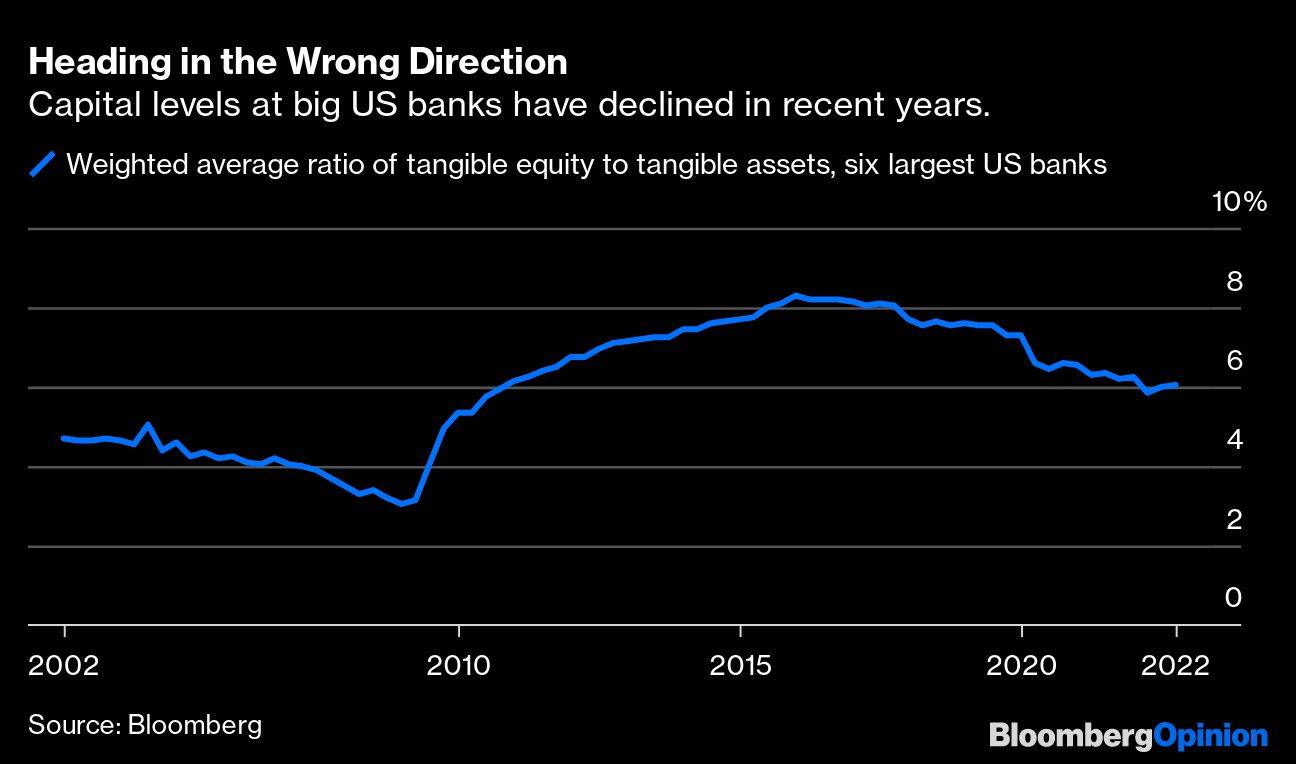
So how much capital do banks really need? It’s hard to say precisely, but it’s abundantly clear that the biggest ones don’t have enough. Even amid the reforms that followed the 2008 financial crisis, one simple measure — the ratio of tangible equity to tangible assets — peaked at a weighted average of just 8.3 percent for the six largest US banks. That’s much less than what both academic research and historical experience suggest they should have to act as a source of strength in a severe crisis. Since then, capital levels have declined.
Granted, the movement of activity away from regulated banks does present a problem. By one estimate, nonbanks now account for almost 60% of credit provision to the US economy, about double the level of 1980. Various incidents, including the implosion of the FTX crypto exchange and repeated runs on money-market mutual funds, have demonstrated the dangers. The right response, though, isn’t to ease up on banks. Instead, officials should monitor and address risks wherever they arise, including by extending leverage limits beyond the banking system.
Fortunately, the Fed’s new head of bank supervision, Michael Barr, is well acquainted with the cases for and against higher capital requirements — and appears to be solidly in the former camp. He has embarked on what he calls a “holistic review” of capital standards, with an eye toward bolstering the resilience of the largest banks and incorporating a wider range of risks in stress tests. Most important, he advocates humility: Given that nobody can predict the nature or severity of crises, it’s prudent to have larger buffers against the unexpected.
In 2008, a lack of capital helped turn a financial crisis into a global debacle that threw millions out of work and cost Americans alone an estimated $1.4 trillion. In his efforts to prevent a repeat, Barr will face daunting opposition. He deserves all the support he can get.
Credit: BloombergDiscover the latest Business News, Sensex, and Nifty updates. Obtain Personal Finance insights, tax queries, and expert opinions on Moneycontrol or download the Moneycontrol App to stay updated!
Find the best of Al News in one place, specially curated for you every weekend.
Stay on top of the latest tech trends and biggest startup news.