






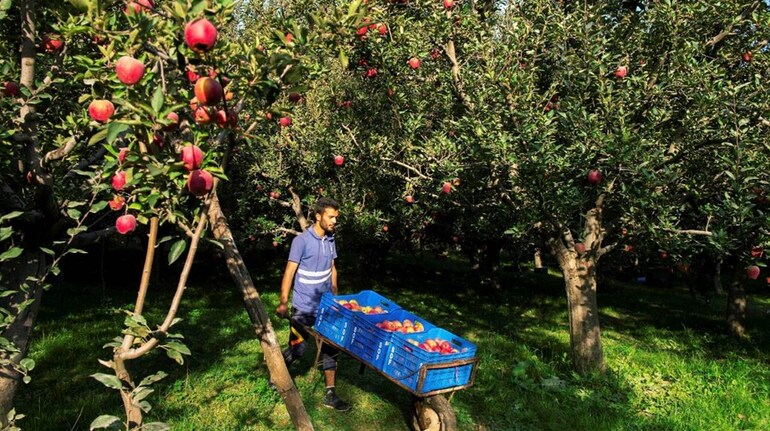
Thousands of apple growers in the country especially from Jammu and Kashmir, Himachal Pradesh, Uttarakhand and some areas of Northeast are anxious following the interim trade agreement between the US and India wherein fresh fruit imports are expected to face reduced tariffs.
The deal came months after India and New Zealand signed a free trade agreement under which India reduced the import duty on New Zealand apples from 50 per cent to 25 per cent under a quota-based system. As per the agreement, import duty concessions will be given to New Zealand on 32,500 metric tonnes (MT) in the first year of the pact. The quota will be increased to 45,000 MT in the sixth year at 25 per cent duty.
Domestic apple growers fear a glut of American apples
Growers are apprehensive that American apples with low import duty will flood the Indian market and result in a major blow to domestic apple growers.
Under the deal, American apples will enter India at a minimum import price (MIP) of Rs 80 a kg, with 25 per cent import duty, making it available to the Indian customer at Rs 100-110.
Growers fear the move could further burden an industry already struggling with losses due to logistical disruptions, climate change and rising input costs.
J&K is the largest domestic source of apples
Jammu & Kashmir is the top producer with roughly 20 lakh tonnes, followed by Himachal Pradesh with about 5-6 lakh tonnes, and Uttarakhand with approximately 50,000–60,000 tonnes.
A few days ago, apple growers in Kashmir wrote a letter to Prime Minister Narendra Modi, warning that cheaper imports could seriously undermine the domestic horticulture sector.
While seeking 100% import duty on foreign apples, the letter stated that the reduction in custom duty on American/European apples will make imported apples cheaper and a trader naturally prefers them over Kashmiri Apple, and this directly affects the pricing of apples of Kashmir, Himachal and Uttarakhand.
Pressure on growers was building up even before the trade deal
There is a growing sense among apple growers in Kashmir that their economy is being steadily squeezed, and that this trade deal could prove to be the final nail in the coffin for the region’s struggling horticulture sector.
With rising input costs, limited cold storage infrastructure, and inconsistent policy support, growers worry that without timely government intervention, thousands of families dependent on apple cultivation could face severe financial distress.
The region has few factories, industries and other reliable means of generating a stable income for the population.
Apple farming is one of the primary sources of employment, engaging nearly 3.5 million farmers, who constitute 27 percent of the region’s population. The Valley exports over 2 million tons of apples annually, generating $ 1.44 billion (Rs 12,000 crore) in revenue. Around 80 percent of India’s annual apple production comes from Kashmir.
In Himachal Pradesh too, the sector is important, contributing 13 per cent to the region's GDP.
Differences between government and growers on domestic production shortfall
However, apple growers have suffered significant losses over the years, particularly since the outbreak of COVID-19 and the successive lockdowns that disrupted markets and supply chains. The situation was further aggravated by the import of tax-free Iranian apples through Afghanistan.
Fayaz Ahmad Malik, president of the Sopore Fruit Mandi, the largest fruit market in the Valley, argues that they can’t compete with Washington apples in the market as horticulture in the US has progressed to a highly mechanised, technology-driven industry backed by strong government subsidies, advanced cold storage infrastructure, and streamlined global supply chains.
“The biggest advantage they have is strong government support,” he said adding “Farmers there receive subsidies, benefit from crop insurance, and produce on a much larger scale.”
Although, the government has said that the Centre has not "opened up" the market for US apples under the interim trade pact, but instead has given them a "quota" that is less than current apple imports, while fully protecting domestic apple growers, the growers argue that India has done this deal with the US under "under pressure” and without taking the farmers into confidence.
In an interview with ANI, Union Commerce Minister Piyush Goyal said that domestic demand for apples exceeds supply, adding that the country is currently unable to produce enough to meet the required quantity.
“The demand for apples is more than 25-26 lakh tons. We produce about 20-21 lakh tons. As we speak, we import 5.5 lakh tons of apples every year. And a large quantity of that comes from the United States of America,” he said.
However, traders and growers across the Valley rejected this claim, arguing that they produce apples in surplus but lack adequate government support in logistics and the development of a robust supply chain.
Policy must support domestic growers
The Modi-led government has been placed emphasis on slogans like ‘Make in India’ and ‘Go local’ to help Indian businesses. However, these principles must translate into concrete policy support, especially for sectors like horticulture that sustain lakhs of livelihoods.
The farmers are the backbone of a country's economy, making a substantial contribution to its overall economic growth and stability.
While it is understandable that many countries have had to renegotiate trade terms with the US amid the new tariff war, the central government should step in to support farmers by providing subsidies until the trade tensions ease.
(Auqib Javeed is a Srinagar-based journalist, and tweets @AuqibJaveed.)
Views are personal, and do not represent the stand of this publication.
Discover the latest Business News, Sensex, and Nifty updates. Obtain Personal Finance insights, tax queries, and expert opinions on Moneycontrol or download the Moneycontrol App to stay updated!
Find the best of Al News in one place, specially curated for you every weekend.
Stay on top of the latest tech trends and biggest startup news.




