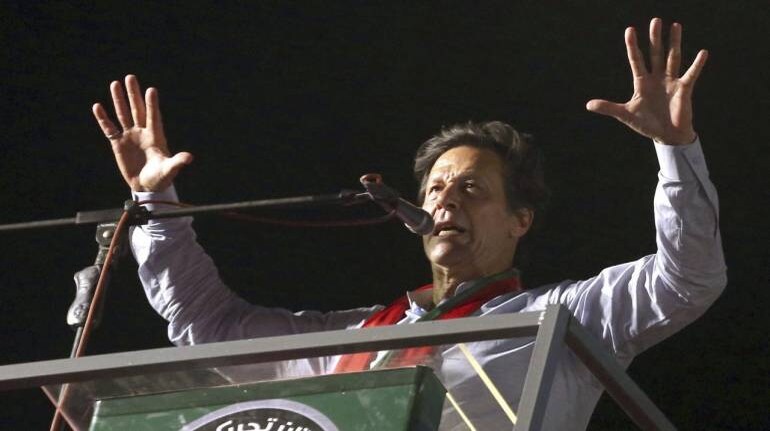
Pakistan’s former Prime Minister Imran Khan has proven that he remains the most popular political leader in the country. Despite losing power in April, his party —Pakistan Tehreek-i-Insaf (PTI), recorded a thumping victory in the by-elections held on July 17, in the Punjab province. The outcome has come as a shocker for Khan’s political opponents, and the Pakistani security establishment. But Khan’s continuing popularity and electoral triumph does not augur well for Pakistan’s political stability.
Days after the by-poll results, Punjab assembly witnessed high political drama and tension on the streets over the election of the province’s new chief minister. The politics of confrontation is likely to only worsen. The ensuing political instability will have disastrous consequences to the country’s faltering economy.
Punjab by-election results show that Khan is carving out a powerful and unique role for himself in Pakistan’s politics. By attacking what he has called the ‘imported government’ of the Pakistan Democratic Movement (PDM) alliance, the Pakistan Army and the ISI, and the election commission, he is projecting himself as a defender of democracy. Taking a stand against the alleged ‘foreign conspirators’ —the United States — he has built a reputation as an avid nationalist. This positioning and narrative have resonated with voters in urban and rural constituencies alike.
In Punjab’s recent political history, it is an unprecedented development that a non-Sharif has won a two-third majority in local by-elections. Out of the total 20 seats, the PTI won 15, while the Pakistan Muslim League (Nawaz) PML-N secured only four seats in its home turf.
Moreover, contrary to the usual trend of low voter turnout in by-elections, the by-poll witnessed a record turnout of nearly 50 percent. The Punjab verdict makes it nearly impossible for the PML-N government to survive for long despite dirty political tricks played by the Sharif brothers, and Pakistan People's Party (PPP)’s Asif Ali Zardari.
Inspired by the triumph in Punjab, Khan is now pressuring the federal government to hold polls to the National Assembly by October. In his victory speech on July 18, Khan warned that unless his demand for a “free and fair” election was met, a greater political chaos could ensue in the country. The predicament of the PDM coalition government is clear: It has nothing substantial to offer as a relief to the ordinary Pakistanis, who are reeling under severe food and energy crisis, and long power blackouts.
The Shehbaz Sharif-led government, in the last three months of its rule, has failed to contain Pakistan’s economic slide. It has failed to revive the stalled
International Monetary Fund bailout programme, that has only caused additional economic woes. PML-N chief and former Prime Minister Nawaz Sharif has attributed his party’s defeat in Punjab to the ‘difficult decisions’ taken by the coalition government.
Yet the two main coalition partners — the PML-N and the PPP — have agreed to delay the general elections until the mid-2023 to provide the PDM alliance some breathing space to take ‘populist’ decisions, make key electoral reforms, improve the country’s economic outlook, and find legal ways to target Khan.
Prime Minister Shehbaz Sharif has already urged the Election Commission of Pakistan (ECP) to announce the “long-delayed” judgment in the prohibited funding case, previously referred to as the foreign funding case, against the PTI.
But Imran Khan is refusing to budge. He has termed the ECP as “biased”, and demanded Chief Election Commissioner Sikander Sultan Raja’s resignation over his alleged favouring of the PML-N. These allegations and counter allegations are only contributing to the deterioration of Pakistan’s political environment. As a result, the country is staring at a greater risk of defaulting amid growing political uncertainty.
If this economic and political chaos persists, the powerful military establishment may have to dump the PDM government and explore political alternatives such as early elections.
Notably, the process to select the new Chief of Army Staff will commence soon as General Qamar Javed Bajwa has decided to not seek the ‘second’ extension. The PDM leadership would not like to miss out on the chance to select the new army chief, who could, in some ways, help the coalition government survive Khan’s challenge.
The PTI too has sensed a similar opportunity and, therefore, pressuring the ECP to conduct snap polls so that Khan, after his return to power, may pick the new army chief. Khan is using the rhetoric of fixing the economy for holding fresh NA elections.
However, with more political uncertainty in the offing, neither the Sharif-led PDM government, nor Khan’s possible return to power can provide relief to the ordinary Pakistanis, who have been failed by their petty-minded politicians - again.
Sameer Patil is Senior Fellow at Observer Research Foundation. Sarral Sharma is PhD Scholar at Jawaharlal Nehru University, New Delhi. Views are personal, and do not represent the stand of this publication.
Discover the latest Business News, Sensex, and Nifty updates. Obtain Personal Finance insights, tax queries, and expert opinions on Moneycontrol or download the Moneycontrol App to stay updated!
Find the best of Al News in one place, specially curated for you every weekend.
Stay on top of the latest tech trends and biggest startup news.