September 07, 2023 / 14:31 IST
PM Modi emphasises that inflation is a global concern.
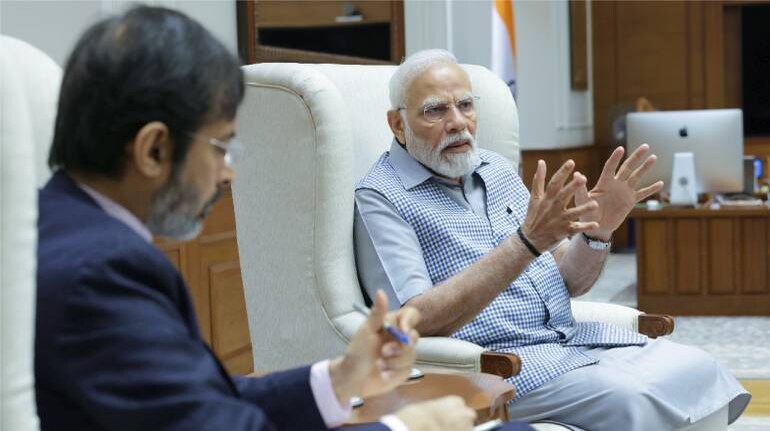
Against the backdrop of the upcoming G20 summit in New Delhi, India’s Prime Minister Narendra Modi in an interview with Moneycontrol, apart from speaking about the role that India can play in the world economy, highlighted how inflation was a key issue that the world faced. It requires finance ministers and central bankers to work together to combat inflation. There has been quite a turnaround of fortunes as far as global inflation, especially in developed countries, is concerned.
On analysing the decadal average of inflation in the developed, and emerging and developing economies, we see interesting comparisons. The decadal average inflation in developed economies has declined in each decade from 1980 to 2020. In the case of emerging and developing economies, average decadal inflation rose in the 1990s compared to the 1980s but declined sharply thereafter.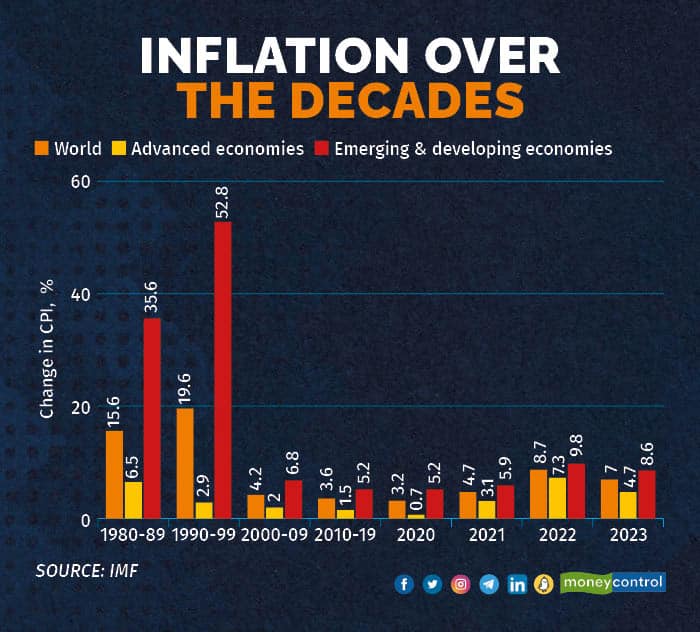
Story continues below Advertisement
Inflation has since cooled in 2023 but is still higher than the inflation target of 2 percent in developed countries. At the recently held Jackson Hole conference, central bankers of developed economies emphasised that inflation was still high and they would do every bit to bring it down to 2 percent. So, it is not surprising that the Indian prime minister has mentioned inflation as a key issue faced by the world economy.
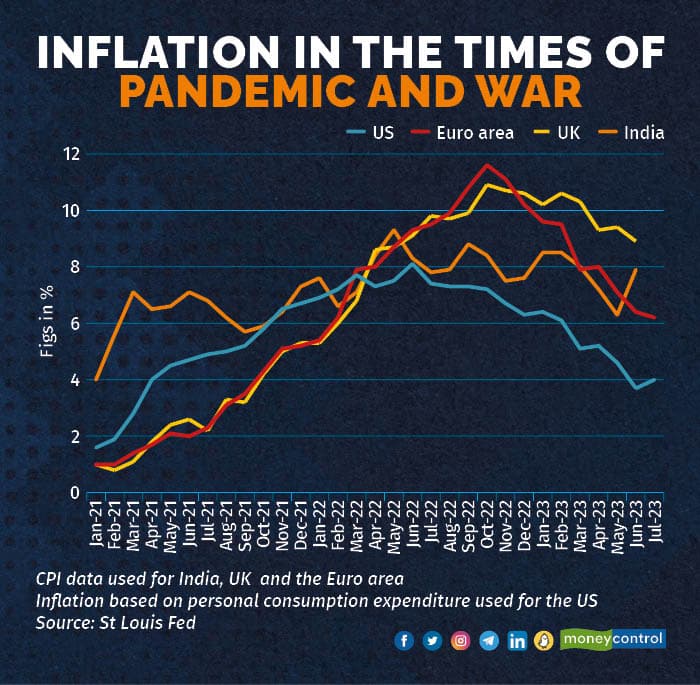
Where does all this discussion leave India? Interestingly, India’s inflation has been lower than that of key developed economies in the 2022-23 period. India has historically always had higher inflation than these economies but since March 2022, it has had lower inflation than the euro area and the UK. There were a few months (Nov 21-Mar 22) when India’s inflation was lower than that experienced by the US. Inflation in the UK and European economies were deeply connected to the oil and gas supplied by Russia. As the Russia-Ukraine war broke out, disrupted supplies led to record inflation levels. India, on the other hand, could buy Russian oil and manage the shocks much better. India’s inflation targeting framework, launched in 2016, has matured a bit and that also helped anchor inflation expectations.Government InterventionApart from the RBI, the government has also intervened to control inflation, especially in food prices. The government banned the export of non-basmati rice, restricted the export of onions, reduced the price of LPG cylinders by Rs 200 and so on. However, these export-restricting decisions in a way lead to higher global inflation, as India is a major supplier of these agricultural commodities. The reduction of LPG price might provide short-term relief but over the long-term, it will lead to higher subsidies, which in turn could be inflationary. Overall, high inflation has become a focal point for the G20 after many years of low global inflation. The developed countries are facing the heat as their economies had already slowed before the pandemic. The World Bank has already projected a lost decade of 2021-30 for the world economy, with developed economies at the forefront of the slowdown. A further tightening of monetary policy or monetary policy conditions will deepen the slowdown in the economy. India should also not be complacent in its fight against inflation. India’s inflation may be lower than the developed world’s but it has been higher than the target for most months since the pandemic. Thankfully, the RBI has stressed that it is committed to bringing inflation to 4 percent over time.
Amol Agrawal teaches at Ahmedabad University, and is the author of 'History of Private Banking in South Canara district (1906-69)’. Views are personal, and do not represent the stand of this publication. Discover the latest Business News, Sensex, and Nifty updates. Obtain Personal Finance insights, tax queries, and expert opinions on Moneycontrol or download the Moneycontrol App to stay updated!