






The AI royalty is in Delhi this week. Sundar Pichai. Sam Altman. Dario Amodei. Bill Gates. Demis Hassabis.The India AI Impact Summit. $33,000-a-night hotel rooms (₹27 lakh). $70–100 billion in expected investment announcements (₹5.8–8.3 lakh crore). My WhatsApp groups won't shut up about it.
I looked at that roster and felt something different. The playbook they're running is 300 years old.
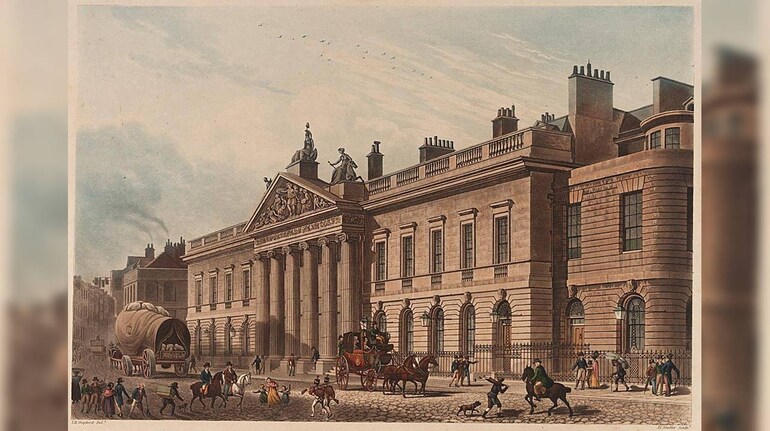
The last time this many powerful foreigners showed up in India with this much capital and this much ambition, they came by ship.They were called the East India Company.
I don't say that lightly. Sven Beckert — Harvard historian, Bancroft Prize winner — wrote the manual. It's called "Empire of Cotton." It's about the 1700s. It reads like a warning about next week.
He documents how Britain captured India's textile industry — then the world's most valuable — through four stages:
1) Capture the networks. The EIC inserted itself as middleman into Indian trade. Controlled shipping, financing, market access.
2) Appropriate the knowledge. British manufacturers studied Indian dyeing, printing, weaving — transplanted it to British mills. Took the knowledge out. Never sent the machines back.
3) Restructure production. India went from exporting finished textiles to shipping raw cotton to Manchester. Finished cloth was sold back at 10×. India became the world's largest customer of its own raw material, transformed.
4) Destroy local capacity. Tariffs banned Indian textiles from Europe — not because they were inferior, but because they were superior. India's share of global manufacturing: 24.5% → 1.7%.
India's cotton industry was decimated… India eventually became the world's largest market for British cotton exports." — Sven Beckert, Empire of Cotton.
The jobs are real. The salaries are good. Nobody is being conquered. Every engineer who joins Google Bangalore does so by choice — and that choice is rational. But Beckert's point was never about force. It was about structure. The EIC also operated through contracts, trade agreements, and willing local partners — until the structure made alternatives impossible.
Now replace the words.
Raw cotton → Data and talent
Manchester → Silicon Valley
Finished cloth → AI models and platforms
East India Company → The CEOs on that stage next week
The EIC captured trade routes. FAANG captured talent routes. The pipeline: Indian taxpayers fund IITs. Indian families spend $200-400K sending their smartest kids abroad. Most stay — H-1B, green card, filing patents for American tech companies. The ones who come back? Google Bangalore, not TCS. GCCs poach from IT services at a 15-20% premium. India funds the training. America owns the graduates. The country has become a giant recruiting agency — one that pays for its own candidates.
Yes, some GCC engineers leave to start companies. But for every founder who walked out, ten thousand stayed and built IP owned by Mountain View. The system isn't designed to produce Indian companies.Every algorithm at Google Bangalore — owned by Alphabet in Mountain View. Every model trained by Microsoft India — IP held in Redmond. Indian data labelers train the world's most powerful AI for $1.50-2/hr. The models are worth trillions. The knowledge flows in. The ownership stays out.
India trains the model. America owns the model. India buys the model — at SaaS pricing.
1,800+ GCCs now operate directly in India. 1.9M employees. $65B revenue. They cut out the Indian IT middleman entirely. Top 5 IT firms added 17 net employees in 9 months. TCS cut 12,200 jobs. Over 1 lakh tech jobs lost globally in 2025. And Infosys now helps MNCs build their own GCCs — literally constructing the Manchester mills that put their own weavers out of work.
Indian IT ran on labor arbitrage, not innovation. But it was Indian-owned, Indian-listed, Indian-taxed. This shift isn't from bad to good — it's from Indian-owned imperfect to American-owned efficient.R&D at IT firms: <2% of revenue vs 20%+ at product companies. No Indian company owns a global AI model, cloud platform, or social network. The talent pipeline, the knowledge, the production, the market — all flow one way.
1800s — India's cotton industry decimated. India became Britain's largest textile market.
2026 — India's IT services being decimated. India is ChatGPT's biggest market. Perplexity's fastest-growing market. Claude's second-largest market. India has zero sovereign AI models in the global top 20.
India supplies the intelligence. America packages it. India buys it back.
"If we don't develop sovereign AI capabilities, we risk a kind of digital colonialism." — N. Chandrasekaran, Chairman, Tata Sons · Mumbai Tech Week 2025
He's not using a metaphor. He's reading the playbook.
The playbook has one more chapter. Today, ChatGPT, Gemini, and Copilot are free — the dopamine phase. We've seen this before, and not just in the 1800s. Gmail was free until every Indian business ran on it — now Google keeps raising storage prices. Netflix entered India cheap, hollowed out Bollywood's distribution model, then hiked subscriptions. The British did the same thing: flood India with cheap Manchester cloth until local weavers are gone, then raise prices. Once AI becomes the utility layer — and it will — the meter starts running. Billions per year flowing from India's consumption basket to Redmond and San Francisco.
Not investment. Rent.
(Amit Bhartiais Portfolio Manager at Delorean Partners.)
Views are personal, and do not represent the stance of this publication.


Discover the latest Business News, Sensex, and Nifty updates. Obtain Personal Finance insights, tax queries, and expert opinions on Moneycontrol or download the Moneycontrol App to stay updated!
Find the best of Al News in one place, specially curated for you every weekend.
Stay on top of the latest tech trends and biggest startup news.






