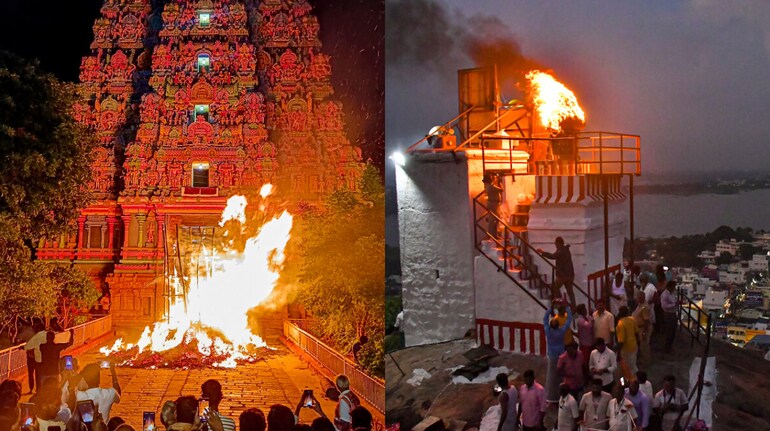
What should have been a religious claim to a secular public space, last week, turned into a site of contestation for different religious groups.
While archaeologists, experts and activists have termed the controversial pillar atop the Thirupparankundram hill near Madurai a theodolite stone used to measure areas, the Tamil Nadu government in its arguments in the Madurai Bench of the Madras High Court has given a religious hue to counter the BJP claim of it being a Deepathoon (lamp pillar) for lighting the annual Kathigai Deepam fire. In the process the DMK government seems to have changed a public order issue to a land dispute among religious groups.
A Division Bench of Justices G Jayachandran and KK Ramakrishnan commenced the hearing from December 12 (Friday), on appeals preferred against the order of Justice GR Swaminathan who had directed the Subramaniya Swamy temple management to light Karthigai Deepam at the deepathoon besides the usual places and also other connected appeals. The state government’s arguments before the bench initially submitted that over 150 years the mahadeepam (sacred fire) was lit at Uchipillaiyar Temple and never at the disputed pillar coined as deepathoon by Justice Swaminathan. It argued that there is no temple record, register, inscriptions, file in the Hindu Religious and Charitable Endowments Department or any Agama reference to support that the disputed pillar was the traditional deepathoon.
The state, represented by Advocate General PS Raman, referred to earlier judgements saying that there was no mention of deepathoon. In a 1920 order areas belonging to the temple and the dargah were demarcated. In 1996 (on a petition filed in 1994) MHC declined to permit lighting of the lamp in any place on the hill other than the Uchipillaiyar Temple Mandapam.
Making its observations, the bench had questioned why a lamp visible to all devotees (from hill top) should not be allowed if that was the petitioner’s concern.
More arguments poured in the following days, complicating the issue into a religious tone. The Sikandar Badshah Dargah, represented by senior lawyer T Mohan, submitted that it was directed to go to the civil court to establish the custom of animal sacrifice and so a similar direction should be given to the petitioner to establish the custom of lighting the Deepam on the disputed pillar. The dargah countered that the permission to light the lamp on the disputed pillar was given by the single judge despite not establishing it was a traditional deepathoon and that the judge did not give them proper opportunity to present their case.
The same day the Joint Commissioner of the Hindu Religious and Charitable Endowments Department, represented by senior advocate N Jothi said that books written by experts mentioned that the pillar was established by Jains and does not belong to Hindus. Similar pillars were erected elsewhere in Madurai district, like on Samanar Hills and Shravanabelegola in Karnataka. He contended that Digambars who came from Madhya Pradesh lived on Thirupparankundram hill and used the pillar to light lamps when they congregated at night. The Karthigai Deepam lamp was lit only at Uchipillaiyar Temple Mandapam.
Next day the Tamil Nadu Waqf Board joined the argument claiming that the pillar came under the summit area belonging to the dargah, as per the judgement in 1920 Original Suit. Advocate R Abdul Mubeen arguing for the Board said that according to the order the flight of steps from Nellithope, the summit of the hill, and its adjuncts, including a mandapam, belonged to the dargah/mohammedans: “The stone pillar/deepathoon was accessible from the dargah.” However, he went on to add that the issue could be resolved through a “court-monitored mediation”.
The hearing ended Thursday. Court reserved order. On the last day TN told the court there is no evidence that the stone is a deepathoon. It also told the court that it has not formed an opinion on the pillar.
The TN government probably thought that if the pillar was projected as a secular site, all religious groups would claim access to it for different rituals during various periods; and, since Jains were not numerically strong in the area, projecting the pillar as a Jain pillar would prevent any communal flashpoints between Hindu groups and Muslim sections. But what should have been a simple adjudication over the right to perform a religious ritual in a public space is now a land dispute between religious groups.
Discover the latest Business News, Sensex, and Nifty updates. Obtain Personal Finance insights, tax queries, and expert opinions on Moneycontrol or download the Moneycontrol App to stay updated!
Find the best of Al News in one place, specially curated for you every weekend.
Stay on top of the latest tech trends and biggest startup news.