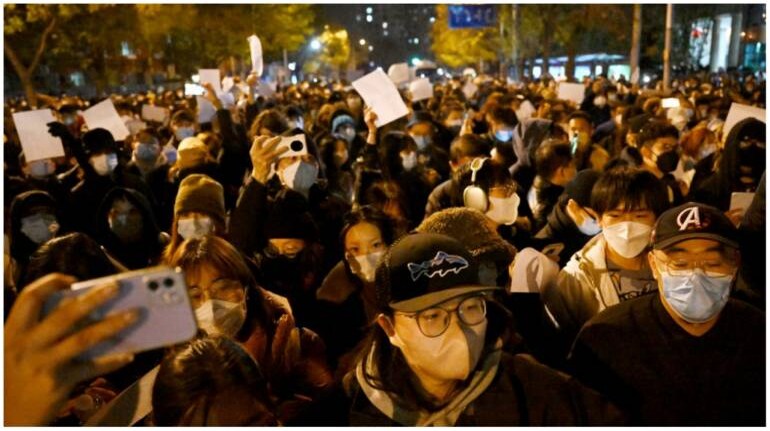
China’s COVID dilemma seems to be deepening by the day. Its real big problem seems to be born out of its own success: Beijing was remarkably successful in using harsh tactics in containing the original COVID infestation, and it even managed to keep its economy afloat in 2020 and 2021. But today, the Omicron variant is bypassing Chinese controls. Most of its 1.4 billion people are without natural immunity and have never been exposed to the virus. Only now are the Chinese authorities scrambling to launch “a more aggressive drive to boost immunity and… expand hospital capacity.”
On November 24, China again recorded its highest number of daily COVID cases since the outbreak of the pandemic. The footage is doing the rounds on Chinese social media of protestors clashing with police wearing hazmat suits at the iPhone factory in Zhengzhou. The earlier peak was focused on Shanghai but this time around, there were reports of rising cases in all of China’s provinces and regions.
On the same day, The Global Times reported that Beijing’s anti-COVID fight had reached its “most critical point" after the city was hit by 1,000 infections a day. Beginning 24th November, city residents would require a negative test certificate obtained within 48 hours to enter public venues.
According to one report, currently, more than 80 Chinese cities are battling high levels of infection, compared with 50 cities during the Shanghai shutdown which lasted 60 days. These cities generate half of China’s GDP and generate 90 percent of its exports.
The impact of the most recent restrictions has resulted in the disruption of big industry events. The organisers cancelled the China Automotive Overseas Development Summit in Shanghai after just half a day of its inaugural. Earlier this month, the Guangzhou International Motor Show was postponed because of the COVID restrictions. The Beijing show, postponed in April, will not be held in 2022.
There is no doubt that China’s zero-COVID approach has helped save many lives. It also kept the Chinese economic growth going when the rest of the world fumbled in 2020 and 2021. They have not seen the devastating losses suffered by countries such as India, the United States, Brazil, or Russia and the big worry for the Chinese leadership is the possibility of a surge in deaths if they relaxed controls. But the strict controls ensured that the Chinese population has lower immunity towards more transmissible variants.
As it is, China’s vaccination record has been spotty. Government data shows that 66 percent of people over 80 have been fully vaccinated, while only 40 percent have got a booster shot. For reasons unknown, Beijing has also adopted a restrictive attitude towards importing foreign vaccines which have been updated to fight the Omicron variant.
A Bloomberg Intelligence report says that a full reopening at this point could lead to 363 million infections, some 5.8 million people being admitted into ICUs and almost 620,000 deaths. As a result, it says that China will adopt a slow exit from its zero-COVID policy which could extend beyond 2023.
The report estimates are derived from the experience and data of the US and Europe where a full-blown Omicron outbreak led to a quarter of the people being infected.
As of now, the Chinese authorities are determined to maintain their zero-tolerance policy towards COVID infections though there have been some changes that have eased the tough measures such as sweeping lockdowns and repeated mass testing.
The Bloomberg Intelligence report also says that China needs to push its vaccine booster shots more and one problem it confronts is the lack of adequate coverage for the elderly.
At the beginning of November, the Chinese leadership declared that they would stick to their zero-COVID approach, but adopt a more targeted approach. The Politburo Standing Committee, chaired by Xi Jinping, said that they expected a larger wave of infections in winter and expected the tough measures to remain in place till spring of 2023.
The dynamic zero policy features repeated mass testing, travel restrictions, and snap lockdowns that can last weeks or months. Urumqi, the capital of Xinjiang, has been under lockdown for three months.
But the meeting led to the adoption of new rules to “optimise and adjust” the policy to minimise the impact on people’s lives and the economy. A circular by the government stressed the importance of preventing imported cases and domestic resurgences. Lockdowns are now placed on buildings and neighbourhoods, rather than entire cities as was the case with Shanghai earlier this year. The new measures called for cutting COVID quarantine periods for close contacts and inbound travellers. The categorisation of areas was reduced from “high, medium, and low” to just “high and low”.
The circular also called for steps to redouble efforts “to rectify one-size-fits-all approach and excessive policy steps” to prevent needless disruption. The problem has been with the fact that the implementation of policies by local authorities has featured excessive zeal as local officials were often punished for outbreaks.
Local officials have tried targeted measures, but found that Omicron’s effects can be overwhelming and were compelled to institute larger lockdowns. China needs to gear up its vaccination programme and hospital capacity before it can safely alter its policy.
Effects of Prolonged Zero-COVID Policy
The consequences of the persistence of COVID in China will be both domestic and international. Domestically, it will disrupt the life of its citizens who are already fed up with the restrictions and are, in some instances, resisting. Bloomberg cited a report by Nomura Holdings Inc. that said that China is likely to have a “protracted and costly” reopening. An economist Hao Hang said that the gradual reopening in China had fatigued the people and damaged productivity as people are being forced to get regularly tested, in some jobs even daily. For example, in Chengdu, officials conducted mass testing for five successive days from November 23.
As it grapples with COVID, the government is struggling to stabilise the Chinese economy. A 16-point package was rolled out earlier in November to help the embattled real estate developers. Now state-owned banks have joined together to strengthen the finances of the troubled property sector by offering some US$30.7 billion in credit lines. But all these measures may not be sufficient till there is a broader optimism over reopening and the direction of economic policies. But this is not China’s only problem, youth unemployment numbers which showed that one-fifth of the 16-24 age group people were out of jobs is alarming. The numbers are higher than in the US, Europe, and Japan and many of those looking for jobs are university graduates
For the world, the war in Ukraine and uncertainty in global supply chains resulting from the disruption of production in China could further dim the outlook for world economic growth. Unlike the Global Financial Crisis of 2008, Beijing, which has driven more than one-fifth of the global GDP growth, is unlikely to be the locomotive of growth that helps pull out the global economy from recession.
In a report issued this week, the International Monetary Fund said that China had made an impressive recovery from the initial impact of the pandemic, but its growth has since “slowed and remains under pressure.” It said that in the near term “a recalibration of the COVID strategy, including an acceleration in vaccination and further action to end the property sector crisis would support growth.”
(This article first appeared in the ORF.)
Manoj Joshi is a Distinguished Fellow at the ORF. Views are personal, and do not represent the stand of this publication.
Discover the latest Business News, Sensex, and Nifty updates. Obtain Personal Finance insights, tax queries, and expert opinions on Moneycontrol or download the Moneycontrol App to stay updated!
Find the best of Al News in one place, specially curated for you every weekend.
Stay on top of the latest tech trends and biggest startup news.