






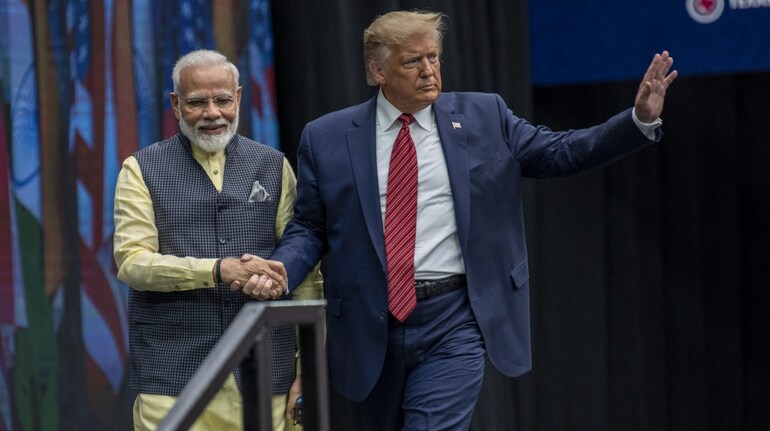
In February 2025, US President Donald Trump and Prime Minister Modi announced, “Mission 500”, an ambitious target to more than double bilateral trade to $500 billion by 2030. The summit launched TRUST (Transforming Relationship Utilizing Strategic Technology) and COMPACT (Catalyzing Opportunities for Military Partnership, Accelerated Commerce & Technology) frameworks. These frameworks recognized that Indian growth strengthens the American innovation base. Ten months later, that premise lies in ruins.
Adversarial approach to a strategic partner
The Trump administration has imposed 50 percent tariffs on Indian exports with a bilateral trade deal nowhere in sight, introduced a $100,000 fee for H-1B visa applications, and triggered mass postponement of visa appointments across Indian consulates for increased social media vetting
The same administration that looked towards India as a strategic partner is now treating it with a policy toolkit reserved for adversaries like China.
Members of the Trump administration take daily potshots at India. Meanwhile, anti-Indian rhetoric on American social media, portraying Indian professionals as job-stealers, has reached unprecedented levels
Two opposing instincts at work
Hostility or simple indifference toward India in Washington comes from two opposing instincts. One camp dismisses India as too weak and too messy to matter as an economic or security partner. The other treats India as “China in waiting,” a future rival to be contained early. Both stories collapse under minimal scrutiny. India is neither irrelevant nor extractionist
India is not China
Both India and China import roughly 70-85 percent of their crude oil. Yet, China runs persistent current account surpluses, while India runs deficits. The difference is policy, not geography. China suppresses domestic consumption and restricts capital outflows. India permits consumption-driven growth and allows multinational companies to repatriate earnings freely
American technology giants generate over $6 billion in advertising and cloud revenue from India annually. Google, Microsoft, Meta, Amazon, and Netflix operate without restriction. There is no great firewall, no mandatory joint ventures, and no forced technology transfer. It is a fundamentally different approach to economic engagement, unlike China.
MNCs are not forced into unfavourable arrangements
The multinational investment story reinforces this distinction. Suzuki entered India in the 1980s and was permitted to increase its stake over time, unlike Chinese joint ventures, which were capped at 50 percent. Today, Suzuki holds 58 percent of Maruti Suzuki, which commands over 40 percent of Indian passenger vehicle sales. With a market capitalization exceeding $60 billion, Maruti Suzuki is the most valuable asset in Suzuki’s global portfolio.
Hyundai entered as a wholly-owned subsidiary in 1996 and conducted India’s largest-ever IPO in October 2024, raising $3.3 billion at a $19 billion valuation. Both companies built value and retained it. This is the opposite of China, where GM, Ford, and Volkswagen are now fighting for survival against competitors they were forced to train.
The talent
At ~$151,000, Indian Americans have the highest median household income of any ethnic group in the US. Though they represent roughly 1 percent of the population, they contribute an estimated 6 percent of federal income tax revenue. They also power America’s innovation economy. Indian-born founders lead the largest cohort of immigrant-founded unicorn startups, 90 founders among approximately 500 unicorns analyzed by Stanford Graduate School of Business. Indian-origin executives run Google, Microsoft, Adobe, FedEx, IBM, and many such iconic American companies.
Yet, US policy is increasingly treating this talent pool as a liability. Proposed changes to the H-1B lottery system would sharply reduce opportunities for recent graduates, the very pipeline that has historically fed America’s tech leadership. Further, the visa appointment uncertainties not only have real human costs, but also impact employer planning in the U.S. This could end up increasing offshoring, likely harming the US consumption economy itself, especially as tech hiring is no longer as buoyant as the past 20 years.
India has friction, but not
India is not a frictionless market. Indian tariffs average 17 percent, among the highest of major economies. The Reserve Bank of India mandates domestic storage of payment data. The Digital Personal Data Protection Act (2023) includes localization provisions. E-commerce FDI rules prohibit inventory-based models
But friction is not extraction. India’s restrictions target specific sectors through transparent regulation, barring the odd example of Vodafone. China’s Great Firewall blocks entire platforms. While India regulates the terms of participation, China prohibits participation altogether
The Production Linked Incentive (PLI) scheme illustrates the distinction. India has allocated over $26 billion in subsidies across 14 sectors. But unlike China’s model, PLI subsidies are available to foreign firms on equal terms. Apple’s major suppliers (Foxconn, Pegatron, Wistron) are primary beneficiaries. The scheme incentivizes production in India. It does not mandate technology transfer or cap foreign ownership.
A choice Washington cannot
Despite the political frictiontrade flows have proven remarkably resilient. India’s exports to the US grew 20 percent year-on-year in November 2025, reaching $38.13 billion, a reversal of the 11.8 percent decline recorded in October. On a cumulative basis, India’s exports to the US between April and November 2025 reached $59 billion, up 11.4 percent from the same period last year. This reinforces the fact that India is not a mercantilist competitor gaming the system
The evidence is clear. India is not China. Indian talent strengthens American innovation. Indian consumers enrich American shareholders. Indian manufacturers diversify their supply chains away from adversarial dependence.
India has been clear about its position on strategic autonomy. The question is whether Washington can accept a partner that does not follow instructions but whose interests nonetheless align on the issues that matter most. The evidence suggests it should. The current policy suggests it has not.
(Athan Joshi is a Junior at Los Altos High School with interest in politics, economics and business.)
Views are personal, and do not represent the stance of this publication.
Discover the latest Business News, Sensex, and Nifty updates. Obtain Personal Finance insights, tax queries, and expert opinions on Moneycontrol or download the Moneycontrol App to stay updated!
Find the best of Al News in one place, specially curated for you every weekend.
Stay on top of the latest tech trends and biggest startup news.




