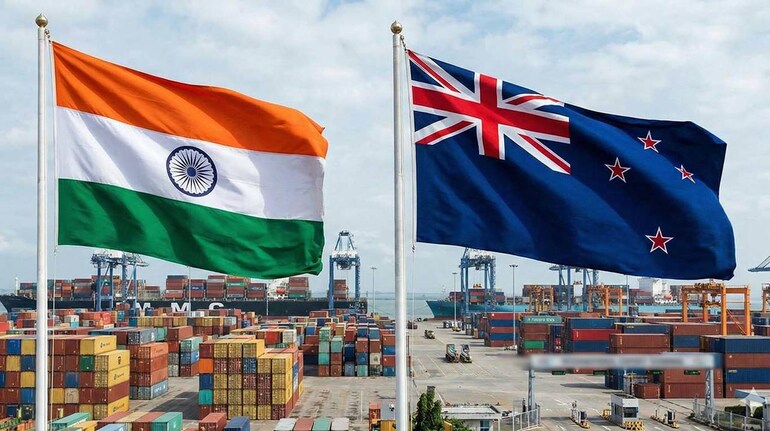
Every major trade agreement arrives amid controversy. That is neither unusual nor necessarily unhealthy. Free Trade Agreements (FTAs), by their nature, force economies to confront sensitive sectors, political anxieties, and short-term adjustment costs.
The recently concluded India–New Zealand FTA is no exception. While the agreement has been welcomed by business communities and strategic thinkers in both countries, it has also sparked some opposition in parts of New Zealand’s political landscape.
These concerns deserve to be heard. But they also deserve to be placed in context—historical, economic, and strategic. When viewed through that broader lens, the India–New Zealand FTA emerges not as a rushed or imbalanced deal, but as a pragmatic and forward-looking foundation for one of the Indo-Pacific’s most underdeveloped economic relationships.
The Dairy Question: A familiar starting point, not a final verdict
Criticism over the exclusion of dairy products has dominated the debate. For New Zealand, dairy is not merely another export sector; it is a national economic pillar. Yet it is precisely because of its sensitivity that dairy has featured—contentiously—in nearly every one of New Zealand’s major trade negotiations.
History offers perspective. When New Zealand negotiated its FTA with China in 2008, dairy access was initially limited and subject to long phase-ins. Similar anxieties surfaced during the Comprehensive and Progressive Agreement for Trans-Pacific Partnership (CPTPP). In both cases, early scepticism gave way to substantial gains over time as trust deepened, review clauses were activated, and commercial relationships matured.
Dairy sector is sensitive to India
India’s dairy sector, like New Zealand’s, is deeply political—but for different reasons. It supports tens of millions of smallholder farmers and sits at the intersection of livelihoods, food security, and rural stability.
Expecting full dairy liberalisation at the outset was never realistic. What matters instead is that the FTA establishes institutional mechanisms, regulatory cooperation, and a pathway for future engagement. Trade agreements are living instruments; their value lies as much in what they enable over time as in what they deliver on day one.
Immigration and Labour Mobility: Investment in capability, not a zero-sum game
Concerns around labour mobility and immigration concessions also warrant a more nuanced assessment. The narrative that expanded visas for Indian professionals and students disadvantage local workers overlooks economic realities facing New Zealand.
New Zealand’s labour market constraints are structural, not cyclical. Skill shortages in healthcare, engineering, IT, construction, and education are well documented. Targeted labour mobility arrangements—especially those tied to skills, qualifications, and time-bound employment—are not a threat but a necessary complement to domestic workforce development.
Moreover, New Zealand’s experience with skilled migration consistently shows positive fiscal and productivity outcomes. Indian students and professionals are not transient participants; many become long-term contributors, entrepreneurs, taxpayers, and bridges to global markets. Australia’s experience following its own trade and migration arrangements with India offers a parallel: initial political unease gave way to recognition of talent flows as a strategic asset rather than a liability.
Market access is not a one-way street
The charge that the agreement is “neither free nor fair” rests on an overly narrow reading of reciprocity. Trade value is not measured solely by tariff lines on one sector, but by the aggregate opportunities unlocked across goods, services, investment, technology, and people-to-people ties.
New Zealand exporters of apples, kiwifruit, meat, forestry products, education services, digital solutions, and renewable technologies gain improved access to one of the world’s fastest-growing major economies. India’s middle class—already larger than the entire population of the United States—is expanding rapidly in purchasing power and preference for premium, trusted food, and services. New Zealand’s reputation for quality, sustainability, and safety aligns exceptionally well with this demand.
At the same time, Indian exports enhance affordability, competition, and supply-chain resilience in New Zealand—an increasingly important consideration in a geopolitically fragmented world.
Was the deal rushed—or realistically timed?
Trade negotiations are rarely perfect, but they are often time sensitive. The global trade environment today is marked by friend-shoring, strategic diversification, and intensified competition for market access. India has become a central node in this recalibration. Delaying engagement in pursuit of theoretical perfection risks strategic irrelevance.
Other countries that hesitated—whether in Southeast Asia or Latin America—are now racing to conclude agreements with India, often on terms no more favourable than those now secured by New Zealand. The choice was not between an ideal deal and a flawed one, but between engagement and marginalisation.
The strategic dividend
Perhaps the most underappreciated aspect of the FTA is its strategic significance. India and New Zealand share interests in a stable Indo-Pacific, resilient supply chains, climate action, and rules-based trade. Economic agreements deepen trust, institutionalise dialogue, and anchor long-term cooperation.
Japan’s early FTAs with ASEAN, the EU–South Korea FTA, and even India’s own experience with ASEAN illustrate a common pattern: early resistance followed by gradual integration, expanding trade volumes, and diversification beyond initial expectations. In almost every case, the long-term gains outweighed the short-term discomfort.
Looking ahead
The India–New Zealand FTA should be seen not as a final settlement, but as a starting platform. Review mechanisms, side agreements, sectoral dialogues, and future negotiations—particularly on dairy, services, and investment—remain very much on the table.
Trade agreements reward patience, not perfectionism. They mature through use, trust, and adaptation. If judged not by its first year but by its first decade, the India–New Zealand FTA has the potential to be one of the most consequential economic partnerships either country has entered in the Indo-Pacific.
The real risk would not be in moving forward with this agreement—but in allowing short-term discomfort to overshadow long-term opportunity.
(Shishir Priyadarshi & Bidisha Bhattacharya are President & Senior Fellow respectively at Chintan Research Foundation.)
Views are personal, and do not represent the stance of this publication.
Discover the latest Business News, Sensex, and Nifty updates. Obtain Personal Finance insights, tax queries, and expert opinions on Moneycontrol or download the Moneycontrol App to stay updated!
Find the best of Al News in one place, specially curated for you every weekend.
Stay on top of the latest tech trends and biggest startup news.