






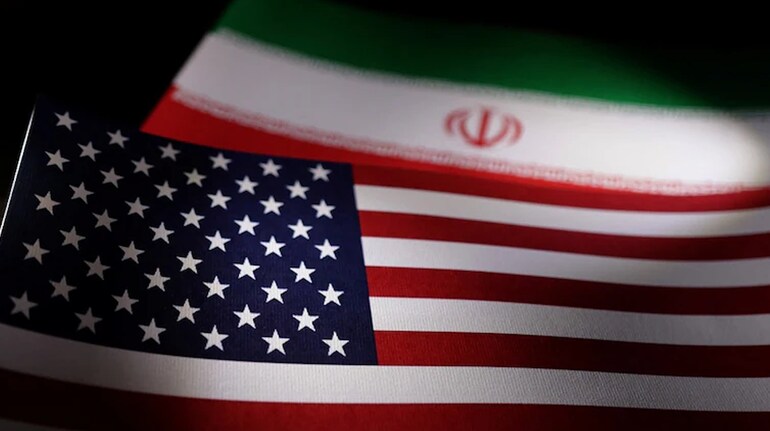
US President Donald Trump has amassed an unprecedented level of military might in West Asia, the largest airpower mobilisation since the 2003 war in Iraq, signaling that a strike may be imminent. From massive movements of aerial refueling tankers and early warning aircraft to the deployment of advanced fighters and destroyers, this buildup doesn't appear to be mere posturing. It's a clear message that the US is preparing for action.
This path however is fraught with danger, potentially leading to an escalatory spiral that neither side can fully control.
Iran's Supreme Leader, Ayatollah Ali Khamenei, has drawn unambiguous red lines. He has publicly stated that Iran will not give in to US demands on its nuclear program and missile arsenal. In no uncertain terms, he has warned that any attack on Iran would result in retaliation against American warships in the Gulf.
This isn't bluster, it's a reflection of the regime's survival instincts. Having just suppressed widespread protests last month with brutal force—resulting in thousands of deaths—the Iranian leadership views any US strike as an existential threat. Trump himself has stated that regime change would be "the best thing that could happen" to Iran, further fueling Tehran's paranoia.
The US faces a stark dilemma: opt for a large-scale strike with uncertain outcomes or a limited one that might provoke the very war it seeks to avoid. A "limited" attack could serve Trump's domestic political narrative—justifying the massive buildup and allowing him to claim a win. However, Iran won't absorb such a blow passively. Doing so would signal weakness. A symbolic response from Iran would only invite US coercion in the future, eroding its deterrence. Instead, Tehran's rational strategy would be escalation: targeting US naval assets and bases in the region to impose prohibitive costs.
This creates a dangerous second-move trap for the US. Trump, whose brand is built on unyielding strength, cannot afford to let Iranian retaliation go unanswered. Losing even a single warship—let alone a carrier—would be politically devastating.
Thus, any initial strike must be overwhelming to suppress Iran's command and control, missile sites, and drone infrastructure before retaliation can occur. Yet, complete suppression is no easy feat. Iran has invested heavily in dispersal, hardening, and redundancy to withstand such assaults. A partial degradation would leave Iran with both the motive and means to strike back, accelerating the conflict rather than containing it.
Reportedly, Gen Dan Caine, the Chairman of US Joint of Chief of Staff has not given an assurance that military objectives can be achieved, as they did in Venezuela.
Complicating matters, Iran won't fight alone. China has a vested interest in seeing the US Navy take hits from Iranian missiles. Beijing will most likely provide Tehran with critical intelligence, not just to weaken America but to validate its own anti-access/area denial (A2/AD) strategies in preparation for a potential Taiwan conflict. There are reports of numerous flights from China carrying military stores, which could include air defence systems.
For the US, if strikes proceed, it would mark its first "non-contact" war—fought with standoff weapons and airpower against an inferior adversary. The lessons learned will prove invaluable as a potential showdown with a near peer rival China over Taiwan will likely be non-contact. While China hasn't fought a war in nearly 50 years.
Israel's role cannot be overlooked. While reports suggest Jerusalem advised Trump against striking during Iran's recent protests, Israel has no interest in a US-Iran deal that leaves Iran with its vast missile arsenal and manufacturing capabilities, and preserves the regime.
If the US acts, Israel will likely join, providing vital intelligence and possibly participating in operations. After all, Iran would target Israel regardless. Meanwhile, Gulf states like Saudi Arabia face acute risks. Iranian retaliation could extend to their infrastructure, leading to regional instability. The Houthis in Yemen and Hezbollah in Lebanon—proxies armed by Iran—could further widen the conflict.
Trump perhaps sees strikes as a way to finish the unfinished business, as evident from his statement that “For 47 years, they’ve been talking and talking and talking”. While he claimed last year the US has crippled Iran's nuclear capabilities after strikes on its nuclear facilites, yet he warns of "violence" if Tehran doesn't negotiate.
Some argue regime change requires boots on the ground, but Trump may bet on decapitation strikes against Khamenei and IRGC leaders to spark internal collapse. By degrading Iran's nuclear program and missile arsenal while eliminating key figures, he might hope the remnants fracture amid renewed public unrest. It's difficult to predict if the Iranian people, still reeling from last month's bloodshed, would rise again, or will the strikes have an opposite effect of uniting the Iranians. What is certain is that such a scenario would create a fluid, destabilising vacuum in the region—one Trump might not factor in, or care about.
For the Iranian regime, not giving up its nuclear enrichment and missile program along with regime survival will be a victory, even if it is bombed. Reportedly, Khamenei has laid out a roadmap for succession and delegation of power, so that the regime survives, even if he is killed. Trump’s envoy Steve Witkoff has stated that the US president is “frustrated” as to why Iran has not “capitulated”.
With two rounds of indirect talks already completed—one mediated by Oman earlier this month and the second in Geneva on February 17—and a third round set for February 26 in Geneva – leaving a glimmer of hope for a diplomatic path amid the shadow of war. But between now and then, it's entirely possible that Trump decides to pull the trigger, as Iran is not going to give up on its uranium enrichment and missile programs.
Short of that, the JCPOA deal had taken care of the level of enrichment, number of centrifuges, stockpile of enriched uranium, with intrusive compliance inspection to make sure that it constrained Iran’s nuclear program. But Trump in his first term withdrew from it for not being comprehensive to curb Iran’s missile program and its proxies in the region. Anything more than what JCPOA achieved will cross Iran’s red lines. Anything less, will not be politically acceptable to Trump after all his rhetoric and amassing of air and naval forces to pressure Iran.
For the world, the implications are profound. Energy markets could be disrupted if Iran chokes the Strait of Hormuz, a threat central to its deterrence. In the end, this isn't about nuclear ambitions or missiles alone, it's about power, survival, and miscalculation. Trump must weigh whether the risks of escalation outweigh the rewards. A strike might degrade a persistent threat, but it could also unleash chaos across West Asia and beyond.
Unfortunately, neither diplomacy nor war will bring a lasting solution.
(Yusuf T Unjhawala is an adjunct scholar at the Takshashila Institution. He tweets at @YusufDFI.)
Views are personal and do not represent the stand of this publication.
Discover the latest Business News, Sensex, and Nifty updates. Obtain Personal Finance insights, tax queries, and expert opinions on Moneycontrol or download the Moneycontrol App to stay updated!
Find the best of Al News in one place, specially curated for you every weekend.
Stay on top of the latest tech trends and biggest startup news.




