December 14, 2022 / 11:28 IST
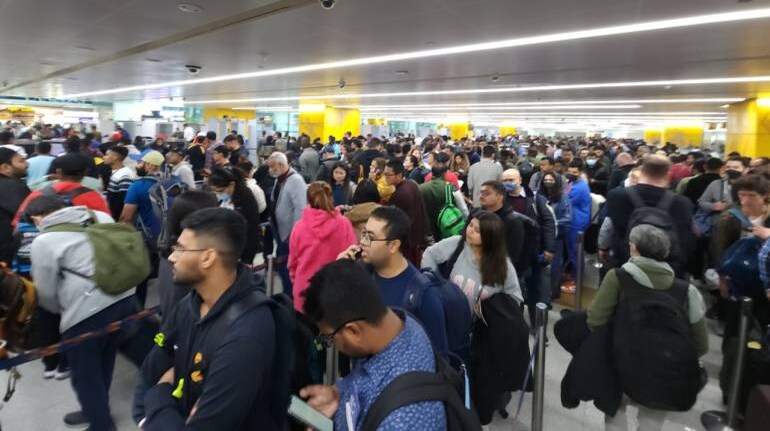
The level of queuing, congestion, and missed flights at some airports is alarming. (Image credit: @karmanomad/Twitter)
Air travel is back, and how! While travel volumes are approaching pre-COVID-19 levels, the level of queuing, congestion, frayed tempers, and missed flights at some airports have surpassed anything we have seen in the past.
It should be noted that this is despite passenger volume levels being still lower than 2019 levels. Closure or reduction of capacity of some terminals for renovation, excess loads taken by other terminals, new x-ray belt equipment, non-standardised processes, and knee-jerk reactions — for example, telling passengers to come three to four hours before even domestic flights and adding to the crowding at the airport — are exacerbating the problem.
Story continues below Advertisement
Recently, Prime Minister Narendra Modi declared ‘ease of travel’ to be one of his top priorities. However, matters with airport-queuing-time and crowding have come to such a head that the Minister of Civil Aviation, Jyotiraditya Scindia, had to personally intervene, and is working with key stakeholders to try to address the situation, and bring relief to passengers, airports, and airlines.
Here are a few quick and longer-term fixes that can help bring relief to the situation:
Airport Entry- Scan only boarding passes at airport terminal entry, and no ID checks at this point. IDs can be checked at the head of the security queue instead. Checking boarding passes is recommended to prevent non-travellers from entering the terminal and adding to the crowd.
- Encourage Digilocker facial recognition, and enable it for all security queues, not just for single dedicated queue.
- Streamline and standardise country-wide what needs to be taken out of bags for x-ray checks (typically only laptops), to speed up the process, and reduce tray usage.
- Streamline what triggers bags for secondary (hand) inspection to reduce a congestion there, and have more dedicated staff do this secondary scanning; at least two staff per belt.
- Have wand searches only if the metal detector beeps while the passenger pass through.
Adopting these suggestions will speed up the x-ray process, and reduce pile-up of bags on the belt.
Not Too Early, Not Too Late- For ATRS (Automatic Tray Retrieval System) x-ray belts (as seen at Delhi airport, among others), open up all five or six simultaneous drop off points per belt, rather than limiting it to two or three.
- Dedicate a feeder queue for each belt, with staff assigning drop-off spots to passengers (as is done at Heathrow airport, London).
- Have estimated queuing-time posted at each airport entry and security queue entry.
- Move to ‘not too early, not too late’ model for passengers to arrive at airport. Arriving too early just adds to crowding at the terminal, and also needlessly delays people who have closer flights. Between 1.5 to 2 hours should be fine for domestic flights — suggesting 3 to 4 hours just adds to the problem. For international flights, between 2.5 to 3 hours should be fine.
For International Arrivals- Ensure landing cards (that are still required for foreign passport holders) are given by the airline prior to arrival.
- Do away with paper landing cards ASAP, and move to digital APIS (Advance Passenger information System) in the check-in process.
Sterile Passage- Remove security requirements for same-terminal D2D (domestic to domestic) and D2I (domestic to international) connections immediately by having a sterile passage from arrival gate to departure level with just a boarding pass scan required. Nowhere else is security required for D2D and D2I connections.
- Work towards sterile airside inter-terminal transfers with no need to enter the terminal landside, and pass through landside security again. Looking at the London again, Heathrow also has physically separate terminals like Delhi and Mumbai. However, to change terminal at Delhi or Mumbai, passengers have to exit the airport with their baggage, take local roads to the next terminal, and go through the airport entry and security process all over again — adding to the queues.
Longer Term- Have a ‘trusted traveller’ programme, perhaps for Digiyatra users, where one does not need to remove laptops, etc. (similar to TSA pre-check).
- Use automated gates to process departure and arrival immigration for e-enabled passports for Indians and select foreign countries, to reduce queues at immigration.
If we can implement even half of these recommendations, the queuing time could to reduce by 50 percent or more.
Sanjiv Kapoor is CEO, Jet Airways. Views are personal, and do not represent the stand of this publication. Discover the latest Business News, Sensex, and Nifty updates. Obtain Personal Finance insights, tax queries, and expert opinions on Moneycontrol or download the Moneycontrol App to stay updated!