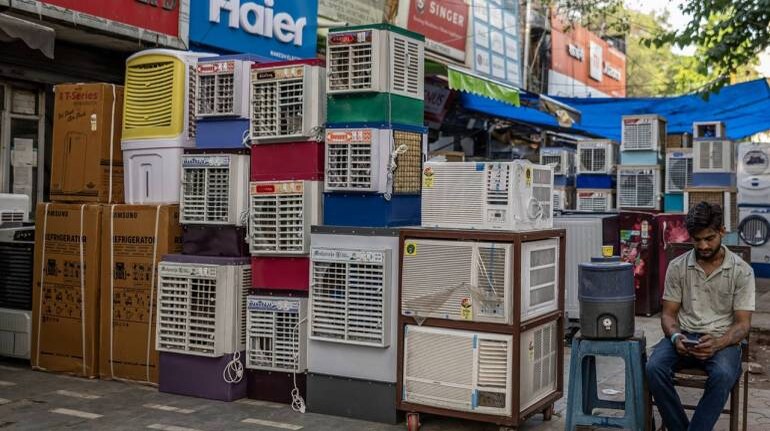
It’s a good time to be in the air-conditioning business.
As my colleagues at Bloomberg News write, an additional 1 billion cooling units are expected to be installed by the end of the decade. It’s one of the main ways in which humans are adapting to more frequent and intense heatwaves.
With a potentially strong El Nino on the horizon – a climate pattern which increases global temperatures – and greenhouse gas emissions still higher than ever, we’re looking at another record-breaking summer, and another one, and another and so on.
For many, owning an air conditioner has already become a matter of survival rather than comfort. But, of course it creates a vicious cycle: The hotter the earth gets, the more air conditioners we’ll need or want to install. But air conditioners are a disaster for the planet, containing toxic coolants with greater warming potential than CO2 and drawing on precious energy resources. So more air conditioners means more potential warming, which means more air conditioners.
An analysis of global population density gives us a peak MAT of about 13C, and a second smaller peak at 27C – associated with monsoon climates in South Asia. These are the zones in which we thrive. The dip in the middle corresponds with drier climates that aren’t as suitable for us, our livestock or our crops; therefore, it has lower population densities, such as parts of the Middle East. The temperature zone is no coincidence: Gross domestic product also peaks at about 13C, and if the temperature shifts, we see productivity fall. For context, New York City and Milan have MATs of about 13C.
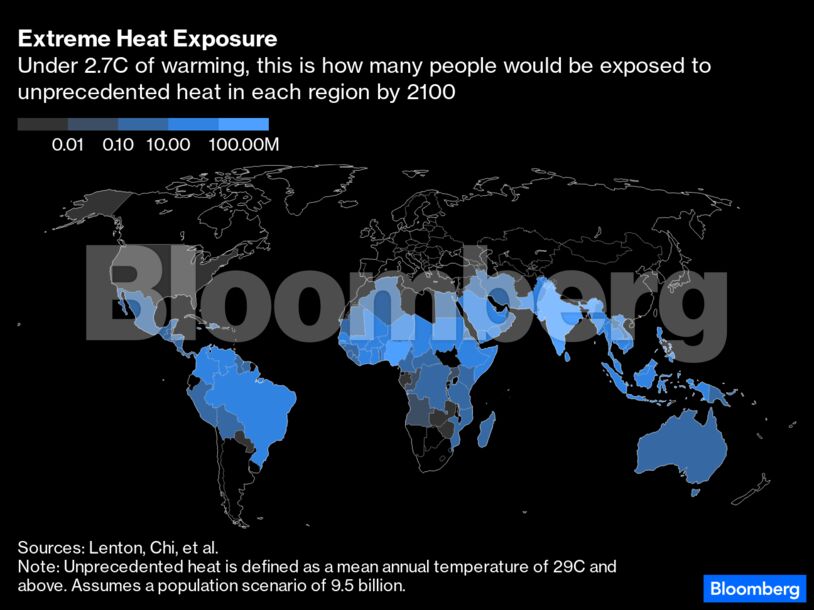
The study, published in Nature, explores the human cost of rising global temperatures, taking a helicopter view on what works for people now, and how climate change will alter that. As things stand, current policies and action put us on track for 2.7C of warming above pre-industrial temperatures by 2100. This would leave a staggering 2 billion people – 22% of the projected end-of-century population – exposed to unprecedented heat (defined as being a MAT of 29C and above). India — set to be the world’s second-biggest market for cooling units after China by 2050 — and Nigeria would be the worst affected population-wise, with a combined 900 million people living in dangerously hot temperatures. Hundreds of millions of people would also get pushed into the middle ground which hasn’t historically supported dense human populations. That poses huge challenges for adaptation.
Discover the latest Business News, Sensex, and Nifty updates. Obtain Personal Finance insights, tax queries, and expert opinions on Moneycontrol or download the Moneycontrol App to stay updated!
Find the best of Al News in one place, specially curated for you every weekend.
Stay on top of the latest tech trends and biggest startup news.