In FY2022, the Government of India (GoI) had introduced the Production-Linked Incentive (PLI) scheme, followed by the Design-Linked Incentive (DLI) scheme. These schemes targeted 14 key sectors to boost manufacturing and exports, reduce imports, attract investments and technology, and to make Indian manufacturers globally competitive. Progress of this scheme has been keenly watched by the markets, especially amidst the current global uncertainties related to tariffs and trade.
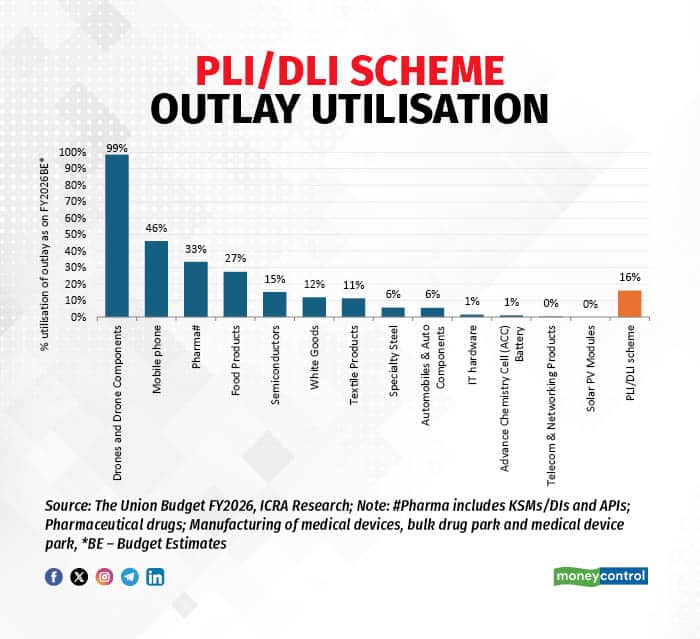
Encouragingly, a sizeable ~Rs. 1.8 trillion capex is set to be incurred by March 2025, which is 40-45% of the total estimated capex. However, based on the FY2026 Union Budget, ICRA expects a limited ~16% of the outlay to be utilised for PLI/DLI incentives by end-FY2026. Moreover, progress in the various sectors is decidedly mixed.
Drones and Drone Components
The budgetary allocation indicates that the modest outlay of Rs. 1.20 billion will be ~99% utilised by FY2025. However, according to the Ministry of Civil Aviation, approximately Rs. 0.60 billion have been disbursed, as an incentive under the scheme till December 2024.
Mobile phone
Encouragingly, India has become a net exporter of mobile phones in FY2024 from a net importer in FY2015. The scheme has attracted Rs. 91 billion worth of investment, which is higher than the initial projected investment. The momentum is expected to be maintained in FY2026 as well with budgetary allocation of ~Rs. 89 billion, a 55% YoY increase.
Pharmaceuticals and medical devices
The budgetary allocation has increased by 58% YoY in the FY2026 Budget Estimates (BE), driven mainly by manufacturing of identified pharma categories and bulk drug parks. As of October 2024, total investment of Rs. 335 billion was realised under the scheme (originally projected investment of Rs. 173 billion) driven by Key Starting Materials (KSMs)/Drug Intermediates (DIs) and Active Pharmaceutical Ingredients (APIs) and pharma goods.
Food products
By mandating the use of domestically grown agricultural products in the manufacturing process, the scheme has reportedly generated employment of over 2.89 lakh and an investment of Rs. 89 billion across 213 locations as of October 2024. The budgetary allocation has been enhanced by a sharp ~70% increase in FY2026 BE over FY2025 Revised Estimates (RE), indicating continued progress in the scheme.
Semiconductors
In September 2024, the GoI approved two more semiconductor facilities in addition to three semiconductor entities approved earlier in February 2024. The total capex for these five facilities is Rs 1.52 trillion and outlay of Rs. 760 billion will be fully utilised for these five facilities in a period of five years, i.e. by FY2029–FY2030. However, the budgetary allocation indicates that the cumulative capex deployment by FY2026 would be limited to ~15%.
White Goods (ACs and LEDs)
The incentive scheme for white goods has attracted significant investments, boosted production, sales and exports. The scheme has seen three rounds of applications so far. Altogether, 84 companies under the PLI Scheme for White Goods are set to bring investments of Rs. 105 billion, resulting in production worth Rs 1.7 trillion. Budgetary allocations indicate a substantial jump in incentives for white goods in FY2026.
Textiles
As of September 2024, approximately 40 companies have initiated their investment activities under the scheme. Based on the request from the sector, the Ministry of Textiles simplified the claim processing in November 2024. A major incentive claim is expected to be paid in FY2026.
Specialty Steel
In January 2025, the Ministry of Steel came out with PLI scheme 1.1 for speciality steel for five product categories to enable further participation as industry participants requested the ministry for relaxation. As of November 2024, the actual investment achieved was Rs. 183 billion. It is estimated that the payout for the participants will commence from FY2025 with a major payout starting from FY2026.
Automobiles and Auto Components
The GoI had amended the scheme in January 2024 to enhance clarity and flexibility. As of September 2024, ~50% of the investment (Rs. 207 billion) and approximately 5% of incremental sales (Rs. 105 billion) have been achieved. Budgetary allocations also indicate a substantial jump in incentives in FY2026.
IT Hardware
The PLI Scheme 2.0 (second round) was launched for IT hardware, as it expected broadening and deepening of the manufacturing ecosystem. The scheme has already achieved remarkable progress, with total investments of Rs. 5.2 billion and production worth Rs. 100 billion as of December 2024. However, the incentive disbursements remained low despite the launch of the second round of incentive scheme with higher outlay in May 2023.
Advanced Chemistry Cell (ACC) Batteries
Three of the approved firms under the scheme have signed the Programme Agreement for setting up manufacturing facilities of 30 GWh ACC capacity. In September 2024, Reliance Industries Limited was awarded 10 GWh ACC capacity under the PLI scheme. However, the budgetary allocations indicate the manufacturing progress remains low for ACC batteries.
Telecom and Networking Products
As of December 2024, the total investment was Rs. 40 billion with sales under the scheme at Rs. 775 billion and export share of ~19% in sales. However, despite the substantial growth in sales, incentive disbursements in the telecom sector have been relatively low.
Solar PV Modules
The progress in developing the capacities (except module units) remains slow. While few players have commissioned cell units and one player has completed an ingot and wafer facility, the overall progress remains slow in relation to the timelines under the PLI scheme. This is attributed to the significant reduction in prices across the solar module value chain over the past two years, adversely impacting the viability of these units in India.
Despite successes in the incentive schemes in some sectors, there have been some challenges as well. The GoI has been adjusting allocations, refining schemes, inviting applications in response to higher sector appetite etc. to enhance efficiency and uptake incentive disbursements across all sectors. To improve the utilisation of the announced outlay, the GoI may introduce an additional incentive scheme for new sectors, which could aim to attract private investors to these new fields.

Discover the latest Business News, Sensex, and Nifty updates. Obtain Personal Finance insights, tax queries, and expert opinions on Moneycontrol or download the Moneycontrol App to stay updated!





Find the best of Al News in one place, specially curated for you every weekend.
Stay on top of the latest tech trends and biggest startup news.