Supreme Court stays Karnataka HC order making Union minister HD Kumaraswamy party in contempt case
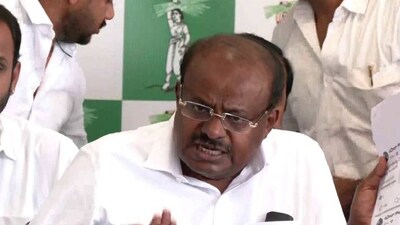
The court stayed an order making Union Minister and JDS leader H D Kumaraswamy a party to the ongoing contempt proceedings over the alleged large-scale land encroachment in a Karnataka village.

Supreme Court hands over 12-yr-old to his mother after he develops anxiety, distress
The court noted that four reports of the child's psychological assessment have indicated him to be undergoing significant anxiety, difficulty in coping with emotions and separation anxiety due to the looming threat of custody change.
Jaggi Vasudev’s Isha Foundation files plea against Nakkheeran Publications in Supreme Court for publishing ‘defamatory’ content
Isha Foundation had filed a defamation suit against Nakkheeran Publications before the Delhi High Court last year in December, claiming that some of its content maligned its reputation, demanding Rs 3 crores as damages.
Parliament may move to impeach Justice Yashwant Varma, but history offers little hope
The impending impeachment motion against Justice Yashwant Varma highlights India’s weak judicial accountability, where past cases show judges often resign to evade scrutiny, undermining public trust in the judiciary’s integrity
Karnataka HC declines to stay govt takeover of Gali Anjaneya Temple amid corruption allegations
Justice Sunil Dutt Yadav heard a petition filed by the temple's trustees challenging the takeover order.
Rape case can be quashed based on mutual settlement under exceptional circumstances, says Supreme Court
The Supreme Court observed that criminal proceedings related to rape offences can be quashed based on settlement, however, under exceptional facts and circumstances of the case.
‘Why misdirecting, seizing devices’: Supreme Court asks SIT probing Ashoka University professor Mahmudabad case
The SC said that the conditions imposed while granting interim bail to Mahmudabad only restrained him from commenting on the sub-judice issues, he is free to write or express opinions on other topics.
Prisoners don’t have fundamental right to demand costly, personalised food: Supreme Court
The division bench of of Justices J B Pardiwala and R Mahadevan said the right to life under Article 21 of the Constitution extends to all prisoners, however, it did not confer a right to demand personalised or luxurious food choices.
Spreading radical ideology on social media attracts UAPA, says Delhi High Court
The Court noted that circulating extremist content digitally is sufficient ground for legal action under UAPA.
Rahul Gandhi gets bail in defamation case linked to Indian Army during Bharat Jodo Yatra
The complainant alleged that Rahul Gandhi's remarks insulted Indian Army soldiers.
Secret recording of spouse’s conversation admissible evidence in matrimonial disputes: SC
The recording does not breach the right to privacy in the case under the Evidence Act, the court ruled, setting aside a Punjab and Haryana High Court order in a case.
'Cannot direct Parliament': Delhi HC dismisses PIL seeking repeal of BNS provisions
The petition was filed against Sections 147 to 158 related to certain offences “against the state”, Sections 189 to 197 related to “offence of public tranquility” of the BNS.
Delhi riots planned with sinister move, says SG Mehta in high court
Mehta said there is an attempt to divide the country on religious lines and that it is not simply a case of rioting, as per News18.
Judiciary treats Constitution’s preamble as a no-go area
RSS general secretary Hosabale wants a discussion on whether a decision to introduce the words “socialist” and “secular” in the Constitution in 1976 should be reversed. When asked to decide on the same issue earlier, the judiciary has signalled that it’s the Parliament’s call
RCB moves Karnataka HC against CAT remarks blaming it for Bengaluru stampede
In the June 4 Chinnaswamy stadium stampede case, the CAT had said that the RCB seemed to be prima facie responsible for the large crowds that gathered at stadium which led to the stampede and loss of eleven lives.
Madras HC confirms Ajith Kumar custodial death, asks CBI to appoint investigators
The HC asked the Central Bureau of Investigation to appoint investigators in the case within a week.
No intention of holding on, finding house catering to daughter’s special needs a challenge: Former CJI Chandrachud
Former CJI Chandrachud spoke about his two foster daughter's health conditions and how finding another house catering to their special needs has been a challenge.
SC collegium tightens process for selecting HC judges amid Justices Varma, Yadav controversies
The Supreme Court Collegium has reportedly conducted a comprehensive personal interview exercise in a bid to intensify the check analysing the candidate's resume and areas of work.
'Conflict of interest in CEC may compromise FCAA cases': Retired bureaucrats write to CJI
The signatories, in an open letter, pointed out that there were no independent members in the panel.
44th Amendment: Restoring constitutional safeguards and limiting emergency powers
The Forty-Fourth Amendment (1978) reversed the Emergency-era changes, strengthening democratic safeguards by restricting executive powers, protecting fundamental rights, and ensuring stricter parliamentary oversight during national emergencies
Justice HR Khanna’s dissent in the Emergency’s infamous ADM Jabalpur case still resonates
Emergency was one the worst phases for the Supreme Court as it failed to provide the necessary check on the excesses of the political and permanent executives. This failure was encapsulated in the ADM Jabalpur case when the majority in the five-member bench ruled that people could not question their detention. Justice HR Khanna provided the sole dissent and was superseded for it. His dissent, however, echoes to this day and serves as a reference point
Fali Nariman, a beacon of moral courage when Emergency was proclaimed
Fali Nariman was Additional Solicitor General of India when Emergency was declared. He resigned in protest, displaying moral fibre when it was scarcely discernible in the executive or judiciary. A look at that tumultuous period through his experiences provides an important takeaway. Once laws remove restraints on the executive, they will act with 'hobnailed boots'
Even cinema calls out POCSO misuse; law needs safeguards
While POCSO aims to protect children, courts and reports reveal growing misuse in consensual teen relationships, prompting calls for nuanced reforms that balance child rights with justice and intent
WhatsApp status in a court of law
With so much of personal and professional communication taking place over WhatsApp, there’s a gradual evolution in the manner the law is viewing it as evidence. In addition, the courts have also set boundaries on its use as evidence. A look at the status of WhatsApp communication as evidence follows
How the judiciary assumed greater theological authority than high priests of religions
In the ongoing challenge in the Supreme Court to amendments in the Waqf law, the issue of the role of charity in Islam came up. The origin of this argument and similar ones in earlier cases can be traced to a unique Indian judicial invention, the essential religious practices doctrine. It arose from the need for the judiciary to gauge the point of demarcation between secular law of a modern state and traditional religious practices that cannot be tampered with