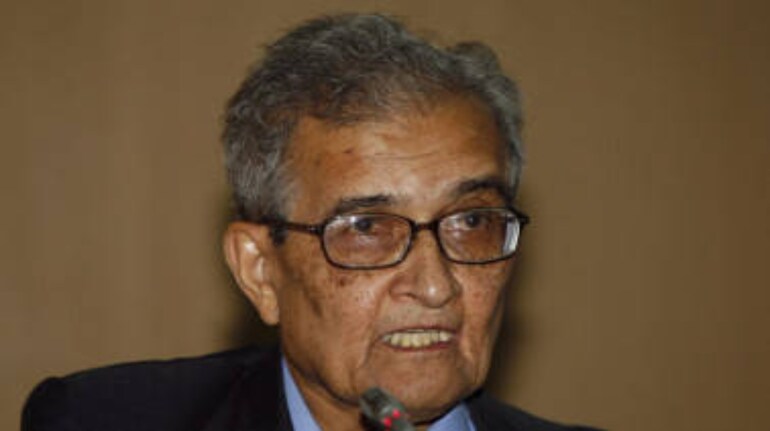

Nobel laureate Amartya Sen has raised serious concerns over the Special Intensive Revision (SIR) process in West Bengal, warning that the exercise is being conducted with “undue haste” and could undermine democratic participation, particularly with assembly elections just months away.
Speaking to PTI from Boston, Sen highlighted the democratic importance of electoral roll revisions and the need for the exercise to be carried out carefully and with sufficient time, which he said is currently missing in the state.
“A thorough review of electoral rolls done carefully with adequate time can be a good democratic procedure, but this is not what is happening in West Bengal at this time,” he said.
“The SIR is being done in a hurry, with inadequate time for people with voting rights to have sufficient opportunity to submit documents to vindicate their entitlement to vote in the coming assembly elections. This is both unjust to the electorate and unfair to Indian democracy,” he added.
Recalling his personal experience during the SIR, Sen noted that time pressure was evident even among poll officials.
“Sometimes, the officials of the Election Commission themselves seem to lack enough time. When they questioned my right to vote from my home constituency in Santiniketan – from where I have voted earlier, and where my name, address and other details are registered in official records – they questioned me about my late mother's age at my date of birth, even though, as a voter herself, my mother's details, like mine, were stored also in their own official records,” he said.
The economist also highlighted the challenges of documentation, particularly for citizens born in rural areas.
“Like many Indian citizens born in rural India (I was born in the then village of Santiniketan), I do not have a birth certificate, and my eligibility to vote required further paperwork to be presented on my behalf,” Sen said.
Although he was eventually able to resolve the issue with help from friends, Sen expressed concern for citizens without similar support.
“Even though I could happily say (like the Beatles) – ‘Oh, I get by with a little help from my friends' – I worried about others who do not have so many loyal friends. My friends helped me to get through the rigid gates of the formidable EC,” he said.
Sen was summoned for a hearing after a “logical discrepancy” was flagged over an age difference between him and his mother. Asked whether the SIR could benefit any political party in Bengal, he said he could not give a definitive answer.
“I am not an election expert, so I cannot answer the question with certainty. I have been told by those who seem to know more, that the BJP will benefit from the under-accounting. I don't know whether that is true, but the real point is that the EC should not insist on a faulty arrangement and force our proud democracy to commit an unnecessary error, no matter who benefits,” he said.
Sen also pointed to the sections of society most at risk of being excluded during the SIR.
“An obvious answer must be the underprivileged and the poor. The documents needed for being allowed into the new electoral roll are often difficult to obtain for the underdogs of society. The class bias that may show up in the necessary requirement of getting and showing particular documents in order to qualify to enter the new voters' list will tend to work against the indigent,” he said.
He further flagged potential difficulties faced by minority communities.
“Another possibility to look into may relate to the difficulties that minority communities sometimes face in getting their rights, including voting rights, respected. Indian Muslims are sometimes relegated to disadvantaged positions through the activism of the recently bolstered Hindutva extremists. Some categories of Hindus also may face discrimination and targeting.” Sen emphasized the need for vigilance at the highest levels, adding, “The EC and the Supreme Court must make sure that no adult Indian citizen has difficulty to qualify for voting.”
Sen said he remains eager to vote in the upcoming assembly polls, depending on the schedule in his constituency.
“I would very much like to do that. It depends, however, on the exact date on which my constituency's voting is fixed.” He explained that his professional commitments abroad require careful coordination.
“As a Professor at Harvard University, I have duties I cannot escape at Cambridge, Massachusetts, and as a Former Master of Trinity College in Cambridge, England, I have other duties there,” he said.
Recalling a previous instance that demonstrated his commitment to voting, he said, “I have to try to carry out all my obligations, including casting my vote in Santiniketan. On one previous occasion, I had to travel rapidly from Cambridge to London, to Delhi, to Kolkata, to Santiniketan, to Kolkata, to Delhi, to London, to Cambridge, all within 48 hours.” Reflecting on his age, Sen added, “But I am 92 now – a little more elderly. I was then only around 82 years in age. During the journey, I could re-read an old book of Rabindranath where he explained why he was proud to be a product of three cultures – Hindu, Muslim and European. I hope to be able to think about Tagore's explanation this time also – if I manage to do what I should, if I could.”
Discover the latest Business News, Sensex, and Nifty updates. Obtain Personal Finance insights, tax queries, and expert opinions on Moneycontrol or download the Moneycontrol App to stay updated!
Find the best of Al News in one place, specially curated for you every weekend.
Stay on top of the latest tech trends and biggest startup news.