The Uttar Pradesh government has placed before the legislature a demand for supplementary grants amounting to Rs 24,496.98 crore for the financial year 2025–26, citing inadequacy of provisions in the original budget to meet actual expenditure requirements and to fund new heads of spending.
The demand has been moved under Article 205 of the Constitution, which allows governments to seek legislative approval when authorised expenditure for a financial year is found to be insufficient or when spending is required on items not provided for in the original budget. The government has also included certain token demands, which are part of the established fiscal practice when expenditure involves new schemes or significant changes in existing ones.
The budget has been released for industrial development, the power sector, health welfare, medical education, and the sugarcane and sugar mill sectors.
Of the total supplementary demand, Rs 18,369.30 crore pertains to the revenue account, while Rs 6,127.68 crore relates to the capital account. Detailed grant-wise and account-head-wise break-ups have been provided for the purpose of appropriation bills.
The state government said the supplementary grants are primarily necessitated by the likelihood that budgeted allocations may fall short of actual expenditure needs during the year. Some of the demands also relate to new expenditure items for which no provision was made in the original estimates for 2025–26.
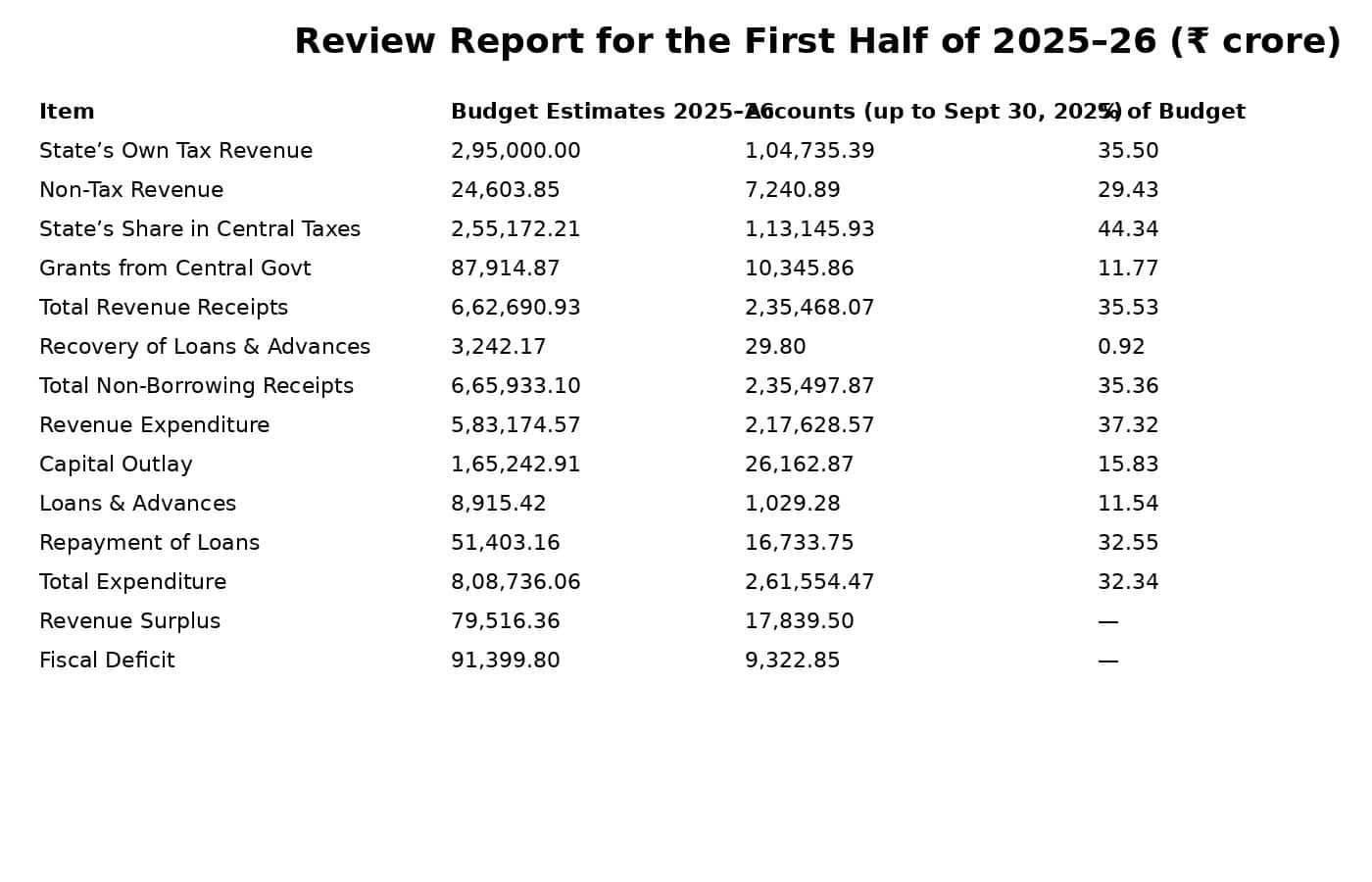
Alongside the supplementary demands, the government has tabled the mandatory statements under Sections 6(2) and 6(5) of the Uttar Pradesh Fiscal Responsibility and Budget Management Act, 2004. As required under the Act, a mid-year review of budget receipts and expenditure trends has also been presented, based on data compiled by the Accountant General for the first half of the financial year.
Allocation of fundsAccording to the review, the state’s total revenue receipts stood at Rs 2.35 lakh crore as of September 30, 2025, which is about 35.5 percent of the budget estimate of Rs 6.63 lakh crore for the full year. Own tax revenue amounted to Rs 1.05 lakh crore, or 35.5 percent of the annual target, while the state’s share in central taxes reached Rs 1.13 lakh crore, accounting for 44.3 percent of the budgeted figure. Grants from the Centre, however, remained relatively low at Rs 10,346 crore, just under 12 percent of the annual estimate.
On the expenditure side, total spending in the first half of the year was Rs 2.62 lakh crore, around 32.3 percent of the budget estimate of Rs 8.09 lakh crore. Revenue expenditure stood at Rs 2.18 lakh crore, while capital outlay was Rs 26,163 crore, reflecting only 15.8 percent of the annual capital spending target.
The mid-year review shows a revenue surplus of Rs 17,839.50 crore during the first half of the year, while the fiscal deficit stood at Rs 9,322.85 crore as of September-end, significantly lower than the budgeted fiscal deficit of Rs 91,399.80 crore for the full year.
The government said that after adjusting for Rs 2,197.25 crore expected as the Centre’s share for centrally sponsored schemes, the net additional burden on the Consolidated Fund of the state from the supplementary demands would be Rs 22,299.73 crore. This will be financed through achieving targeted tax and non-tax revenue collections and by curbing unproductive expenditure, it added.
Sector wise budget presentationAccording to the Finance Minister Suresh Khanna the supplementary budget includes provisions of Rs 18,369.30 crore under revenue expenditure and Rs 6,127.68 crore under capital expenditure. He said the approach balances immediate expenditure needs with continued investment in infrastructure and long-term development.
Energy, health and urban development have emerged as major focus areas in the supplementary budget. An allocation of Rs 4,874 crore has been made for industrial development, while the power sector has received Rs 4,521 crore. The health and family welfare department has been allocated Rs 3,500 crore to strengthen healthcare services across the state.
Urban development has been provided Rs 1,758.56 crore, with emphasis on improving urban infrastructure and civic amenities. Technical education has received ₹639.96 crore to promote skill development and innovation. The government has also earmarked Rs 535 crore for women and child development schemes.
In addition, Rs 500 crore has been allocated to the Uttar Pradesh New and Renewable Energy Development Agency to promote solar energy. Medical education has been provided Rs 423.80 crore, while Rs 400 crore has been earmarked for the sugarcane and sugar mill sector.
Discover the latest Business News, Sensex, and Nifty updates. Obtain Personal Finance insights, tax queries, and expert opinions on Moneycontrol or download the Moneycontrol App to stay updated!
Find the best of Al News in one place, specially curated for you every weekend.
Stay on top of the latest tech trends and biggest startup news.