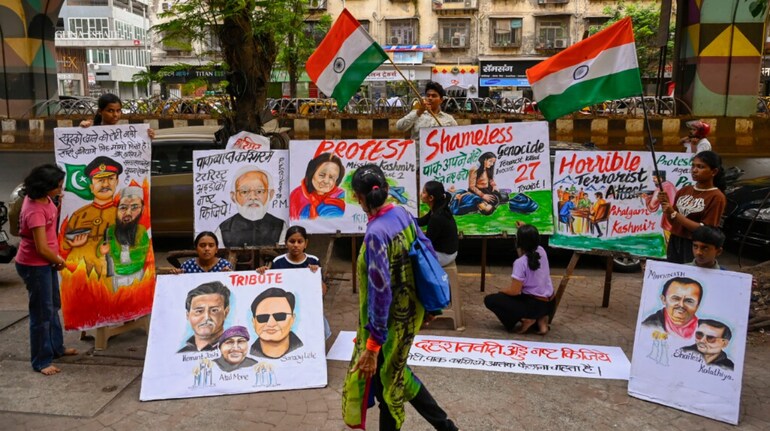
Even as Pakistan attempts to distance itself from the horrific terror attack in Jammu and Kashmir's Pahalgam-which claimed 26 lives, mostly tourists-the country's duplicitous stance on terrorism stands exposed once again.
Pakistan's defence minister Khawaja Asif has dismissed the attack as a "home-grown" uprising and part of a so-called rebellion within India. However, the group that claimed responsibility - The Resistance Front - is widely known as a front for Lashkar-e-Taiba, a Pakistan-based terror organisation long supported and sheltered by the country's deep state.
While TRF claims to be an indigenous resistance movement, mounting evidence - corroborated by Indian intelligence and global watchdogs - indicates that it is merely a proxy of the banned Pakistani terror group Lashkar-e-Taiba (LeT).
What makes TRF particularly dangerous is not just its ability to execute high-casualty attacks, but its strategic value for Pakistan. TRF gives Islamabad the leeway to deny direct involvement in cross-border terrorism, while effectively continuing its decades-long proxy war in Kashmir.
Origins of TRF: A Convenient Facelift for LashkarTRF burst onto the scene in 2019, following the government's move to abrogate Article 370, and has claimed responsibility for several attacks on security forces and civilians alike in the Valley since then.
Indian intelligence sources have repeatedly asserted that TRF was floated by Pakistan's Inter-Services Intelligence (ISI) as a front for Lashkar-e-Taiba. The idea was simple but effective: rebrand LeT under a new, secular-sounding name to bypass international scrutiny. Unlike LeT, whose Islamist ideology is unmistakable, TRF uses non-religious rhetoric, projecting itself as a political resistance against Indian "occupation."
This rebranding also helped Pakistan obfuscate its involvement. By using an outfit that didn't carry the historical baggage of groups like LeT or Jaish-e-Mohammed, Pakistan could plausibly deny state support for cross-border terrorism while keeping the militant infrastructure intact.
Speaking to Moneycontrol, former Jammu and Kashmir DGP SP Vaid said the outfit has been "deliberately named in way so that it appears local, but more than 90 per cent of those recruited in it are Pakistanis."
Meanwhile, Dr Shalini Chawla, Distinguished Fellow at Centre for Air Power Studies (CAPS), pointed out that another strategy by Pakistan behind the launch of TRF was to avoid Financial Action Task Force (FATF) scrutiny back then, and even now.
"TRF was created post abrogation of Article 370 and was strategically not given a religious identity. Why not Lashkar, though it is a shadow of Lashkar, because of the fact that at that time, Pakistan was under the FATF grey list and was under the scrutiny for terror financing and other things. So, this was a move which was basically designed to avoid scrutiny of FATF," Chawla told Moneycontrol.
"Lashkar definitely is a prime part of it, but some other terror outfits are also part of The Resistance Front, but Lashkar is the main body. Their job primarily is to recruit online," she added.
TRF's Lashkar Connection: Too Obvious to DoubtDespite TRF's attempts to project itself as a local resistance group within India, multiple linkages with Lashkar-e-Taiba are now well-established. According to a 2021 report by the United Nations Security Council's Analytical Support and Sanctions Monitoring Team, TRF is considered a front organization of LeT.
Intelligence reports and investigations have revealed that the leadership and key operational commanders of TRF are either former or current members of Lashkar-e-Taiba. Figures like Sheikh Sajjad Gul, a top TRF commander, have long-standing ties to LeT. The cadres recruited into TRF are often drawn from the same pool that traditionally supplied LeT.
Reports suggest that probe agencies have identified Saifullah Kasuri, also known as Khalid, a senior LeT operative, as the main orchestrator of the terror attack. Kasuri operates from Punjab in Pakistan.
They are also investigating the role of two Lashkar commanders, one of whom is Abu Musa, who called for jihad and bloodshed in the Valley just a few days ago.
"We will shower bullets, slit your necks, and honour the sacrifices of our martyrs," Musa had said at a rally in Rawalkot's Khai Gala in Pakistan-occupied Kashmir (PoK).
Recognizing its direct involvement in terrorism, the Indian government proscribed TRF last year for actively recruiting youth online for terror, facilitating the infiltration of terrorists, and orchestrating the smuggling of weapons and narcotics from Pakistan into Jammu & Kashmir.
Further, the weapons used in many of TRF's attacks - including American-origin M4 carbines and sophisticated IEDs - point to an organized supply chain that only an established group like LeT could maintain.
How TRF Recruits TerroristsAs part of its facelift, the Lashkar proxy outfit moved away from the traditional modes of recruitment used by Pakistan-sponsored terror groups. While earlier groups relied heavily on personal networks and local madrassas, TRF has embraced encrypted messaging platforms Telegram, WhatsApp, and Signal to reach disaffected youth, offering a mix of ideological indoctrination and financial incentives.
The messaging is subtle and politically charged - a far cry from the overt Islamist rhetoric of the past. TRF's propaganda videos, often accompanied by graphics and slick editing, present the group as a "resistance movement" fighting against a so-called occupation, rather than as a jihadist organization.
This digital-first strategy has helped TRF attract a younger demographic. Some recruits are barely out of their teens and have little to no formal religious education - a sharp contrast to earlier generations of militants. Many are radicalized online, drawn in by narratives of state oppression and false promises of martyrdom and heroism.
Attack Strategy: Urban Guerrilla WarfareTRF's modus operandi is markedly different from traditional Pakistani terror outfits. It focuses on high-impact, low-investment urban guerrilla tactics - hit-and-run attacks, targeted assassinations, and the use of magnetic IEDs.
In the past two years, TRF has carried out numerous attacks in urban centres like Srinagar, Anantnag, and Pulwama. These include assassinations of political workers, off-duty police officers, migrant workers, and now, tourists.
The Pahalgam attack saw another tactic, which has traditionally been an identity of ISIS: targeting victims on the basis of their religious identity.
First-hand accounts confirmed that the terrorists - dressed in camouflage and traditional kurta-pyjamas - targeted male tourists and confirmed their religious identity before shooting them. This was also a chilling throwback to some of the worst episodes of sectarian violence in the Valley.
Pakistan's Role: Plausible DeniabilityFor Pakistan, TRF represents a win-win: it can continue to fuel unrest in Kashmir while maintaining diplomatic distance from the bloodshed.
Statements from Pakistani officials routinely paint TRF as a local resistance group. Islamabad uses this plausible deniability to deflect international pressure and sanctions.
Pointing towards Pakistan's backing to TRF and other such outfits and its behind it, Dr Chawla told Moneycontrol, "Pakistan has always believed in the strategy of covert war, they have adopted terrorism as a foreign policy tool - with India, with Afghanistan - since its inception. It never ended, we just saw a little bit of lull time, primarily because Pakistan was struggling with its own domestic issues and it also had to get the IMF bill out."
"What I feel is Pakistan, for quite some time, has been trying very hard to revive its strategic relevance, because after US withdrew from Afghanistan, it has somewhere lost its strategic relevance, which it has cherished for many decades. I feel this move is a desperate attempt to revive its strategic relevance, bring Kashmir again in the international limelight and very importantly to challenge the narrative of normalcy in J&K," Dr Chawla opined.
Indian security agencies have also traced TRF's funding back to Pakistan, with hawala networks and crypto-based transfers being the primary channels. Additionally, many TRF operatives reportedly receive training in PoK under the supervision of retired Pakistani military personnel and LeT trainers.
According to security analysts, this arrangement allows Pakistan to maintain a level of "strategic depth" - a Cold War-era military doctrine whereby Pakistan keeps the Kashmir insurgency alive without risking direct confrontation with India.
Air Marshal Anil Chopra (Retd), in conversation with Moneycontrol, highlighted the fact that "diplomatic and military pressure" on Pakistan was the need of the hour.
"There are so many groups there, not just LeT, our focus should be on Pakistan because all of them are fed by Pakistan," he told Moneycontrol.
While Pakistan continues to deny links to TRF, it has taken no visible action to dismantle the infrastructure that supports the group. LeT continues to operate training camps in PoK, and Hafiz Saeed, despite being convicted on terror financing charges, remains a powerful ideological figure.
Additionally, the Pakistani military's reluctance to act against these groups - many of which are considered "strategic assets" - shows that the state is unwilling to sever ties with terror outfits that serve its geopolitical goals in Kashmir.
In her conversation with Moneycontrol, Dr Chawla also noted that the vague statements by Pakistani Army chief Asif Munir (referring to Kashmir as "Pakistan jugular vein") and its defence minister Khawaja Asif referring to the attack as "home grown violence" were indicative of Pakistan's plausible deniability.
The Resistance Front is not an organic Kashmiri resistance movement but a carefully constructed facade, a proxy wielded by Lashkar-e-Taiba and its Pakistani patrons to carry out terror attacks in India while attempting to maintain a distance. The tragic attack in Pahalgam is a stark reminder of this deceptive strategy and the continued threat posed by Pakistan-backed terrorism.
Defence minister Rajnath Singh has already indicated that the government will not only go after the terrorists who carried out the killings but those who worked "behind the scenes" and hatched the conspiracy. Though Singh did not name anyone, the message is quite implicit.
Discover the latest Business News, Sensex, and Nifty updates. Obtain Personal Finance insights, tax queries, and expert opinions on Moneycontrol or download the Moneycontrol App to stay updated!
Find the best of Al News in one place, specially curated for you every weekend.
Stay on top of the latest tech trends and biggest startup news.