






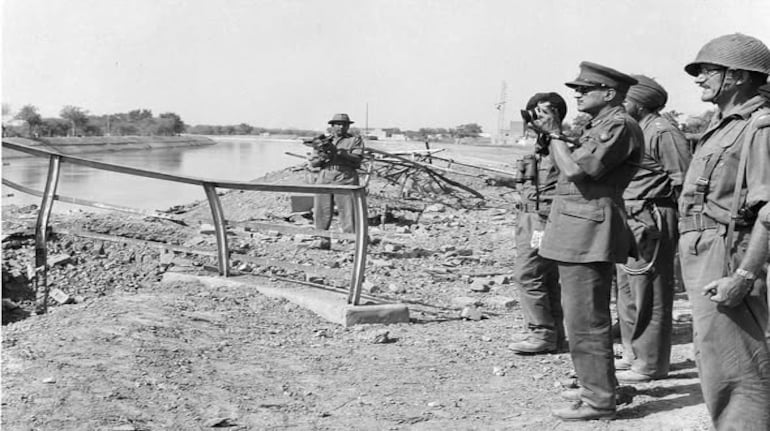
Just before midnight on September 6, 1965, Indian infantry began moving silently through fields outside Lahore. There was no artillery barrage to announce their arrival, no armoured spearhead to smash a path forward. What followed at Dograi was a rare thing in modern war: a fast, close-quarters night assault carried almost entirely by foot soldiers, bayonets and momentum.
By dawn, Indian troops were inside a Pakistani village barely 20 kilometres from Lahore. By evening, they were ordered to pull back.
Dograi would become one of the most audacious infantry actions of the 1965 war and one of its most bitter lessons.
Why Dograi mattered
Dograi lay astride the Ichhogil Canal, Pakistan’s primary defensive obstacle protecting Lahore. The canal was deep, steep-banked and heavily fortified, running north–south as a deliberate barrier against Indian advances. Capturing crossings over it was essential if India was to threaten Lahore or force Pakistan to divert forces from other fronts.
Indian planners understood that a daylight assault across the canal would be costly. Instead, they gambled on speed and surprise.
The task fell to 3 Jat Battalion, under Lieutenant Colonel Desmond Hayde, part of 15 Infantry Division. The objective was clear and narrow: seize Dograi village, secure a foothold beyond the canal, and hold until armour and reinforcements could link up.
What was less clear was how long the infantry would be able to hold on alone.
The night attack
The assault began shortly before midnight. Indian troops crossed the border quietly, navigating irrigation ditches, crops and village tracks under moonless skies. There was no preparatory bombardment. Surprise was the weapon.
Pakistani defenders at Dograi were caught off guard. The initial resistance was scattered and confused. Indian sections moved quickly, clearing houses room by room. Grenades were thrown through doorways, bayonets used where firing would give away positions. In several accounts, the fighting is described as disorienting and intimate, taking place at distances of a few metres.
By early morning, Dograi was in Indian hands.
The speed of the capture stunned Pakistani commanders. Indian infantry had breached what was assumed to be a firm defensive belt guarding Lahore’s eastern approaches. For a brief moment, the road ahead appeared open.
Holding ground without depth
But taking Dograi was only half the task. Holding it proved far harder.
Indian infantry now sat exposed beyond the Ichhogil Canal, with limited artillery support and no immediate armoured backing. Pakistani forces regrouped quickly. By daylight, Dograi came under heavy counter-attack, including artillery fire and infantry assaults from multiple directions.
Pakistani units understood the vulnerability of the Indian position. Cut off from quick reinforcement, the village became a pocket under pressure. Indian soldiers fought from house to house again, this time defensively, repelling repeated attempts to retake the village.
Communication with higher headquarters became increasingly strained. Requests for armour and ammunition ran up against the reality of canal crossings not yet secured elsewhere.
By late afternoon, the situation had turned precarious.
The order to withdraw
The decision to pull back was taken reluctantly. Indian commanders recognised that without rapid reinforcement, holding Dograi would bleed the battalion white. The withdrawal order came even as Indian troops still held parts of the village.
Pulling back under fire was as dangerous as the assault itself. Sections disengaged in small groups, covering each other as they moved back towards the canal. Some wounded had to be carried. Others could not be evacuated.
By nightfall, Indian forces were back on their original side of the Ichhogil Canal. Dograi was once again under Pakistani control.
The cost had been heavy. 3 Jat suffered significant casualties, including officers and junior leaders who had led from the front. But the psychological effect of the assault lingered.
Shockwaves beyond the battlefield
Dograi rattled Pakistani command more than its brief occupation might suggest. The fact that Indian infantry had crossed the canal and captured a defended village near Lahore forced Pakistan to reinforce the sector heavily. Units were redeployed, and defensive priorities were reassessed.
For India, Dograi became both a point of pride and a source of frustration. The assault proved that Pakistani defences could be penetrated by well-planned infantry action. The withdrawal underscored the limits of such success without depth, reserves and rapid exploitation.
Two weeks later, Indian forces would return.
On September 21, Dograi was assaulted again, this time with stronger support. The village was recaptured and held until the ceasefire. But it was the first assault that entered regimental memory.
Why Dograi endures in infantry lore
Dograi occupies a special place in Indian military history because it was unapologetically an infantry battle. There were no dramatic tank duels, no sweeping manoeuvres. Victory depended on junior leadership, night navigation, courage under confusion and the willingness to keep moving forward when visibility, communication and certainty were all absent.
The battle highlighted truths that do not age. Infantry can seize ground faster than armour can exploit it. Surprise can outweigh firepower. And captured ground is only as secure as the support behind it.
For the Indian Army, still absorbing lessons from 1962, Dograi was a reminder of what disciplined, aggressive infantry could achieve. It also reinforced the importance of integration between arms, a lesson that would shape later doctrine.
The cost of speed
Dograi’s legacy is not romantic. It is sobering.
The assault succeeded because it moved fast and accepted risk. The withdrawal happened because that risk could not be sustained indefinitely. The cost was borne by soldiers who fought twice over the same ground, once advancing and once pulling back, under fire both times.
Today, Dograi is studied not as an unqualified victory but as a complete battle, from planning to aftermath. It is remembered because it tells the full story of infantry warfare: bold entry, brutal holding, and hard decisions when the situation turns.
That is why, six decades later, Dograi is still taught, discussed and remembered. Not for how long it was held, but for how it was taken, and what that moment revealed about speed, surprise and the price of standing alone beyond the line.
Discover the latest Business News, Sensex, and Nifty updates. Obtain Personal Finance insights, tax queries, and expert opinions on Moneycontrol or download the Moneycontrol App to stay updated!
Find the best of Al News in one place, specially curated for you every weekend.
Stay on top of the latest tech trends and biggest startup news.




