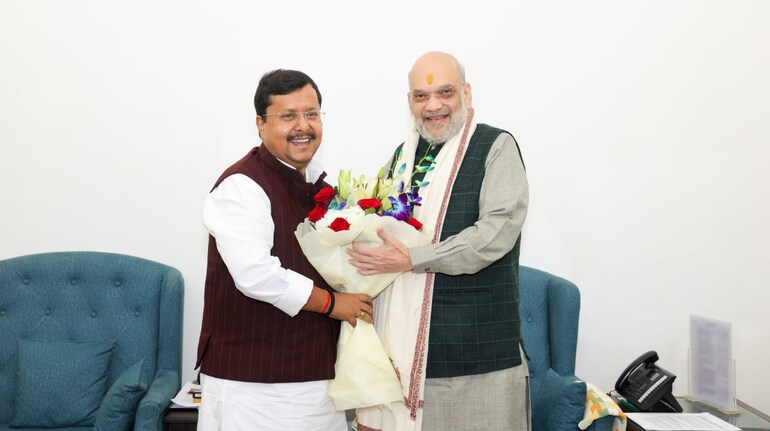

As Nitin Nabin prepares to take over as the national president of the Bharatiya Janata Party on January 20, he inherits a party riding high on the national level and in several other regions, but faces serious tests in some of India's most politically crucial states. Nabin's elevation marks a generational shift in the BJP's leadership, making him the youngest leader to assume the top organisational post.
The BJP is likely to issue a notification for the election of its full-time president on January 17. Nabin is expected to file his nomination on January 19 and, in the absence of any other nominee to the post, be declared the BJP president the same day. He is expected to take charge as the BJP's youngest full-time president on January 20.
Party insiders say his real work begins now. As he transitions from working president to full-time chief, Nabin confronts a mix of strategic and electoral challenges that will define his three-year tenure as well as the BJP's fortunes ahead of the 2026 and 2029 elections.
Converting local wins into state-level success
The BJP's recent local body victories, especially in urban centres, have provided momentum, but translating these into Assembly or state-level breakthroughs remains elusive in places like West Bengal, Tamil Nadu, Kerala and even parts of the Northeast. Internal assessments warn that without stronger grassroots penetration, vote-share gains may not translate into seats.
Strengthening BJP-RSS coordination
After reported strains between the party and the Rashtriya Swayamsevak Sangh (RSS) during the 2024 Lok Sabha campaign, Nabin has prioritised tightening ties with Sangh affiliates. He is expected to hold a series of meetings with heads of RSS bodies as he seeks smoother coordination on ideology, cadre integration and campaign mobilisation.
Organisational overhaul and team building
A new organisational team is expected to be announced alongside Nabin's elevation. Party leaders say the emphasis will be on inclusive representation and functional ability rather than seniority alone. This rebuild will test Nabin's consensus-building skills, especially among established leaders competing for key slots.
South India push and key state battles
The BJP's push into South India is one of Nabin's immediate priorities. He has already called for a 90-day ground campaign in Tamil Nadu to challenge the ruling DMK by highlighting issues such as governance failures and safety concerns.
Beyond Tamil Nadu, the party is also eyeing gains in West Bengal, where it has never formed a government, and Kerala, where recent vote-share rises have yet to convert into Assembly seats. Nabin must tailor strategies that resonate culturally and politically across these diverse regions.
Promoting the next generation of leaders
As a relatively young leader at 45, Nabin embodies the BJP’s push to cultivate next-generation leadership. Yet this comes with the challenge of balancing youthful energy with experience. Party insiders say his ability to identify and empower emerging leaders while keeping factions aligned will be critical for organisational longevity and electoral success at the national and state levels.
Maintaining national momentum
While the BJP remains strong in states like Uttar Pradesh, Gujarat and Madhya Pradesh, setbacks in key regions underscore the complexity of India’s electoral landscape. Nabin inherits the task of ensuring that local issues do not derail the party’s broader narrative on development, governance, and nationalism. Analysts say maintaining cohesion on core ideological themes while adapting to localized contexts will be a defining test of his leadership.
Nabin's rise comes as the BJP seeks to balance its established urban organisational dominance with deeper rural penetration and cross-regional appeal. With Assembly elections in several states set for later this year and the 2029 Lok Sabha polls on the horizon, his success will be judged not just by organisational reshuffles but by the BJP's ability to expand its footprint across India.
Beyond organisational restructuring and state-level battles, Nabin's tenure is also likely to be shaped by the BJP's push on high-stakes systemic reforms, including such as One Nation, One Election, women's reservation, and a possible caste census, carry both political opportunity and risk. While driving these agendas will allow the BJP to reinforce its narrative of decisive reform and long-term institutional change, each of these reforms also opens up fault lines with Opposition parties and, in some cases, within the NDA itself.
One Nation, One Election, for instance, fits squarely into the BJP's pitch for political stability and cost efficiency, yet it raises federal concerns among regional parties, making alliance management a crucial organisational task for Nabin. Similarly, women's reservation, already legislated but pending implementation, offers the BJP a chance to consolidate women voters across states, especially in urban and semi-urban constituencies where it has been expanding. How and when this is rolled out will place the party organisation at the centre of execution.
The caste census, however, is the most politically sensitive of the lot. While the BJP has traditionally resisted caste-based enumeration in favour of a broader social justice narrative, rising Opposition pressure and state-level precedents mean the issue may be unavoidable. Managing this debate without allowing it to fragment the BJP's carefully stitched social coalition will test Nabin.
Discover the latest Business News, Sensex, and Nifty updates. Obtain Personal Finance insights, tax queries, and expert opinions on Moneycontrol or download the Moneycontrol App to stay updated!
Find the best of Al News in one place, specially curated for you every weekend.
Stay on top of the latest tech trends and biggest startup news.