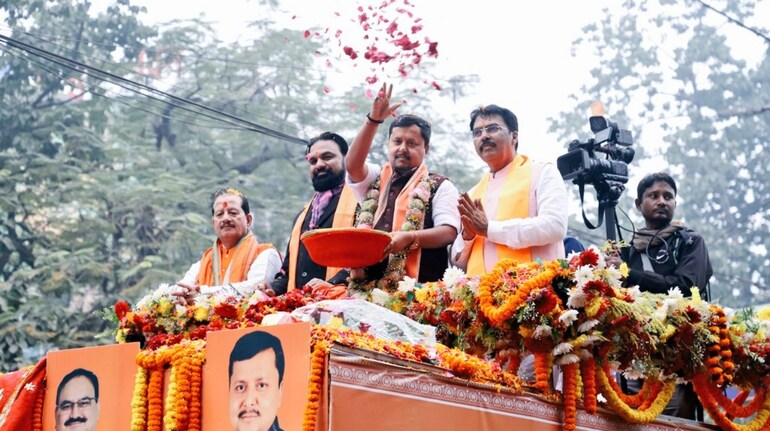

Nitin Nitin Nabin's elevation as the Bharatiya Janata Party's national working president is being read within the party as more than a routine organisational change. It signals the beginning of a well-considered generational and structural reset at the top, one that could reshape the BJP's central power architecture ahead of the battle for states in 2026 and the 2029 Lok Sabha elections.
The BJP has seen such transitions before, but rarely with this degree of intent. When Amit Shah took over as party president in 2014, the focus was on electoral aggression and booth-level consolidation to complement Narendra Modi's prime ministerial campaign.
Shah's tenure centralised authority, sharpened discipline, and built the BJP into an election-winning machine. JP Nadda's elevation in 2019 marked a different phase that focused on institutional continuity, expansion into new geographies, and managing governance after the party's second consecutive national victory.
Nabin's rise appears to mark a third phase. At 45, he is the youngest leader to be placed in charge of the BJP's central organisation in decades. What makes his appointment all the more significant is how a performance-driven evaluation rather than factional bargaining or seniority defined the party's choice.
This mirrors earlier leadership handovers (Shah in 2014 and Nadda in 2019) where the party prioritised utility over optics. But unlike those transitions, which were anchored in national electoral momentum, Nabin's elevation comes at a moment when the BJP is consciously planning for the post-2024 political roadmap.
Party insiders say a large-scale reshuffle of the central organisation is inevitable once Nabin formally takes over as full-time president from Nadda, likely in January 2026, with formal ratification at the National Council meeting later that year, reports The Sunday Guardian. The expectation is that this new team will stay in place through the 2029 Lok Sabha elections, making the upcoming overhaul central to the BJP's medium-term strategy rather than a stopgap arrangement.
What distinguishes this transition is the emphasis on generational change. Under Shah and Nadda, the BJP's central team was dominated by leaders in their late 50s and 60s, marked by seasoned organisers with deep roots in the Sangh ecosystem.
Under Nabin, the balance is expected to tilt decisively towards leaders in the 35-50 age bracket. This is as much about youth optics as it is about the BJP's assessment that the next political cycle will demand adaptability, digital fluency, and sustained organisational stamina rather than episodic electoral mobilization that the party usually associates with the Opposition as a deterrent.
Nabin's long stint in the Bharatiya Janata Yuva Morcha is central to this recalibration. Unlike many senior leaders who rose through ideological or administrative tracks, Nabin built his network through cadre management, state-level coordination, and electoral execution across regions. That exposure has given him a granular understanding of mid-career leaders who are neither veterans nor novices but form the BJP's operational spine.
As per the report cited above, many of these leaders are now being evaluated for national roles based on past performance and future deployability, not factional heft.
This marks a subtle but important departure from earlier organisational cultures. During Shah's presidency, central appointments often rewarded loyalty and proven electoral toughness. Under Nadda, continuity and ideological balance were key considerations.
Nabin's approach is expected to blend both models but add a sharper filter of measurable effectiveness. Party insiders stress that "big names" will not find automatic entry into the new structure and will be subject to the same scrutiny as lesser-known organisers.
Strategically, this reorientation also reflects the BJP's evolving electoral map. With West Bengal, Tamil Nadu, Telangana, and Kerala remaining difficult terrain, and urban local body elections emerging as key battlegrounds, the party needs a leadership bench that can manage sustained political combat beyond headline elections.
While Prime Minister Narendra Modi and Home Minister Amit Shah will continue to define the party's ideological and strategic direction, the organisational reins are expected to rest firmly with Nabin. This mirrors the autonomy Shah enjoyed post-2014 and Nadda after 2019, reinforcing the BJP's tradition of separating political command from organisational execution while keeping both aligned.
There is also a longer arc at play. Just as Shah's team shaped the BJP's rise between 2014 and 2019, and Nadda's oversaw consolidation after 2019, the leadership cadre assembled by Nitin Nabin is likely to determine how effectively the party transitions into the not just the next election, but the next decade.
Nabin's elevation thus is less about succession and more about system-building. If Shah was the architect of expansion and Nadda the custodian of continuity, Nabin may well emerge as the manager of the BJP's long-term political endurance.
Discover the latest Business News, Sensex, and Nifty updates. Obtain Personal Finance insights, tax queries, and expert opinions on Moneycontrol or download the Moneycontrol App to stay updated!
Find the best of Al News in one place, specially curated for you every weekend.
Stay on top of the latest tech trends and biggest startup news.