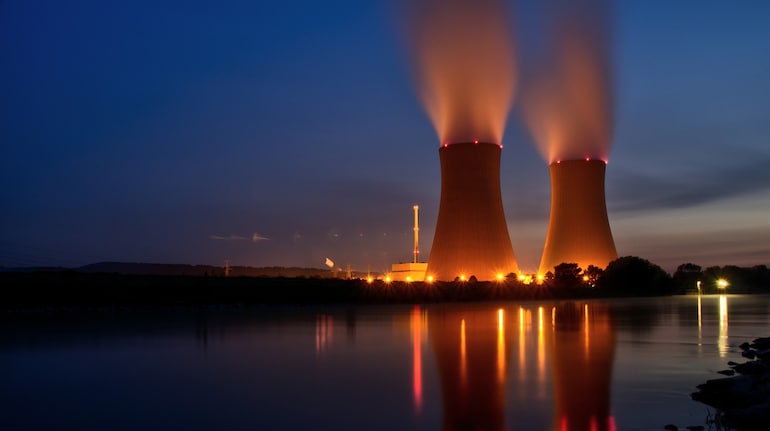
In the early years of the republic, nuclear power sat in a special category: too strategic to leave to the market, too sensitive to decentralise, too politically explosive to treat like any other power plant. The Atomic Energy Act, 1962 hard-wired that instinct into law. It gave the Central government sweeping powers over atomic energy, materials, and installations, the legal spine of a state-run nuclear programme.
That legal architecture produced a nuclear sector that is competent, cautious, and, compared with India’s hunger for electricity, stubbornly small. Today, nuclear remains a thin slice of India’s power mix; the government’s pitch is that it can’t stay that way if India wants clean, reliable 24×7 electricity at scale.
Enter SHANTI.
What is the SHANTI Bill, 2025 in plain English
The Sustainable Harnessing and Advancement of Nuclear Energy for Transforming India Bill, 2025 (SHANTI) is the government’s attempt to do something India has refused to do for decades: let non-government companies participate in the civil nuclear power business. The government plans to table it in the Winter Session’s final stretch (as reflected on the Lok Sabha agenda listing).
The one line that matters: Who gets to own and operate a reactor
The central promise, and the central controversy, is this: SHANTI would open the door for private participation in building and operating nuclear power projects, breaking from the long-standing model where the state (through entities like NPCIL) dominates the sector.
If you’re looking for the 'so what': This is India trying to treat nuclear power like infrastructure, something you can finance, build, and scale, rather than like a museum piece guarded by one institution.
Why now: The 100 GW ambition, and the money problem
The government’s stated target is 100 GW of nuclear power capacity by 2047. That is the number doing the heavy lifting in every argument for SHANTI.
The subtext is blunter: nuclear projects are expensive, slow, and capital-hungry. The state alone can’t bankroll a nuclear build-out on that scale while also funding roads, railways, defence, welfare, and the rest of modern governance. The Cabinet’s case, as reported, is that private capital and faster execution are now necessary, not optional.
How this differs from the Atomic Energy Act, 1962
The Atomic Energy Act is the legal reason India’s nuclear sector stayed closed. It centralised control and made atomic energy a sovereign function, not a normal commercial sector.
SHANTI’s significance is less about one policy tweak and more about changing the default setting: from 'government-only' to 'government-regulated, with private participation.'
The liability problem SHANTI is trying to fix
India’s nuclear liability regime has been the graveyard of big foreign reactor deals since 2010. The Civil Liability for Nuclear Damage Act (CLND) channels liability to the operator, but it also gives operators a right of recourse against suppliers in defined circumstances, and Section 46 became a source of anxiety about broader legal exposure.
The Department of Atomic Energy and the Ministry of External Affairs have repeatedly argued that Section 46 does not create a free-for-all against suppliers, but the chill effect on suppliers and insurers has been real, and projects have stalled.
SHANTI, as described in current reporting, aims to clarify and reform liability to make the sector investable, one reason it keeps coming up in the context of attracting private and foreign capital.
If you want the bottom line: a private nuclear market doesn’t exist without a liability framework that banks, insurers, and suppliers can price.
Will foreign money be allowed, and how much
Multiple reports around the Cabinet decision say the reform package contemplates allowing foreign investment up to 49 percent in nuclear power projects.
This is the government trying to thread a needle: attract global capital and technology without giving up domestic control in a strategic sector.
Small modular reactors: the 'move fast' promise
A lot of the political selling for SHANTI is attached to small modular reactors (SMRs), smaller units that can, in theory, be deployed more quickly, serve industrial clusters, and complement renewables for steady power.
In plain terms: SMRs are being pitched as nuclear power with a startup mindset, still regulated like a hawk, but built and rolled out with less drama than a giant conventional plant.
Who stands to gain: a quick map of potential beneficiaries
Indian heavy industry and utilities: If private participation is real, companies that build large projects (EPC), manufacture critical equipment, or need reliable clean power for industry have an obvious incentive to get involved.
Global reactor vendors: US, French, and other suppliers that have kept India at arm’s length because of liability uncertainty may reassess if the rules become clearer and commercially aligned. (This is inference based on the long-standing liability debate; SHANTI is explicitly framed as an 'opening up' plus liability reform package.)
The government itself: If SHANTI works, New Delhi gets a stronger baseload clean-energy story without carrying the full financing burden.
Many countries run civil nuclear sectors with private operators under strict regulation (think: the US model with the Nuclear Regulatory Commission). Others have state-heavy structures but still use private capital and vendors. India’s historic outlier status has been the combination of a closed sector plus a contentious liability architecture. SHANTI is designed to change that equation.

Discover the latest Business News, Sensex, and Nifty updates. Obtain Personal Finance insights, tax queries, and expert opinions on Moneycontrol or download the Moneycontrol App to stay updated!
Find the best of Al News in one place, specially curated for you every weekend.
Stay on top of the latest tech trends and biggest startup news.