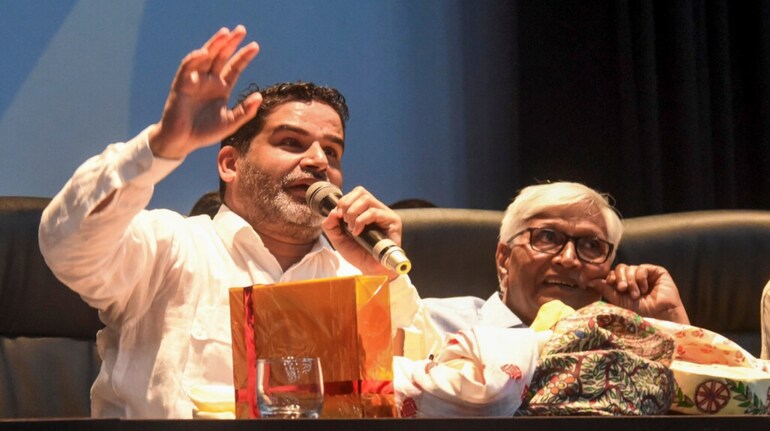
Over dependence on ‘Brand Modi’, the manner in which the Opposition was able to spin the ‘Abki Baar 400 Paar’ slogan to link it to reservations and the Constitution and the disenchantment among even the Prime Minister’s most ardent supporters over remarks on ‘mujra, Muslims and mangalsutra’ were among some key factors that resulted in the Bharatiya Janata Party winning fewer than expected Lok Sabha seats in the elections this year, poll strategist-turned-activist Prashant Kishor said in an interview telecast on Sunday.
Speaking to Rajat Sharma on India TV’s ‘Aap Ki Adalat’, Kishor said that the people of the country viewed the Lok Sabha election results this year as "a good one", pointing out that they were happy that Modi is back as Prime Minister of the country, but were equally glad that he had been served a message.
"People have sent a clear message to Modi asking him to run the government. They have also conveyed to him that ‘You Are Not God’...run the government, but not as a dictator, run the government like a democratic leader," Kishor said.
Asked if the BJP's slogan of 'Abki Baar 400 Paar' proved to be costly for the BJP in this election, Kishor said that the slogan was good but incomplete. "Abki Baar 400 Paar to theek hai par kyun yeh Opposition ne bataya. (Abki Baar 400 Paar is good but it was completed by the Opposition.
“It was the Opposition which said ‘400 paar’ because they (BJP) wants to change the Constitution, to end reservations. Of course, it also allowed a sense of overconfidence to set in among the BJP cadre since they believed that victory was almost certain,” he said, adding that remarks by some of the BJP’s own leaders on changing the Constitution only helped the Opposition.
Kishor further said that even the most ardent supporters of the Prime Minister felt disappointed at the use of certain terms by Modi. “Phrases like mangalsutra, mutton, Muslims etc were not expected of the Prime Minister. Even Modi’s core supporters felt disappointed. Also, it set off alarm bells that Modi had to resort to something like this since he had perhaps sensed an impending defeat.”
Kishor, who had claimed that the BJP would win 300 seats on its own, said that despite his projections going wrong, there has been a clear shift of the political axis from Congress to the BJP.
The BJP managed to win 240 seats in the Lok Sabha polls, falling short of a majority for the first time in three elections. The reduced mandate compelled the BJP to seek coalition partners in order to form a government. The Opposition has claimed victory in the BJP's lower-than-projected tally as the people's rejection of Modi's "autocratic" leadership.
Asked about the stability of the ruling government, Kishor said that the Assembly elections in nine states hold key to the answer. "Results in nine state assembly elections, J&K, Delhi, Haryana, Maharashtra, Jharkhand, Bihar, West Bengal, Tamil Nadu and Assam will decide the stability of this government. These results will also decide the direction this government will take.
"If BJP loses in five or six out of these nine states, definitely the question of stability will become an issue," he said.
Kishor, however, admitted that BJP will continue to be the political axis on the national scene for the next 25 to 30 years, irrespective of whether it wins or loses elections.
"The Congress was the political axis from 1950 till 1990, and there has been a clear shift of this axis from Congress to BJP,” he said.
Discover the latest Business News, Sensex, and Nifty updates. Obtain Personal Finance insights, tax queries, and expert opinions on Moneycontrol or download the Moneycontrol App to stay updated!
Find the best of Al News in one place, specially curated for you every weekend.
Stay on top of the latest tech trends and biggest startup news.