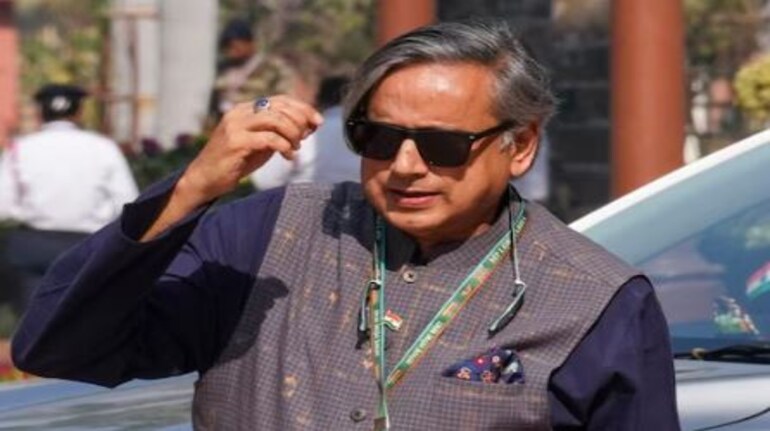
Stressing on the need for bipartisanship, Congress MP Shashi Tharoor said there is a distressing pattern that emerges whenever India faces a crisis such as the 22 April Pahalagam attack.
In his opinion piece in The Hindu, Tharoor said as India grieves the loss of 26 lives in the Pahalgam terror attack, one must also recognise the critical importance of bipartisanship.
“There is a distressing pattern that emerges whenever India faces a crisis of this nature: political parties, instead of closing ranks in defence of the nation, often resort to scoring points — weaponising grief for electoral advantage rather than forging a unified front. We saw this after the Pulwama attack in 2019, where swift retaliatory action became intertwined with campaign narratives,” Tharoor wrote.
According to Thraroor, bipartisanship is critical in shaping India’s response and in ensuring that national security does not become another theatre for political posturing.
He also remembered when he became chairman of the Parliamentary Standing Committee on External Affairs, he declared that “there is no such thing as a Congress foreign policy and a BJP foreign policy; there is only Indian foreign policy, and Indian national interests”.
“I was reminded of a famous episode of Indian diplomatic history in 1994, when Prime Minister P.V. Narasimha Rao picked Opposition Leader (and then Chairman of the External Affairs Committee) Atal Bihari Vajpayee to lead the Indian delegation to present India’s case on Kashmir, and counter Pakistan’s falsehoods, at a United Nations session in Geneva. The Congress Minister of State for External Affairs, Salman Khurshid, was named as A.B. Vajpayee’s deputy,” he said.
Tharoor said Vajpayee later recalled with amusement just how bewildered the Pakistani governing class was at seeing an Opposition leader representing his nation’s interests at such a prestigious forum, and at such a crucial moment.
“Sadly, this episode has not been repeated in the last three decades, as our politics has turned ever more rancorous and bitter. There is very little mutual respect and friendship on display between the ruling party and the Opposition,” said the Congress MP.
According to him, the core assumption of democratic politics is supposed to be that both sides understand that the other is as committed to the national interest as itself, even if they disagree on how best to ensure the nation’s well-being. “In that sense the two sides are not enemies but adversaries. But that assumption has yielded to a bitter polarisation in recent years,” he said.
Tharoor said political discourse on security has frequently devolved into blame games, sidestepping the actual need for strategic recalibration. “India’s relationship with Pakistan, though complex and fraught, requires clarity. There can be no ambiguity in condemning acts of terror; the line between national security and political point-scoring is not a thin one. It is in India’s interest to unite in the response to terror, because a perception of division at home always emboldens the enemy. Inflammatory rhetoric, though politically expedient, serves no substantive purpose,” he said.
Tharoor said if India is to emerge as a responsible power, it must ensure that its politics is mature. “What India needs today is a structured national security doctrine that remains insulated from electoral cycles — one that provides a clear vision on counter-terrorism, intelligence-sharing, and strategic deterrence without becoming a tool for political one-upmanship,” he said.
Discover the latest Business News, Sensex, and Nifty updates. Obtain Personal Finance insights, tax queries, and expert opinions on Moneycontrol or download the Moneycontrol App to stay updated!
Find the best of Al News in one place, specially curated for you every weekend.
Stay on top of the latest tech trends and biggest startup news.