






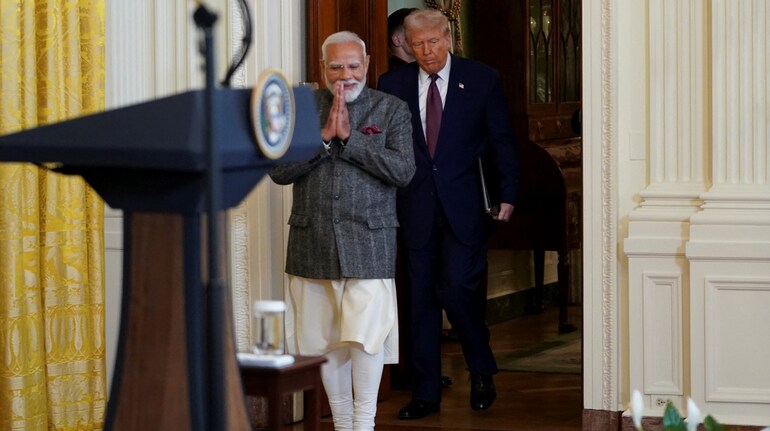
US President Donald Trump moved swiftly this week to secure a significant trade deal with India, positioning it as a direct response to New Delhi’s recently concluded free trade agreement with the European Union.
The US deal comes after global trading partners like the European Union and India, and China and Canada, signed their own trade pacts since the new year, leaving America looking ostracized, CNBC reported.
Analysts had anticipated that these deals, specially the EU-India pact, could “light a fire” for the US to get its own stalled trade agreement with India done and dusted. But it has come quicker than most expected.
Also Read: India’s two trade paths: How the EU deal and the US interim pact really compare
Trump announced on his social platform that the United States will lower its effective tariff on Indian goods to 18%, a move he framed as strengthening economic ties and addressing trade imbalances. In his remarks, he also said India agreed to dramatically expand its purchases of American products — including energy, technology and agricultural goods — potentially reaching $500 billion over time.
Prime Minister Narendra Modi publicly welcomed the tariff cut, expressing appreciation for Trump’s role in advancing closer economic cooperation between the two countries.
India-EU trade deal
The deal comes just days after India and the European Union concluded what leaders are calling a landmark free trade agreement — widely referred to in public statements as the “mother of all deals” — designed to liberalise trade across a broad range of goods and services.
That pact, decades in the making, promises to expand access between India’s vast market and the EU’s 27 member states, potentially doubling exports over the next decade.
Under the EU deal, tariffs have been eliminated or phased out across a very large share of goods trade. A significant portion of India’s labour-intensive exports, including textiles, apparel, leather, footwear, gems and jewellery, and marine products, move to zero duty either immediately or on a clear timeline.
Meanwhile, analysts say the timing of the India-US trade deal — following the EU pact — shows Washington’s urgency to match global partners in securing economic ties with New Delhi.
Farwa Aamer, director of South Asia Initiatives at the Asia Society Policy Institute, commented Tuesday that the conclusion of the U.S.-India pact “is interesting as the deal comes straight after the EU-FTA.”
“Though India-US trade negotiations were on for a while, the deal with EU could have served as impetus for the US to push forward. Again, it was finally the leadership-level engagement that we have been talking about since the beginning that was able to bring the deal around,” he said, as reported by CNBC.
Discover the latest Business News, Sensex, and Nifty updates. Obtain Personal Finance insights, tax queries, and expert opinions on Moneycontrol or download the Moneycontrol App to stay updated!
Find the best of Al News in one place, specially curated for you every weekend.
Stay on top of the latest tech trends and biggest startup news.




