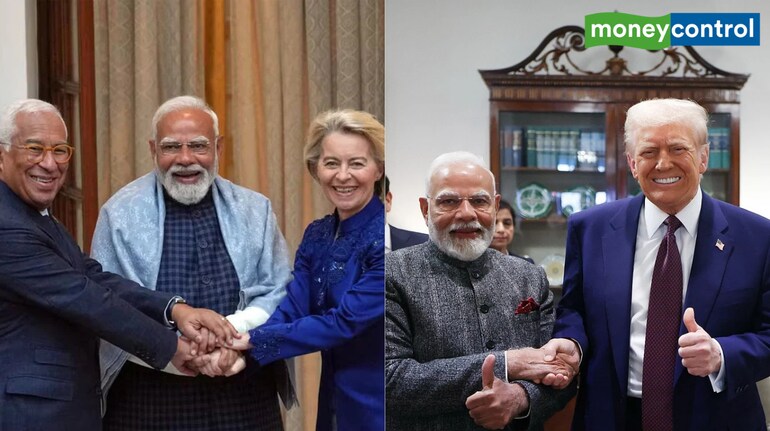

India is simultaneously reshaping its trade relationships with two of its biggest partners, the European Union and the United States.
One is a comprehensive, legally binding Free Trade Agreement (FTA) with deep tariff cuts and enforceable rules. The other is a fast-moving interim framework with a headline tariff number and multiple conditions attached.
Together, they reveal how India is hedging its trade strategy in a more fragmented global economy.
Structure: Treaty versus framework
The EU-India agreement is a full FTA, negotiated over years, with detailed tariff schedules, services commitments, rules of origin, sustainability provisions, and a formal dispute-settlement mechanism. Once ratified, it is designed to be stable and hard to unwind.
The US–India arrangement, by contrast, is an interim trade framework ahead of a proposed Bilateral Trade Agreement (BTA). It relies heavily on executive orders, sector-specific commitments, and future negotiations. It prioritises speed and flexibility over permanence.
Tariffs: Elimination versus management
Under the EU deal, tariffs are eliminated or phased out across a very large share of goods trade. A significant portion of India’s labour-intensive exports, including textiles, apparel, leather, footwear, gems and jewellery, and marine products, move to zero duty either immediately or on a clear timeline.
In the US interim deal, the anchor is a reciprocal tariff rate of 18 percent on Indian goods. Relief beyond that, for products such as generic pharmaceuticals, gems and diamonds, and aircraft parts, is explicitly conditional on further steps, investigations, and the successful conclusion of the interim agreement.
Non-tariff barriers: Compliance versus correction
The EU agreement places heavy emphasis on standards, sustainability, labour norms, and regulatory alignment. Compliance costs can be significant, particularly for smaller firms, but the rules are spelled out in advance.
The US framework focuses on removing specific frictions that Washington has long flagged: pricing and regulatory barriers in medical devices, restrictive import licensing for ICT products, agricultural access issues, and acceptance of US or international standards within set timelines.
Services, digital trade, and technology
The EU deal expands access for services, including IT, professional services, and mobility of skilled workers, within a structured, rule-based system.
The US framework links trade more directly to strategic technology cooperation. It explicitly references data centres, GPUs, supply-chain resilience, export controls, and investment screening. Digital trade rules are framed as part of broader economic-security alignment.
Geopolitics inside the trade text
Geopolitics sits differently in the two agreements.
The EU FTA foregrounds sustainability, labour standards, and climate commitments as core trade disciplines.
The US framework openly ties trade to national-security tools and 'non-market policies of third parties', signalling a more strategic use of tariffs and market access.
Who benefits first
From the EU deal, labour-intensive Indian exporters stand to gain the most, especially those able to meet regulatory and sustainability standards.
From the US deal, exporters in sectors like textiles, leather, chemicals, and select manufacturing gain immediate clarity, while high-value sectors such as pharma and aerospace wait for conditional relief.
Discover the latest Business News, Sensex, and Nifty updates. Obtain Personal Finance insights, tax queries, and expert opinions on Moneycontrol or download the Moneycontrol App to stay updated!
Find the best of Al News in one place, specially curated for you every weekend.
Stay on top of the latest tech trends and biggest startup news.