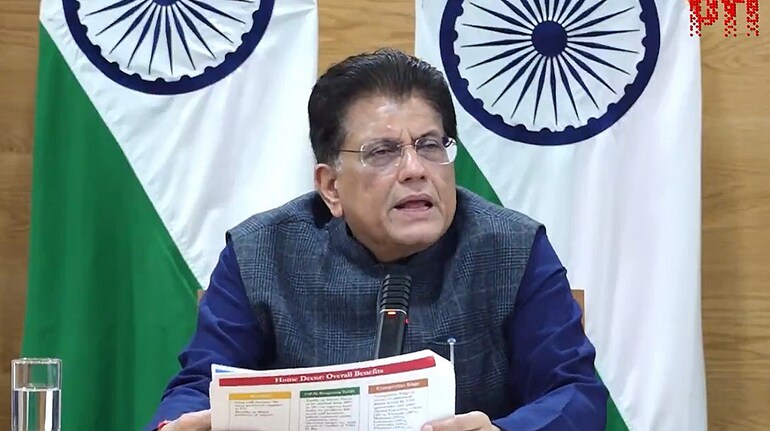

India on Saturday said that the interim trade agreement framework with the United States places strong emphasis on safeguarding domestic agriculture, with Commerce and Industry Minister Piyush Goyal stating that the interests of farmers have been fully protected under the proposed pact.
Apple imports and protection for domestic growers
Speaking on Saturday, Goyal said India has offered only a tightly controlled, quota-based duty concession on apples imported from the United States, while simultaneously strengthening protective barriers for domestic apple growers.
Under the proposed trade pact, apples from the US will attract a minimum import price of Rs 80 per kg along with an import duty of 25 per cent.
This pricing structure effectively blocks imports of US apples priced below Rs 100 per kg. At present, apples are subject to a higher import duty of 50 per cent with a minimum import price of Rs 50 per kg, which restricts imports below Rs 75 per kg.
“Our apple farmers are fully protected, and there is no need to worry,” Goyal told reporters, adding that India continues to meet a large part of its apple consumption through imports, which total around six lakh tonnes annually from multiple countries, including the US.
Scope of market access under the framework
Beyond apples, the government has said that the broader interim trade framework draws a clear line between limited market access and full protection for sensitive farm sectors.
Goyal said that while India has agreed to eliminate or reduce tariffs on a defined list of American agricultural items, no concessions have been extended on staples and livelihood-sensitive products.
Under the framework, the US may gain lower tariffs on products such as dried distillers’ grains for animal feed, red sorghum, tree nuts, select fresh and processed fruits, soybean oil, wine, and spirits.
However, the agreement explicitly excludes genetically modified crops and a wide range of core agricultural and dairy items.
Exports by Indian farmers and GM restrictions
“Agricultural products from Indian farmers will be exported to the United States at zero duty. At the same time, no tariff concessions have been granted for agricultural products from US farmers entering the Indian market,” Goyal said.
He further said that “the agreement also makes it clear that genetically modified (GM) food will not be allowed into India,” reflecting long-standing regulatory and safety concerns.
Sensitive sectors kept out of tariff concessions
According to the minister, sectors such as maize, rice, wheat, millets, ragi and soyabean, along with dairy products including milk, cheese, butter and yoghurt, remain completely outside the scope of tariff concessions.
Poultry, meat, ethanol, tobacco and certain vegetables have also been kept protected due to their direct link with small and marginal farmers.
In a social media post, Goyal said the framework “reflects India's commitment to safeguarding farmers' interests and sustaining rural livelihoods by completely protecting sensitive agricultural and dairy products.” He reiterated that these goods are considered sensitive precisely because they support millions of farming households.
'No concessions to sensitive agricultural sector'
“No concessions have been extended to sensitive agricultural sector produce in grains, fruits, vegetables, spices, oilseeds, dairy, poultry, and meat amongst many others,” the minister said, adding that this approach is consistent with India’s stance in other trade agreements as well.
Goyal said that agriculture in India is fundamentally a livelihood issue rather than a purely commercial activity. With more than half of the population dependent on farming and allied activities, import duties and regulatory controls remain critical policy tools.
Farmer interests at the centre of negotiations
“I can state categorically and without any hesitation that India's farmers, MSMEs, artisans, and craftsmen will not suffer any loss. On the contrary, India will benefit from greater access to the US market,” he said, while maintaining that farmer protection remains paramount.
Describing the framework as a turning point, Goyal said it offers “new hope, renewed enthusiasm, and fresh resolve” without compromising the core interests of Indian agriculture. He added that the interim agreement balances global trade engagement with domestic food security and rural stability, ensuring that sensitive farm sectors remain shielded even as India expands its export footprint.

Discover the latest Business News, Sensex, and Nifty updates. Obtain Personal Finance insights, tax queries, and expert opinions on Moneycontrol or download the Moneycontrol App to stay updated!
Find the best of Al News in one place, specially curated for you every weekend.
Stay on top of the latest tech trends and biggest startup news.