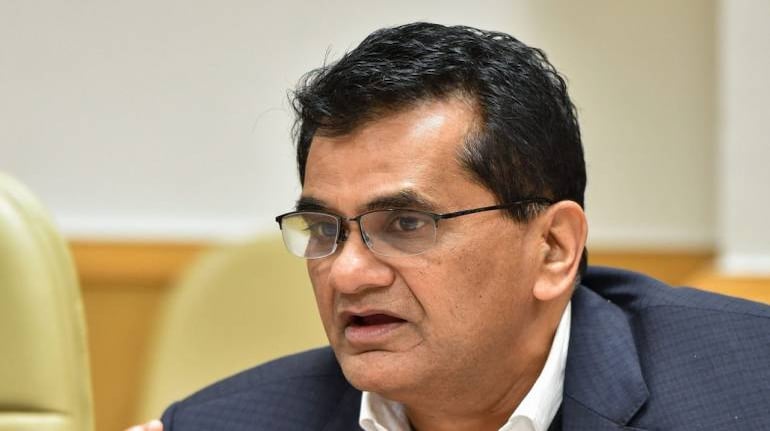
India is set to make the Public Distribution System location independent to ensure that no one, especially the inter-state migrants, is left behind, NITI Aayog CEO Amitabh Kant has said, citing the 'One Nation, One Card' initiative being implemented by the government as a transformative solution in response to the COVID-19 pandemic.
Addressing the special event on the Sustainable Development Goals (SDG) Acceleration Actions on the margins of 2020 High-Level Political Forum on Tuesday, Amitabh Kant said collective action through international cooperation is more relevant and important than ever before in these truly unprecedented times.
He told the session that the ‘One Nation, One Card' initiative is an example of a recent transformative solution by India presently being implemented as a response to the pandemic.
"The first half of 2020 has underscored the importance of responsive and adaptive policy making, more than ever before. When challenges are dynamic and unprecedented, peer learning and knowledge exchange are of utmost significance. We are deeply committed to foster this spirit and accelerate progress on the SDG targets by not only focusing on the recovery but by building back better for long term transformation," Kant said.
The ‘One Nation, One Card' initiative ensures right-based access to food supplies and covers over 800 million people at cost as low as 3-5 cents. He added that this is operationalised through beneficiary cards issued by the sub-national governments.
“By leveraging the technological capacity meticulously built over the last few years, India is all set to roll out interoperability in making access to the Public Distribution System location independent,” Kant said adding that it is a “momentous step to ensure that no one is left behind, especially the inter-state migrants.”
The COVID-19 pandemic has also highlighted the power of collectivised problem solving, he said.
Under the ‘One Nation-One Ration Card' initiative, eligible beneficiaries would be able to avail their entitled foodgrains under the National Food Security Act (NFSA) from any Fair Price Shop in the country using the same ration card. The Food Ministry aims to implement this facility across the country by March 2021.
Kant added that “invigorated and renewed synergy” between the government and the private sector has resulted in over 400,000 PPEs and 220,000 N-95 masks being manufactured in India, every day.
“In February this year, we were producing none. This aligns closely with our flagship 'Make in India' approach, through which we aim at becoming a globally competitive manufacturing hub,” he said.
Meanwhile, India on Monday presented its second Voluntary National Review (VNR) at the High-Level Political Forum.
India's VNR report titled ‘Decade of Action: Taking SDGs from Global to Local' highlights not only the country's progress on the SDGs, but also captures the inclusive and participatory process followed in its preparation.
Kant told the session that India is aggressively expanding its renewable energy programme, increasing the renewable energy capacity by 75 per cent since 2014 and aiming to achieve the ambitious target of 450 GW by 2030.
“We have made the global pledge, as part of our Nationally Determined Contributions, to have 40 per cent of cumulative electric power installed capacity from non-fossil fuel sources,” he said, adding that India's renewable energy sector has become a prime destination for global investors, with a potential to attract 10 billion dollars of annual investments.
In the global Ease of Doing Business rankings, India has jumped 79 places in the past five years: from 142 in 2014 to 62 in 2019.
“Our structural reforms in taxation, FDI regime, and insolvency and bankruptcy have contributed to this improvement,” he said.
Emphasising that 21st century challenges need 21st century solutions, Kant said the role of innovation is critical in designing solutions for SDG acceleration and building back better. Today, India is home to the third largest start-up ecosystem in the world, with the third largest number of unicorns.
“We firmly believe that these disruptions in the innovation and entrepreneurial ecosystem will accelerate our pace of achieving the SDGs,” he said.
He also pointed out that the government's Aspirational Districts Programme aims at accelerating transformative socio-economic improvement in 112 districts of the country with relatively greater development challenges.
By improving the lives of over 165 million citizens in these districts in terms of health, education, basic infrastructure, agriculture and water, and financial inclusion and skill development, the initiative highlights the efficacy of the cooperative and competitive federalism approach to development, he said.
“Sharing SDG acceleration actions and successes will be incomplete without discussing SDG localisation in India. Fostering sub-national peer-learning and competitiveness is the approach we took when we released the world's first government-led sub-national SDG Index in 2018,” he said.
Kant said the SDG India Index and Dashboard, which annually ranks Indian States based on their SDG performance, has reshaped the SDG framework adoption and localisation discourse in the country. It has resulted in sub-national entities instituting monitoring systems and preparing development strategies aligned to the goals of the 2030 Agenda, which are customised to the local and hyper-local context.
Discover the latest Business News, Sensex, and Nifty updates. Obtain Personal Finance insights, tax queries, and expert opinions on Moneycontrol or download the Moneycontrol App to stay updated!
Find the best of Al News in one place, specially curated for you every weekend.
Stay on top of the latest tech trends and biggest startup news.