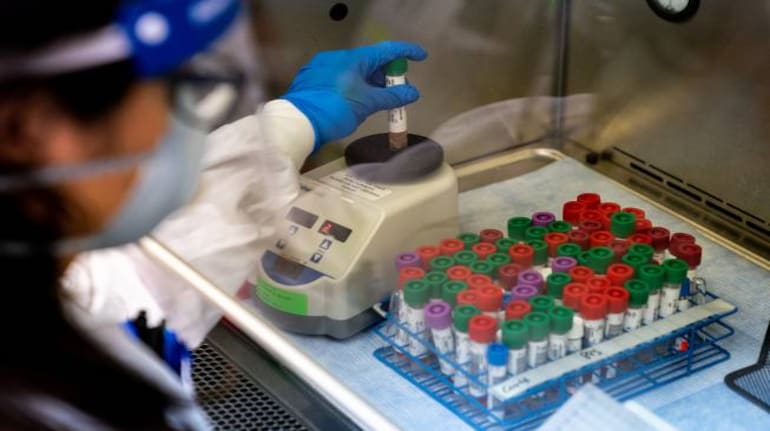
Researchers at the Indian Institute of Science (IISc), Bangalore, are working on rapid identification of COVID-19 biomarkers in blood plasma using Raman spectroscopy and artificial intelligence.
Raman Spectroscopy is a non-destructive chemical analysis technique which provides detailed information about chemical structure, phase and polymorphy, crystallinity and molecular interactions. It is based upon the interaction of light with the chemical bonds within a material.
According to the team, using artificial intelligence and deep learning, the COVID-19 detection process will be automated and rapid and there will be no requirement of any extraction procedure.
"It is of critical importance to develop new technologies that can rapidly detect COVID-19 and perform mass testing, and at the same are cost-effective. In this regard, Raman spectroscopy holds significant promise," according to Dipankar Nandi, Professor at IISc Bangalore and principal investigator of the project.
Follow our LIVE blog for the latest updates of the novel coronavirus pandemic
"Traditionally a chemist's tool, Raman spectroscopy has found numerous applications in biomedicine, especially in disease diagnosis. This method probes bond vibrations and is very sensitive to the structural changes, giving a molecular fingerprint of the sample. Every disease is associated with a change in biochemistry which can either be a cause for disease manifestation or may be a consequence of the disease itself," he added.
The research is being conducted in collaboration with AIIMS, Bhopal, which will be providing patient samples and healthy controls.
"Our proposal is directed at identifying COVID-19 biomarkers in the blood plasma of infected patients. No extraction procedure or reagents are required. The only requirement is a spectrometer and the patient samples. Using artificial intelligence and deep learning, the detection process will be automated and rapid. Spectra collected from infected COVID-19 patients and healthy controls will be used for training and building robust classification models," according to Nandi.
India's COVID-19 caseload rose to 96.44 lakh, while the total number of people who have recuperated from the disease crossed 91 lakh pushing the national recovery rate to 94.37 per cent, according to the Union Health Ministry data updated on Sunday.
The COVID-19 active caseload plunged to almost 4 lakh after 138 days.
The total coronavirus cases mounted to 96,44,222 with 36,011 new infections being reported in a day, while the death toll crossed to 1.40 lakh with 482 new fatalities, the data updated at 8 am showed.
Follow our full coverage of the coronavirus pandemic here.


Discover the latest Business News, Sensex, and Nifty updates. Obtain Personal Finance insights, tax queries, and expert opinions on Moneycontrol or download the Moneycontrol App to stay updated!
Find the best of Al News in one place, specially curated for you every weekend.
Stay on top of the latest tech trends and biggest startup news.