






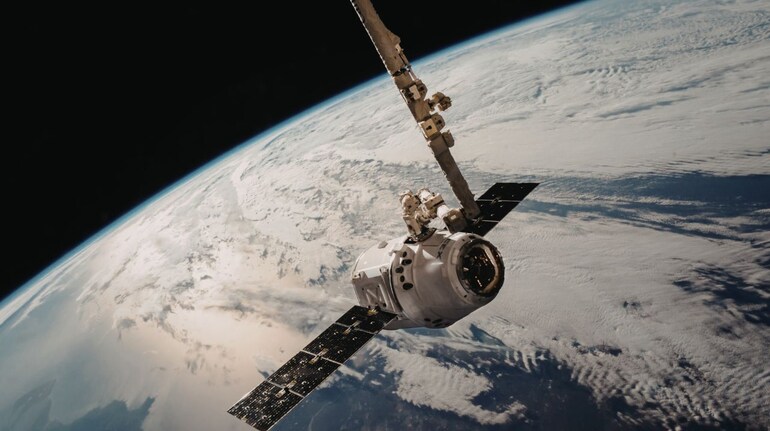
A new study warned on 2025-12-16 that satellite mega-constellations could fail within days if a powerful solar storm disrupts control systems, raising risks for Earth’s crowded low-Earth orbit.
Low-Earth orbit has become increasingly congested with active satellites. Data show two satellites pass within 1 kilometre every 22 seconds. Operators constantly guide spacecraft from Earth to prevent collisions. This careful balance depends on stable communication and navigation links.
Solar storms threaten satellite control systems
The paper was led by Sarah Thiele, a Princeton PhD student. Her team examined rare but dangerous system failure scenarios. The research focused on intense solar storm impacts. Universe Today reported the findings this week. Solar storms increase atmospheric drag on satellites. This drag can push spacecraft onto collision courses. Operators then must perform frequent avoidance manoeuvres.
The greater danger lies in disrupted control capabilities. Solar storms can damage navigation and communications networks. These systems are essential for satellite manoeuvring commands. Without them, operators may lose real-time control entirely.
Collision risks rise sharply in crowded orbit
Researchers introduced a new risk measure called the CRASH Clock. It stands for Collision Realization and Significant Harm. Using this metric, they modelled loss-of-control scenarios. If commands cannot be sent, collisions occur rapidly. The study found a catastrophic collision within about 2.8 days.
This estimate applies to conditions expected in June 2025. In 2018, the same window was 121 days. The shrinking timeframe reflects rising orbital congestion. Even a 24-hour control outage is dangerous. The study found a 30% collision probability. Such an event could trigger the Kessler Syndrome.
What a worst-case solar storm could mean
The Kessler Syndrome involves cascading debris collisions in orbit. Debris clouds could make satellite operations impossible. New launches would also become unsafe. Researchers stressed that storm response requires constant, real-time action. If systems fail, recovery time becomes extremely limited.
The paper also examined a Carrington-scale solar storm. The 1859 event remains the strongest recorded historically. Researchers said such a storm would overwhelm controls. Humans could lose satellite command for over three days. This scenario could wipe out much of today’s satellite infrastructure.
Discover the latest Business News, Sensex, and Nifty updates. Obtain Personal Finance insights, tax queries, and expert opinions on Moneycontrol or download the Moneycontrol App to stay updated!
Find the best of Al News in one place, specially curated for you every weekend.
Stay on top of the latest tech trends and biggest startup news.




