






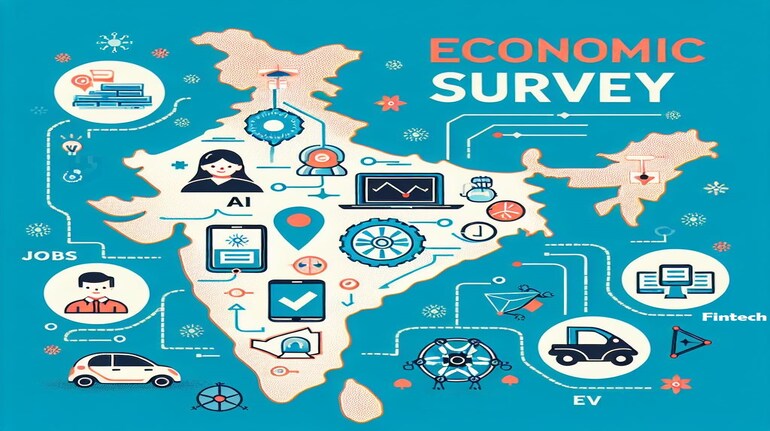

The Economic Survey 2026, for the first time, has classified digital addiction as a national public‑health concern, grouping it with obesity and non-communicable diseases (NCDs) that require urgent policy action.
The survey, released on January 29, warns that India is witnessing a surge in behavioural‑health risks linked to excessive screen time, social‑media overuse and technology‑driven compulsions, especially among adolescents, potentially altering the trajectory of its human capital.
While acknowledging India’s rapid ascent as a digital economy, which now contributes nearly 12 percent to its national income, the government is sounding an unprecedented alarm over the "behavioural risks" of pervasive connectivity.
Toll on human capital
The survey presents a stark dichotomy between physical and mental health challenges facing the nation’s youth. "While obesity and inadequate nutrition threaten the physical health of youth, digital addiction undermines their cognitive and social development." The report details how excessive screen time is triggering a "mental health erosion," characterised by sleep disruption, mood swings, and a decline in attention spans.
Beyond the psychological impact, there is an emerging phenomenon of "social distancing" in India’s most digitally advanced states such as Kerala and Tamil Nadu. The government warns that high-density online networks are often masking a profound decline in real-world social connections, potentially hollowing out the social fabric required for a cohesive economy.
The GenAI trap and productivity risks
A significant portion of the government’s concern is directed at the double-edged sword of artificial intelligence (AI). While India positions itself as a global hub for AI development, the survey cautions against the "widespread use of Generative AI by students as a substitute for creative and critical thinking," arguing that such reliance "ultimately does more harm than good in the long run".
By offloading core analytical tasks to language models, the survey suggests the workforce of the future may suffer from diminished problem-solving capabilities. When combined with "anxiety and depression inducing social media usage", the government fears a permanent dip in national productivity. The report describes this as a "digital overload" that threatens to supplant human intelligence rather than supplement it, unless urgent corrective measures are taken.
Digital rebalance
To mitigate these risks, the government is proposing a strategic "rebalancing" rather than a rejection of technology. The survey emphasises that "India’s challenge is to rebalance youth engagement by combining restrictive safeguards with positive offline opportunities and not to demonise technology." Central to this strategy is the introduction of a mandatory "Digital Wellness Curriculum" in schools to teach screen-time literacy and cyber safety.
The report also calls for the creation of physical "Youth Hubs" in urban and rural areas to provide healthy offline alternatives to the digital world. More formal interventions include a proposed "AI Economic Council" to calibrate the pace of automation and the promotion of "technology-free zones" in workplaces. By scaling back digital dependence in education and encouraging "digital detox" centers, the government aims to ensure that India’s path to a $5 trillion economy remains mentally and socially sustainable.
"The Economic Survey 2026 underscores an emerging human capital risk—digital addiction. Excessive screen time, driven by algorithm-led engagement and always-on connectivity, is reshaping behaviour, mental health and productivity, especially among children and young adults," said Nilesh Maheshwari, Partner - Health Transformation, Grant Thornton Bharat.
"What began as digital inclusion is now tipping into overconsumption, affecting attention spans, learning outcomes and workforce efficiency. Left unaddressed, digital addiction could dilute India’s demographic dividend," Maheshwari added.

Discover the latest Business News, Sensex, and Nifty updates. Obtain Personal Finance insights, tax queries, and expert opinions on Moneycontrol or download the Moneycontrol App to stay updated!
Find the best of Al News in one place, specially curated for you every weekend.
Stay on top of the latest tech trends and biggest startup news.





