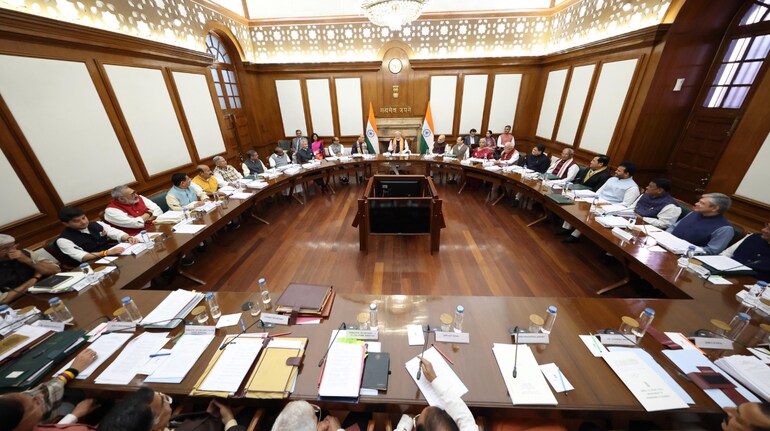

The Union Cabinet, chaired by Prime Minister Narendra Modi, has cleared the launch of the Urban Challenge Fund (UCF), a major new financing mechanism aimed at reshaping how India builds and upgrades its cities. With a central outlay of Rs 1 lakh crore over five years, the initiative is expected to unlock a total urban investment of Rs 4 lakh crore by 2031.
Here’s how it will function:
A shift in how cities are financed
The government has described the UCF as a turning point in urban policy, calling it a “paradigm shift in India's urban development approach from grant-based financing to market-linked, reform-driven and outcome-oriented infrastructure creation.”
Instead of cities depending primarily on direct government grants, the new framework requires them to tap into market sources. To qualify for central support, at least 50 per cent of a project’s cost must be mobilised through avenues such as municipal bonds, bank loans, or public-private partnerships. The Centre will then contribute 25 per cent of the total project cost, while the remaining share can be met by states, Union Territories, Urban Local Bodies (ULBs), or other sources.
The scheme will run from FY 2025-26 to FY 2030-31, with a possible extension until FY 2033-34.
How projects will be chosen
Funding will not be automatic. Instead, cities will compete for support under a challenge-based model. According to the government, proposals will be assessed through a framework that prioritises “high-impact and reform-oriented proposals.”
Projects will also be judged on their ability to deliver “transformative outcomes -- economic, social and climate, including revenue mobilisation, private investment, job creation, improved safety, inclusiveness, service equity and cleanliness.”
Money will be released in phases, linked to reform milestones and performance benchmarks.
Which cities are eligible
The fund will cover cities with populations of 10 lakh or more (based on 2025 estimates), all state and Union Territory capitals that do not fall in that category, and major industrial cities with populations of 1 lakh or more.
In principle, the government has indicated that all cities will be covered under the UCF. Additionally, all ULBs in hilly and northeastern states, as well as smaller ULBs with populations below 1 lakh, can access support through a dedicated credit mechanism.
Support for smaller and first-time borrowers
To enable smaller towns and cities to enter the market for the first time, a separate Rs 5,000 crore Credit Repayment Guarantee Scheme has been approved. This is intended to “facilitate first-time access to market finance for all Cities/ULBs in Northeastern & Hilly States and smaller ULBs.”
Under this arrangement, the Centre will provide a guarantee of up to Rs 7 crore or 70 per cent of the loan amount, whichever is lower, for the first borrowing. After successful repayment, a guarantee of Rs 7 crore or 50 per cent of the loan amount, whichever is lower, will be available for subsequent loans.
What the fund will focus on
The UCF is aligned with the government’s vision announced in Budget 2025-26 to position cities as growth hubs. It will prioritise economic clusters, creative redevelopment of city areas, including heritage zones, and improvements in water and sanitation systems.
The broader goal, as outlined by the government, is to “leverage market finance, private participation and citizen-centric reforms for delivery of high-quality urban infrastructure” and to build cities that are resilient, productive, and responsive to climate challenges.
(With inputs from agencies)
Discover the latest Business News, Sensex, and Nifty updates. Obtain Personal Finance insights, tax queries, and expert opinions on Moneycontrol or download the Moneycontrol App to stay updated!
Find the best of Al News in one place, specially curated for you every weekend.
Stay on top of the latest tech trends and biggest startup news.