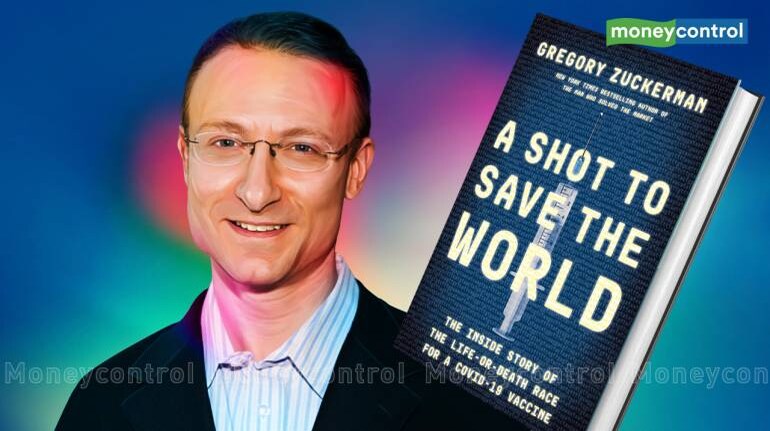
Gregory Zuckerman, bestselling author and special writer at The Wall Street Journal, started to write his book A Shot to Save the World to beat the gloom. The world was deep into the battle against the pandemic and Zuckerman was impatient to get a peek at how it would end. That’s how he started researching vaccine development and reaching out to the people at the forefront of this effort.
In an interview given to Moneycontrol, he tells us how the writing of this book introduced him to unusual courage and an inspiring history. What surprised you, when you met the scientists?I had expected the vaccine giants to be leading the chase (for vaccine development). That's Sanofi, GSK, Merck, those are the companies that have developed most of the vaccines that we all rely on. Instead, the companies and the researchers that were at the front of the chase were companies that had never produced anything in history before this, like Moderna, BioNTech, The University of Oxford. These were all organisations that didn't have a vaccine, didn't have a drug, didn't have anything that was successful that they could point to. So, instead of the expected saviours, there was this group… that really surprised me.Read also: Government tells syringe makers to put supplies on hold as demand for vaccine shots falls
Why didn’t the big names go after it?Until 2020, vaccine development was not an area that big companies wanted to focus on. It's hard to imagine that (now) but it (vaccine development) wasn't something sexy, wasn't something very profitable. If you think about it, vaccines are given once a year or once a lifetime… not very frequently. There’s only so much (profit) you can make by selling vaccines.That's part of the reason why the giants weren't the ones who saved us. It was a group of really unexpected characters who did.What is the update on these new companies? How have their trajectories changed after the vaccine development? So Moderna, BioNTech, Novavax, The University of Oxford… they have all produced really successful COVID vaccines. They have taken the profits from those efforts, and now they're focusing on new areas. Some are working on vaccines for different viruses, others are even more ambitious, like BioNTech is focusing on cancer, then Johnson & Johnson and its partners are very much focused on AIDS.We are in a new era of vaccine development. I’m very optimistic that some of these same success stories that we've seen with COVID-19, we'll see in other areas.
Why do you think investors–who were earlier hesitant to back vaccine development because of the weak profits–would be interested now? Partly because all the money that these companies have made came from these vaccines. Therefore, there’s new interest in mRNA. mRNA, which is the approach behind both the Pfizer vaccine and Moderna vaccine, has saved millions of lives. Until 2020, there was optimism about mRNA, but there was never any proof. There was never any evidence that it could save lives. Now we have that evidence. So, researchers from all over the world, and investors from all over the world have new confidence in mRNA. It may not work, but because of the success from COVID-19, there's a new enthusiasm and there's more support for mRNA.Read also: China developing an mRNA vaccine, and it is showing early promise
You've written that Drew Weissman, who was behind the development of mRNA vaccine technology, is working to develop a shot that could be effective against all future variants of Covid-19. How far has he progressed?So, Drew is making progress, but it's still early. I think it's Phase 1. So, we're still many months if not several years away, but he's not the only one. There are others that are working on what we call second or third-generation COVID vaccines, and I really do think they'll be successful. I think, in a few years, we will go into our doctor's offices and get a vaccine that will protect us from all Coronaviruses and they may even be able to roll it into a flu vaccine. So, you get one vaccine and it takes care of both Coronavirus and the flu.
What do the scientists and academicians who worked in vaccine development say about vaccine hesitancy?They are discouraged, because they went all out to save lives and they've been able to save lives and they have one of history's most effective vaccines. These vaccines are really modern science’s greatest accomplishment. Yet, in the United States, a good 20% to 25% of the population still won't take these vaccines. For some reason, they are eager to take drugs that have not been tested or not been tested well enough. What aspect of vaccine development do regular people fail to appreciate? People appreciate the hard work that went into these vaccines but most people assume these vaccines were created quickly, in 2020. But my book is about the many years of work, in fact decades of work that went into these vaccine approaches. They weren't thrown together, haphazardly, they didn't cut corners. They didn't take chances with people's lives. So, when people understand the long history of the research, they're reassured and realise that these vaccines are much safer than they had imagined. Do you think this aspect has not been communicated effectively to the people? Is that a reason for vaccine hesitancy?I do think that's a problem. It’s a mistake, frankly, on the part of governments that they have talked about the evidence and the data. They should be emphasising the people instead. That’s what I try to do. When you understand who the people are behind these vaccines, that they are serious researchers and not political people, that they are trying to help, that they are courageous… It could be reassuring, that there are heroes behind these vaccines. I wish governments around the world would emphasise who created these vaccines, the career risks they took, and the hard work, creativity and the resilience that went into these vaccines for years.When you were reporting, how much were you influenced by the Theranos scandal? Because, as you've written, Elizabeth Holmes and Moderna’s Stephane Bancel, have very similar personalities.That they had the same kind of secrecy around the product development?Yes, for years, people were skeptical of Stephane Bancel, the CEO of Moderna. They thought he was a fraud, they accused him of being like Elizabeth Holmes, the founder of Theranos. And there were similarities, they both are really good fundraisers, they're both very persuasive. Neither of them are scientists themselves. They both raised a lot of money, billions of dollars from investors. Moderna, just like Theranos, wasn't very transparent and open with its data with its research. Now if you ask the people at Moderna, they'll say we couldn't be transparent, that they didn’t want to share fearing competition. But Bancel was met with scepticism. However, in the end, Moderna had an approach that worked. They showed it to everybody. They published papers, there were conferences held… eventually Moderna did become more transparent. What made you choose the companies that you did, for your book?I decided based on the data on the effectiveness. I was always a little bit sceptical of DNA vaccines. There's another company that does that. So, I was a little worried and didn't think that it would be successful. But I also spent some time with companies that turned out to be failures (and therefore weren’t included in the book). I just decided to let the data dictate who I was going to write about. When the data showed that Moderna, BioNTech, Pfizer, Oxford, J&J and Novavax were going to be the success stories, I decided to focus on them.What did you think about Bharat Biotech’s vaccine effort (which isn’t included in the book) then?Oh, there's a lot of excitement, there’s a lot of hope (in that). It’s not one that the West is going to rely on or has relied on. So, it’s not one that I was very focused on. But people are aware of vaccine technology in India. Serum Institute of India, in particular, is world famous.Did your research decide the shot you took?Well, my research made me comfortable with all the vaccines that have been authorised in the West. So, I frankly went to my local provider and said give me whatever you have. I ended up taking the Pfizer shot because it was available at the time. If I was in another country, I might have been comfortable with both Serum’s (Covishield) and Bharat Biotech’s Covaxin, and others that have been approved in India. I don’t think I’d be as comfortable with the Russian or the Chinese vaccines. They’re just not as effective. There isn’t as much data (to prove effectiveness).Discover the latest Business News, Sensex, and Nifty updates. Obtain Personal Finance insights, tax queries, and expert opinions on Moneycontrol or download the Moneycontrol App to stay updated!
Find the best of Al News in one place, specially curated for you every weekend.
Stay on top of the latest tech trends and biggest startup news.