
Institutional participation is gaining ground in India’s crypto markets, as investments on CoinDCX, CoinSwitch, ZebPay and Mudrex rose more than 30-50 percent year-on-year in 2025, accounting for a significant share of trading volumes on these exchanges.
While Indian institutional crypto traders are gaining confidence in the sector, they have outpaced growth as compared to global exchanges such as Binance, which witnessed a 14 percent increase in institutional users globally.
How have India’s top exchanges fared?Institutional investors in this context refer to high net worth individuals (HNIs), ultra HNIs, family offices and companies.
To be sure, SEBI-regulated investment institutions have stayed away from crypto exposure amid regulatory uncertainty in the country, industry sources said.
Among top crypto exchanges, CoinSwitch has seen the most movement in institutional participation, seeing 93.23 percent uptick compared to 2024.
CoinDCX said close to half of their trading volumes come from their VIP Prime user base of over 3,500 including HNIs, family offices, and institutions – each doing Rs 50 lakh or more in monthly spot volumes. Overall, the exchange’s institutional and family office base grew 50 percent YoY.
Mudrex now gets almost one-third of its trading volumes from institutional activity, which has grown by about 25–30 per cent year-on-year. These investments are being pegged less as short-term speculative bets and more as a portfolio diversifier within a structured allocation framework.
In comparison, Binance, world’s largest crypto exchange, saw a 14 per cent increase in institutional users globally and a 13 per cent rise in institutional trading volume compared to last year. To that extent, India outperformed global market trends.
As of today, Binance has over 200 public companies holding Bitcoin on their balance sheets, signaling growing confidence in VDA (virtual digital assets) as a means of diversification and long-term value preservation.
How much is their overall crypto exposure?Most of these institutions have kept their crypto exposure limited to 2-5 per cent of their overall portfolio, given that the Indian crypto adoption is still at nascent stages.
Globally, institutional benchmarks are more mature. Around 55 per cent of hedge funds now hold crypto, with an average allocation of approximately 7 per cent, and a majority indicating plans to increase exposure over time, shared Sumit Gupta, Co-founder and CEO, CoinDCX.
“This contrast highlights the headroom for growth in India. With clearer regulations and a more balanced tax framework, domestic institutional allocations are well positioned to move closer to global norms in the coming years,” he said.
According to Edul Patel, CEO, Mudrex, ultimately this reflects a disciplined risk management mindset, as institutions take into account the inherent volatility of digital assets while also recognising their potential role as a long-term diversifier within a broader portfolio strategy.
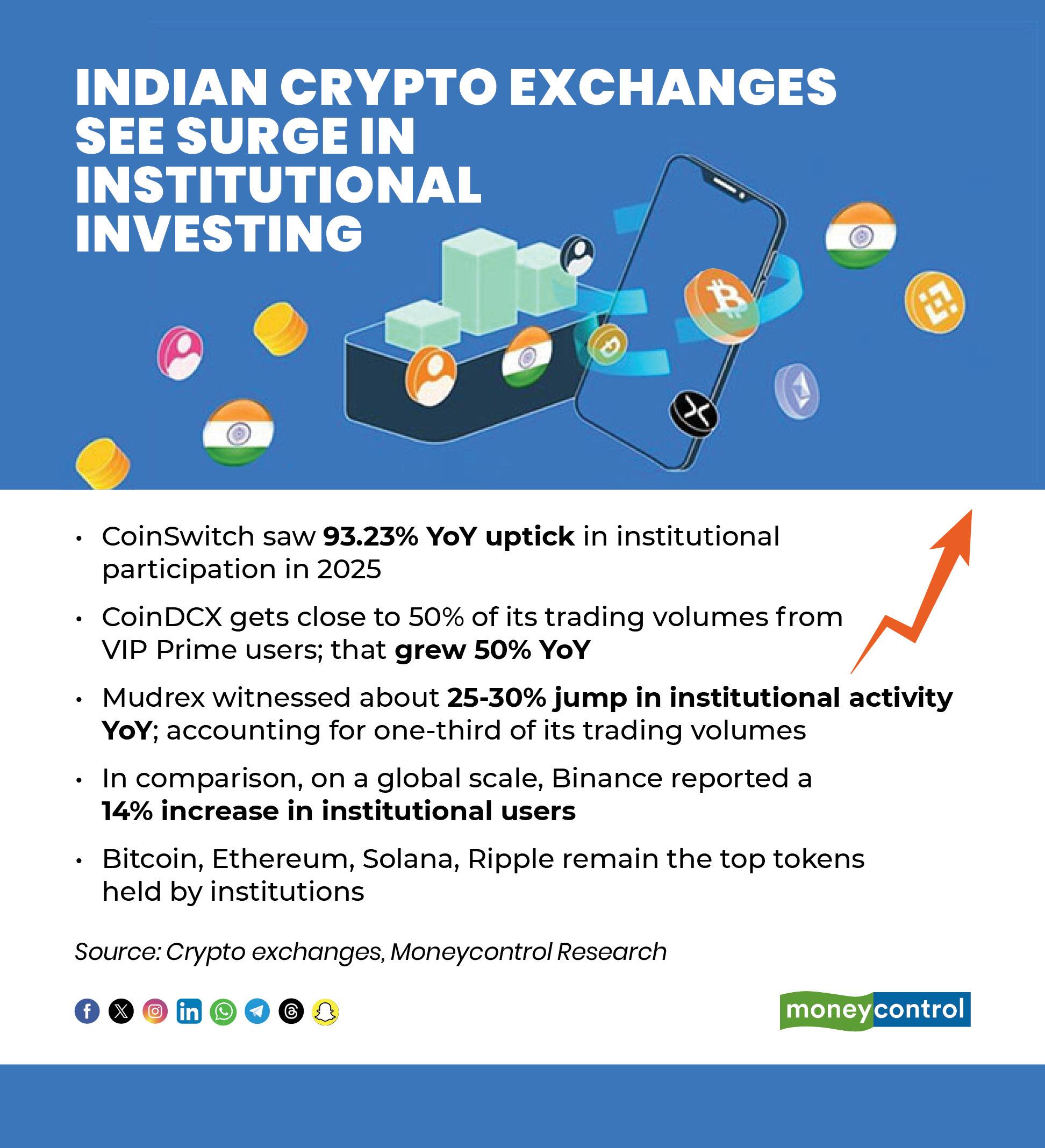
Institutional crypto investors in India have remained focused on blue chip and high-liquidity coins including Bitcoin, Ethereum, Solana, and Ripple.
On Mudrex, Bitcoin, Ethereum, and Solana together accounted for close to 70 per cent of overall institutional activity, both in terms of holdings and trading volumes.
Ashish Singhal, Co-founder and CEO, CoinSwitch said, “These preferences showcase a disciplined institutional approach, with portfolios anchored in proven assets while maintaining flexibility to scale exposure as regulatory clarity and market maturity continue to improve.”
These trends reflect shifting strategies, as institutions opt for assets with strong network fundamentals, liquidity, and long-term utility.
While India still has limited access to various crypto investment instruments, globally institutional investors are going beyond portfolio diversification to include stablecoins as well, as they are increasingly being used for settlement, liquidity management, and treasury operations rather than purely for trading.
Exchanges like Binance are also building institutional-grade VDA infrastructure that enables OTC (over the counter) and execution services for trading, custody, and most recently Crypto-as-a-Service - to help bridge traditional finance and digital assets in a way that is scalable and compliant, SB Seker, Head of APAC, Binance told Moneycontrol.
What factors are driving this trend?Regulatory clarity has historically remained the biggest concern for the crypto industry around the world. But, 2025 brought some certainty to this regulatory maneuvering, at least within the most critical markets.
“The sentiment began to improve in 2025 as global regulatory frameworks started taking clearer shape. Developments such as the GENIUS Act in the US, the EU’s MiCA framework, and progress in various other jurisdictions have signalled a more structured and pragmatic approach to digital assets,” said Mudrex’s Patel.
This, in turn, has improved institutional confidence that India could also move towards greater regulatory clarity over time.
Beyond this, developments such as the increasing institutionalisation of crypto through spot ETFs, sustained participation by global players like BlackRock and Grayscale, and balance-sheet allocations by companies such as Strategy (formerly MicroStrategy) have contributed to a broader sense of legitimacy, said Raj Karkara, COO, ZebPay.
Karkara added, “Consequently, in 2025, we’ve seen Indian HNIs and family offices not only maintain their exposure but actively enhance their holdings, reflecting a shift from opportunistic trading to strategic allocation.”
According to Gupta, this year institutions have stopped asking whether crypto deserves a place in the portfolio and started asking “what that place should be”.
“If I compare 2025 with 2024, the change in institutional participation is very visible. Last year, institutions were present, but the intent was still cautious. Most participation was around specific market moves. Crypto was being traded, not really allocated to,” he said.
“While the market has historically been retail-driven, 2025 has clearly marked the beginning of meaningful institutional adoption,” Singhal added.
Where is institutional crypto investing headed in 2026?In 2026, Binance’s Seker is expecting this trend to accelerate as corporate treasuries diversify beyond Bitcoin and Ethereum into select altcoins, and as governments and public institutions engage more actively through regulatory frameworks and pilot programs.
“While adoption is still at an early stage relative to global capital markets, the pace of institutional engagement is clearly accelerating,” said Seker.
Institutional adoption is expected to further mature as regulatory frameworks take shape, ETFs and tokenised products expand, and digital assets become more embedded in core financial workflows.
ZebPay’s Karkara expects institutional participation in crypto will move into the next phase of strategic integration with broader financial markets in 2026.
“The rise of real-world asset (RWA) tokenisation will continue, where traditional assets such as treasuries, bonds, and real estate will now be brought on-chain, unlocking new liquidity and familiar investment structures for institutions,” he said.
Rightly so, as India is now preparing for the first phase of Nandan Nilekani’s Finternet focused on tokenisation of RWA to launch in 2026.
Earlier this week, Member of Parliament Raghav Chadha urged the government for a Tokenisation Bill comparing RWA tokenisation to being the next UPI moment for India.



Discover the latest Business News, Sensex, and Nifty updates. Obtain Personal Finance insights, tax queries, and expert opinions on Moneycontrol or download the Moneycontrol App to stay updated!

| 1W returns-0.04% |
| 1W returns-1.82% |
| 1W returns-1.98% |
| 1W returns-3.33% |
| 1W returns-5.66% |
| 1W returns-8.07% |
| 1W returns-11.69% |
Find the best of Al News in one place, specially curated for you every weekend.
Stay on top of the latest tech trends and biggest startup news.