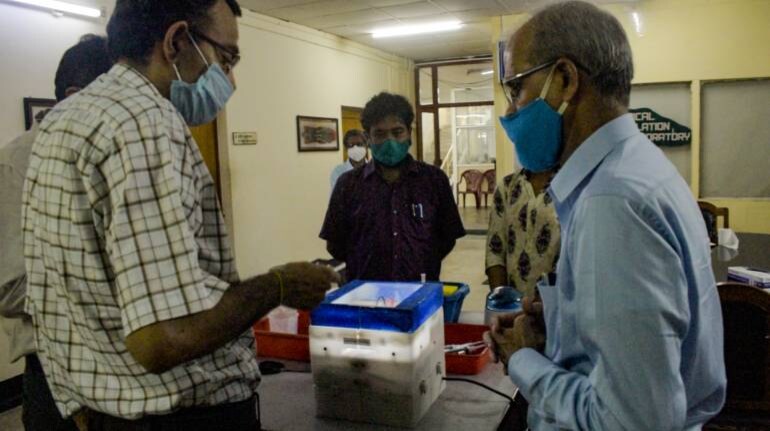
Researchers at Indian Institute of Technology (IIT) Kharagpur have announced that they have developed a novel technology for COVID-19 rapid test. The rapid test can be conducted in an ultra-low-cost portable device with the test results available in a smartphone application for dissemination within one hour. All of this at a cost of Rs 400 per test.
IIT-Kharagpur said the device would bring the testing for COVID-19 out from the walls of expensive laboratories and RT-PCR machines and enable testing at affordable costs.
The equipment developed by teams from Microfluidic Lab and School of Bioscience at IIT-Kharagpur will cost about Rs 2,000 on a pilot scale, compared to the RT PCR machine costing Rs 15 Lakh. The cost of the machine will further reduce with increase in the production scale. IIT-Kharagpur said it has filed the patents for the testing device. The paper-based microfluidic method is now being used in detecting HIV and Malaria.
How does it work?The equipment comes as a small box, about the size of a portable inkjet printer. The device has an automated pre-programmable temperature control unit. A special detection unit on genomic analysis and a customised smart phone application to read the result. But the core-part of the testing is the use of a disposable paper-strip for chemical analysis and visualization of results.
For that, the DNA of the virus is mixed with chemicals on a strip of paper. When the chemicals come in contact with the DNA, the reaction determines whether a sample is positive or negative. The disposable paper-strip records the results of the test, which can be read using a mobile phone app that the team developed. After feeding the sample to the machine, it takes about one hour to throw the result. The machine allows us to test three-10 samples at a time.
How exactly is IIT device different from an RT-PCR machine?The reverse transcription polymerase chain reaction (RT-PCR) machine is a gold standard for testing COVID-19 due to its high sensitivity. RT-PCR uses complex thermal cycling processes and optical systems to identify the coronaviruses. Thermal cycling is used to amplify DNA samples. They are expensive and need laboratory setup, that's probably the reason why scaling up testing is becoming a problem.
The IIT-Kharagpur device uses thermal unit and paper-based microfluidic biosensor to detect the virus. To be sure, the steps such as sample collection using nasal swab, handling the sample and processing remains the same.
Is the machine validatedIIT-Kharagpur researchers said the results from this new technology have been strictly validated by following all established laboratory controls against the benchmarked results obtained from RT-PCR machine, using synthetic viral RNA.
The synthetic RNA is exactly the same replicate of the viral RNA extracted from infected patients, as per accepted scientific benchmarking procedure, and is used for validating laboratory tests to avoid undue contamination and danger due to spreading of infection while handling sensitive body-fluid samples. IIT-Kharagpur researchers said they will be approaching the government and ICMR to validate the machine.
Is it scalable?IIT Kharagpur researchers say that while the institute can produce the testing kit up to a certain scale, producing at mass scale would require commercial partners. The institute said it was ready to facilitate technology transfer to medical technology companies, who are willing to come forward.

Discover the latest Business News, Sensex, and Nifty updates. Obtain Personal Finance insights, tax queries, and expert opinions on Moneycontrol or download the Moneycontrol App to stay updated!
Find the best of Al News in one place, specially curated for you every weekend.
Stay on top of the latest tech trends and biggest startup news.