






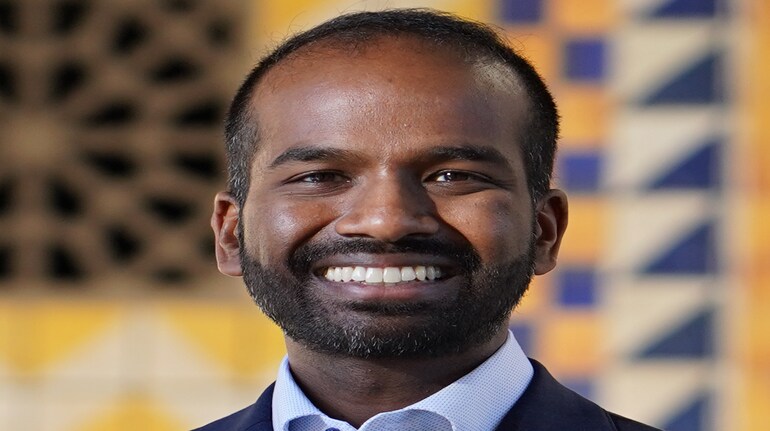

When Bill Gates visited Professor Karthish Manthiram’s lab at Caltech, it was not a courtesy stop or a celebrity cameo. The Infosys Prize 2025 laureate in Physical Sciences said the Microsoft co-founder had done his homework, and came in looking for answers on what the science could realistically change in the world.
“Bill Gates… is a deep reader,” Manthiram told Moneycontrol, adding that Gates “came across our work, read about it, asked to come visit our lab when he came to Caltech (University).”
Manthiram won the Infosys Prize 2025 in Physical Sciences for his breakthroughs in “lithium-mediated ammonia synthesis and oxygen-atom transfer catalysis,” showing how renewable electricity can drive the production of essential chemicals.
Manthiram said Gates was interested in how electrified chemical manufacturing could scale, and offered direct, hard-nosed feedback. “He wanted to understand how what we were developing could change the world. And he had very critical feedback for us,” he said.
At the heart of the conversation was one of the toughest decarbonisation challenges: ammonia, a chemical that powers global agriculture through fertilisers, but is also foundational to a long list of industrial products.
Rethinking a century-old chemical backbone
Ammonia production today is dominated by the Haber-Bosch process, a near century-old method that transformed fertiliser supply and helped drive global agricultural productivity. But Manthiram pointed out that the emissions footprint of the process has become a central problem in a warming world.
“What we know now… is the way that CO2 drives global warming,” he said, explaining why his group has been “figuring out ways that we can sustainably make ammonia without needing hydrocarbons, in which case we can eliminate the CO2 footprint.”
His lab’s approach replaces high heat and high pressure with an “electrically powered method” of converting air and water into ammonia, he said.
That shift is not just about emissions. It could also change how chemical manufacturing is organised.
Gates’ signal: “a clear future” for electrified ammonia
For Gates, the direction of travel seemed clear. Manthiram said one of the most important takeaways from the visit was Gates’ conviction about where the technology could go.
“He is very excited about the technologies that we’re developing. He sees a clear future for electrified ammonia production,” Manthiram said.
But Gates’ interest came with a blunt framework for prioritisation. Manthiram said Gates urged the team to evaluate problems through an outcome-first lens. They should think in terms of “how many deaths are avoided,” and whether a technology “can maximise the number of deaths that can be avoided per dollar that is spent.”
Manthiram said that perspective is shaping how his lab chooses the next set of research problems “that will take us through the next decade.”
Still a few years away
Despite the promise, Manthiram was careful not to oversell timelines. On commercial viability, he said the ammonia technology is “still a few years away” from the stage where he would “seriously go down the path of commercialising.”
The key challenge, he said, is stability. “We need a reactor that works not just for 10s and hundreds of hours, but that can work for thousands of hours,” he said.
That long runway from lab success to real-world impact is also where many deep-tech ideas stall. As Infosys co-founder and Infosys Science Foundation trustee Kris Gopalakrishnan put it while discussing the innovation pipeline, “So between 3 and 4 to 7 is called the Valley of Death because there’s nobody funding that.”
Discover the latest Business News, Sensex, and Nifty updates. Obtain Personal Finance insights, tax queries, and expert opinions on Moneycontrol or download the Moneycontrol App to stay updated!
Find the best of Al News in one place, specially curated for you every weekend.
Stay on top of the latest tech trends and biggest startup news.





