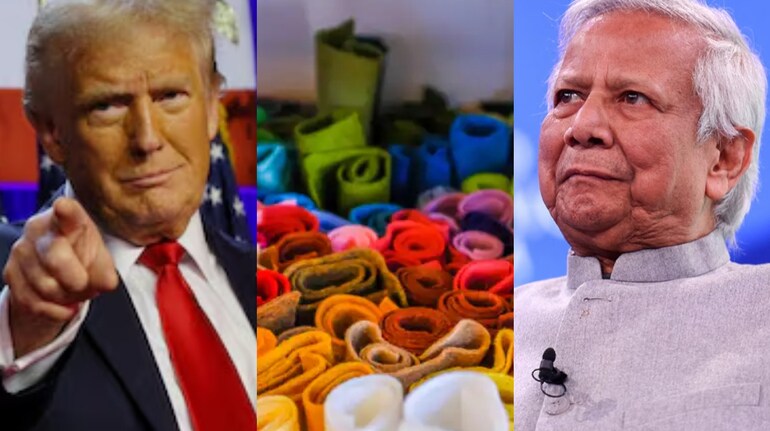

Bangladesh’s zero-duty window for garments made with cotton or man-made fibre sourced from the US may appear to give it an edge over rival nations such as India in the American market.
But a closer look at tariff structures and Bangladesh’s supply chains tells a different story.
Under an agreement between the US and Bangladesh finalised on February 9, Washington agreed to reduce its reciprocal tariff on goods from Bangladesh to 19 per cent and to offer zero-duty entry for garments made with US-origin cotton and man-made fibres.
However, a critical point is that removing or lowering reciprocal tariffs does not eliminate the MFN (Most Favoured Nation) duties that the US levies on countries.
Bangladeshi garments entering the US typically face a 12 percent MFN tariff. That baseline duty continues to apply, along with lower reciprocal duties of 19 percent under the new arrangement.
Thanks to the agreement, Bangladeshi garments made with US-origin cotton or man-made fibres will avoid the 19 percent reciprocal component and pay only the 12 percent MFN tariff.
This means a standard Bangladeshi garment now attracts a total duty of 31 percent. For India, the tariff math works out to about 30 percent once the interim deal with the US is signed.
To be sure, the arrangement could still give Bangladesh a limited edge given that the overall gap in reciprocal tariffs with India is just one percentage point.
Also, India has not secured a conditional zero-reciprocal-duty window for garments made with US cotton and man-made fibres.
Some experts note that this could provide a pricing cushion in segments where US cotton is already used or where buyers are willing to adjust sourcing.
However, the return on investment from zero-duty access for Bangladeshi garments made with US cotton is likely to be limited, given the South Asian nation’s sourcing patterns.
In 2024, Bangladesh exported $50.9 billion worth of garments globally, compared to India’s $16.3 billion.
However, only $7.4 billion of Bangladesh’s garment exports went to the US. More than 63 percent, or $32.3 billion, went to the European Union, where garments already enter duty-free, with no sourcing conditions.
Bangladesh’s garment supply chains are therefore structured primarily around European buyers, not US-linked sourcing requirements.
The input structure further complicates matters. In 2024, Bangladesh imported $16.1 billion worth of textile inputs. China supplied about $9 billion, India $3.1 billion, while the United States supplied just $274 million.
At the product level, the mismatch becomes clearer.
Bangladesh imported $2.5 billion worth of cotton fibre, with India and Brazil as the largest suppliers, while US cotton accounted for only $255 million.
Imports of cotton yarn totalled $1.8 billion, of which India alone supplied $1.6 billion. For woven synthetic filament fabrics, a key input in garment manufacturing, China supplied $1.1 billion out of $1.4 billion in total imports.
In woven cotton fabrics, China supplied $601 million and India $194 million.
Overall, less than one-third of Bangladesh’s garments are made starting from fibre. Most are produced using imported yarn and fabric, according to calculations by the Global Trade Research Initiative (GTRI).
This is crucial since the United States primarily supplies raw cotton, not the yarns and fabrics that form the backbone of Bangladesh’s garment production.
To meaningfully use the zero-reciprocal-duty window, Bangladesh would need to reconfigure long-standing supplier relationships and invest in significant new spinning and fabric-processing capacity, which could involve substantial costs.
Given that the European Union already offers unconditional duty-free access and absorbs nearly two-thirds of Bangladesh’s garment exports, the incentive to restructure supply chains primarily to serve the US market appears limited.
As a result, the concession may lead to only limited growth in Bangladesh’s garment exports to the United States, while US cotton exporters stand to benefit more.
Discover the latest Business News, Sensex, and Nifty updates. Obtain Personal Finance insights, tax queries, and expert opinions on Moneycontrol or download the Moneycontrol App to stay updated!
Find the best of Al News in one place, specially curated for you every weekend.
Stay on top of the latest tech trends and biggest startup news.