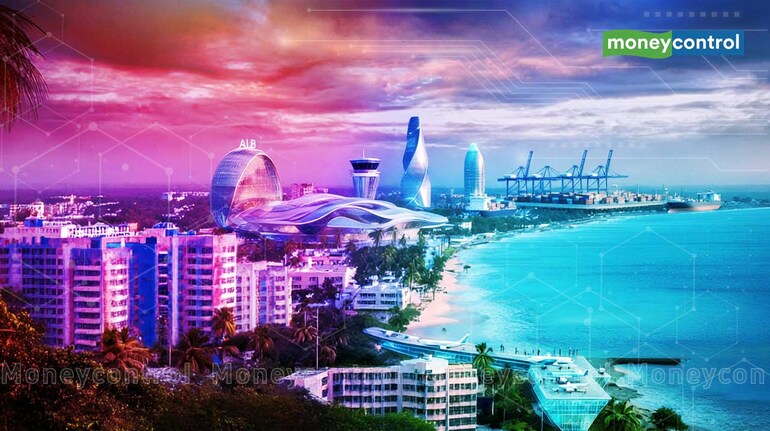

Mangaluru greets you differently. It is not loud. Not rushed. Not trying too hard to impress. The air carries the scent of the sea and rain on red laterite soil. Coconut trees line wide roads. Beaches stretch without the frenzy of party tourism. Mornings matter more than after-parties. Yet beneath that calm coastal rhythm, something is shifting.
The city, long stereotyped for its communal tensions and overshadowed by state capital, is quietly scripting a new chapter in India’s decentralised tech story - not by imitating Bengaluru, but by building on its own strengths.
In boardrooms and startup meetups alike, Mangaluru is increasingly being described as Bengaluru’s ‘plus one’ - a complementary hub that offers cost efficiency, talent depth and quality of life in a single equation.
“Mangaluru has strong potential due to the cluster advantage of Manipal, Udupi and Mangaluru, with a solid foundation of human resources. We must tap this to make it an innovation hub. A few GCCs are already operating there. We’re focusing on skill development, digital and physical infrastructure, more Centres of Excellence, a new tech park, and support for private players, including subsidies for co-working spaces,” Karnataka IT-BT Minister Priyank Kharge told Moneycontrol.
However, Kharge’s recent statement that “while the state is encouraging IT/BT investments in Mangaluru and firms have shown interest, concerns over employee safety amid recurring communal tensions are deterring some companies” has sparked a row.
The ‘Back to Ooru’ Momentum
For founders like Eshwar Shetty of Yatharth Social, returning home was not a fallback but a strategic choice. After spending over a year in London for his master’s degree, Shetty realised he was no longer optimising for visibility but for impact. “In Metros, success feels externally validated - titles, speed, scale,” he says. “In Mangaluru, it’s about sustainability, trust and long-term value.”
That sentiment captures a broader ‘Back to Ooru’ wave - professionals moving back to their roots, choosing familiarity over frenzy. During the pandemic, an estimated 1.2-1.5 lakh professionals returned to the coastal belt of Mangaluru, Udupi and Manipal. Many continued to work remotely, indicating that productivity need not be tied to pin codes in Bengaluru or Mumbai.
What began as a forced relocation has since evolved into a conscious recalibration. The ambition here, industry leaders say, is quieter but not smaller.
For millennials embracing a “back to ooru” life, the move is not just nostalgic, it is intentional.
For Oshin Aggarwal and Manjunath, it meant leaving behind the noise and crowd of Gurugram and returning to Mangaluru, drawn by the comfort of home, a calmer pace of life, and the belief that the coastal city is quietly booming with opportunity.
They saw in Mangaluru not just familiarity, but an emerging ecosystem that allows founders to build meaningfully without the chaos of metro life.
The couple founded Sitaara, a parenting platform focused on early childhood development without pushing consumerism.
“Moving from Gurgaon back to Mangaluru was a conscious choice; we realised we didn’t need a metro to build. The talent is here, the cost of living is sustainable, and the quality of life is better. The ecosystem is growing fast, and even our angel round saw participation from local investors, which reinforced our decision to build from here,” Aggarwal told Moneycontrol.
Similarly, Ashith Prajwal, Founder & CEO of Singularity Automobiles, an EV startup building electric pick-up trucks, said that the ecosystem here is very nurturing.
“Hardware is still a long journey, but a majority of our vehicle is built in Mangaluru. Capital plays a role, and two years ago, there wasn’t much understanding of what a startup really is here, traditional business dominated. That’s changing now as startups become more mainstream.” He added.
A Plus-One Strategy for Companies
For companies grappling with rising rentals, wage inflation and attrition in Metro cities, Mangaluru presents a compelling alternative: high-quality talent, lower operating costs and better retention.
Vinayak Palankar, visiting professor at the National Institute of Technology Karnataka (NITK) and CMO of Monster.com, calls it a ‘complementary extension’ to Bengaluru. “As distributed work models mature, cities like Mangaluru can host core teams and long-term operations - not just overflow centres,” he says.
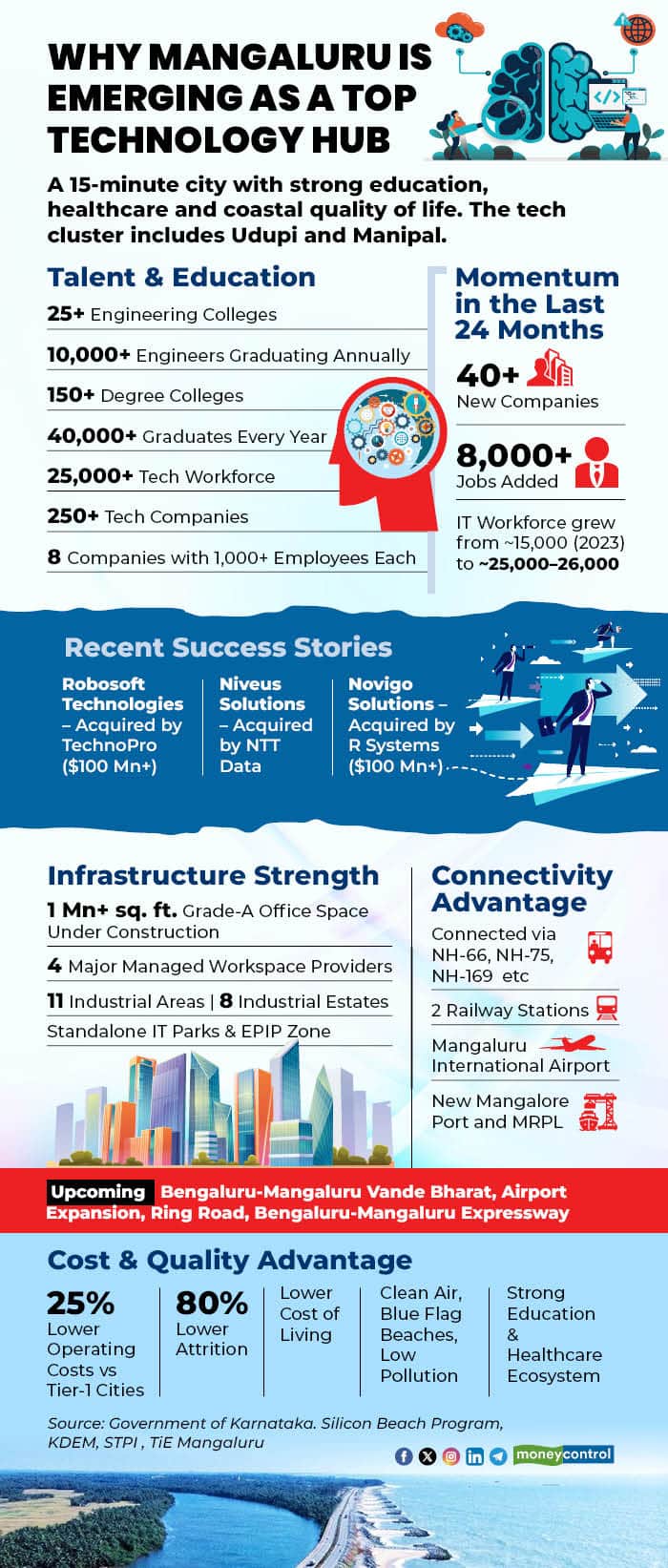
The numbers are beginning to reflect that shift. Over the past two years, more than 40 companies have set up operations across the coastal belt, creating roughly 8,000 jobs. The IT workforce has grown from around 15,000 in 2023 to nearly 25,000-26,000 today.
Several global capability centres (GCCs) have started small and scaled rapidly. EGDK India Private Limited, a subsidiary of Denmark-based EG A/S, expanded from about 20 employees to over 850 within three years. Bose Professional established its first dedicated R&D centre outside the US in Mangaluru, starting with a small team and scaling steadily.
LegalTech firm UniCourt runs its primary development centre from the city. Product companies such as Winman Software India LLP and Semnox Solutions have built global businesses from here.
Even large consulting and services firms are circling. At TiE Con Mangaluru 2026, Romal Shetty, CEO of Deloitte South Asia, said the firm would “come to Mangaluru - it is only a matter of time” as it scales hiring in India.
That momentum is also drawing companies built on alternative operating models. Founded by Saloni Malhotra, DesiCrew, a tech-enabled impact sourcing firm, has expanded its presence in and around Mangaluru as part of its strategy to deliver back-office operations, AI/ML data services and managed tech support from non-metro locations.
The company’s core idea is simple: take high-quality digital work to smaller towns, tap into local talent pools, and build sustainable employment outside traditional IT corridors, a model that aligns closely with Mangaluru’s emerging positioning as a viable extension to Bengaluru.
“We have 500 people here, and the talent in Mangaluru is incredible. Many industry leaders tell us the quality here rivals, and sometimes exceeds, that of bigger cities. The ecosystem is evolving, but that means less noise and more focus. There’s real hunger and real talent here, and I’d definitely bet my money on this city,” Malhotra told.
Talent Density Without Metro Chaos
The coastal region produces roughly 12,000-15,000 engineering graduates annually from more than 23 engineering colleges, including NITK Surathkal, with projections of 17,000-20,000 over the next three years. In addition, around 40,000 other graduates enter the workforce each year.
Historically, most migrated to Bengaluru, Mumbai or abroad due to limited local opportunities. But the remote-work experiment altered employer perceptions.
Prashanth Shenoy Katpady, co-founder and CTO of UniCourt, believes the region’s fundamentals are strong. “Mangaluru offers strong strategic advantages for tech expansion. It has direct flight connectivity - six flights a day to Bengaluru, seven to Mumbai, and three to Delhi. It is essentially a 15-minute city, with minimal commute time, clean air and healthier living conditions. Attrition levels are around 6–7 percent, significantly lower than Metros,” he says.
He adds that the city is evolving into a serious alternative talent base, not merely a satellite. “The ecosystem includes core product and R&D companies, not just IT services firms. Over the next five years, the vision is to grow from around 28,000 IT employees today to 2,00,000 in the future.”
For professionals, the financial math is straightforward. Lower rent, schooling and living costs translate into higher savings and improved work-life balance.
“Mangaluru is effectively a 15-minute city,” says Rohith Bhat, founder of Robosoft Technologies and Founding President of TiE Mangaluru. “Lower attrition, lower operating costs and better quality of life make this region attractive.”
Bhat said that founders from the region have already delivered over $250 million in exits, including Robosoft’s sale to Japan’s TechnoPro and Niveus Solutions’ acquisition by NTT Data.
The longer-term ambition is bold. “We should have at least 4,000 startups, five unicorns, 250 angel investors and $1 billion of investment into regional startups by 2035,” he says. “The goal is to grow from 25,000 IT professionals today to two lakh over the next eight years.”
Building the Ecosystem
Policy support is strengthening. Karnataka’s IT Policy 2025 and Startup initiatives offer incentives such as PF reimbursement and rental subsidies for companies setting up beyond Bengaluru.
Industry bodies are collaborating with local authorities, CREDAI and the Silicon Beach programme to expand IT parks and plug-and-play infrastructure. Around 2 lakh square feet of additional tech infrastructure is reportedly in the pipeline.
Johnson Tellis, co-founder and CEO of Inuinity, sees capital efficiency as Mangaluru’s biggest advantage. “Setting up a nano GCC or full GCC here is far more economical than in Tier-1 cities. Policies under the Beyond Bengaluru push, backed by KDEM and local industry anchors, are accelerating growth. Case studies like Bose Professional and EGDK show companies scaling headcount 300-500 percent in just two years,” he says.
He believes productivity, not just valuation will define the next decade. “Lower setup costs, better work-life balance and lower attrition translate into stronger returns. The quality of life - beaches, connectivity, healthcare and education -is a major differentiator.”
The Data Centre Bet
Mangaluru’s coastal geography could prove to be a strategic differentiator. India’s major submarine cable landing stations are concentrated in Mumbai and Chennai. For hyperscalers and colocation providers seeking low-latency global connectivity, proximity to the coast matters.
Industry leaders have pitched Mangaluru as a viable data centre destination, citing land availability, technical talent and abundant rainfall that can support cooling requirements. The Karnataka government has commissioned feasibility assessments, and discussions around a plug-and-play data centre park are underway.
While data centres are capital intensive and generate fewer direct jobs, they can significantly boost regional GDP and anchor digital infrastructure investments.
If realised at scale, this third pillar - alongside startups and GCCs - could reshape the city’s economic profile.
Satellite Today, Alternative Tomorrow?
For now, many describe Mangaluru as a satellite to Bengaluru. But that framing may evolve. The widening of NH-75 (Mangaluru–Bengaluru), the introduction of Vande Bharat services following electrification of Sakleshpur–Subrahmanya Road ghat section, and proposed Bengaluru-Mangaluru Expressway will significantly enhance connectivity between the two cities.
“Once senior leadership sees credible long-term career trajectories locally, momentum accelerates,” says Palankar.
The region’s cultural grounding - from literary traditions to Kambala - reinforces what industry leaders describe as a loyal, ownership-driven workforce.
Five years from now, ecosystem builders want Mangaluru to be known not as a compromise location, but as a credible Tier-2 tech hub - home to product companies, AI startups, GCCs and sustainable, values-driven enterprises.




Discover the latest Business News, Sensex, and Nifty updates. Obtain Personal Finance insights, tax queries, and expert opinions on Moneycontrol or download the Moneycontrol App to stay updated!
Find the best of Al News in one place, specially curated for you every weekend.
Stay on top of the latest tech trends and biggest startup news.