







For decades, India’s broking industry has relied on a familiar mix of charts, filters, analyst reports and trading terminals. Technology steadily changed how trades are executed, from the early shift to online platforms to the rise of algorithmic trading.
Artificial intelligence, however, is beginning to alter something more fundamental. How investors research, interpret and act on information.
Across brokerages, AI is no longer limited to backend automation or chat support. It is moving closer to the investor’s decision loop, promising faster analysis, personalised insights and conversational interfaces. At the same time, it raises unresolved questions around accountability, explainability and regulation.
Interviews with leaders at Angel One, Dhan, Groww, Fyers and Zerodha show a sector experimenting actively but cautiously, aware that finance is a domain where mistakes have real consequences.
From efficiency tool to intelligence layer
The earliest signs of AI adoption in broking are not flashy trading bots or automated stock calls. Instead, firms are embedding AI quietly across operations, using it to scale intelligence, reduce friction and process information faster.
At Angel One, group CEO Ambarish Kenghe describes AI less as a standalone product feature and more as an organisational capability.
When he joined the company, he says there was “nothing broken that needed fixing”. The mandate was to think long term, over 10 to 20 years, and prepare the firm for structural shifts.
That thinking has translated into several internal deployments.
Angel One moved its customer support chatbot from an external California-based vendor to an in-house system built on foundational models within three months. AI is now used to generate email responses, while partners receive daily updates through AI-generated multilingual podcasts. The firm is also running multiple internal AI initiatives across teams.
The philosophy, Kenghe says, is not to deploy AI for novelty but to use it where it improves speed and scale.
“AI democratises intelligence,” he said, drawing parallels with calculators democratising math and Google democratising information. In his view, tools that once existed only within institutions will increasingly reach individual investors.
Even smaller startups are looking to tap AI into the operations.
"At FinEdge, we see AI and human expertise as complementary, not competing. Wealth creation is deeply emotional and cannot be achieved by algorithms alone. We use AI to analyse data, personalise investment plans and track client behaviour in real time," Harsh Gahlaut, Co- founder & CEO, FinEdge said.
Vertical AI and the push to keep context in-house
As brokerages build internally, another trend is shaping their strategy. Retail investors are increasingly uploading portfolio screenshots and trade histories to general-purpose AI tools like ChatGPT, Gemini and Perplexity to seek analysis or suggestions.
The problem, executives say, is that such horizontal models lack deep market context and often work with incomplete data. That has pushed brokerages towards vertical AI models trained specifically on Indian financial markets.
Dhan, operated by Raise Financial Services, is betting on this approach with ‘Fuzz’, an agentic AI model designed for finance and markets. Trained on India-specific datasets and built to ingest regulatory filings, company data, news and market movements in real time, Fuzz is designed to deliver source-backed outputs rather than generic responses.
“Just like Dhan, this is meant for serious investors, analysts and finance professionals,” founder Pravin Jadhav told Moneycontrol back in August, adding that user data “never leaves the country”. Built by an internal team, Fuzz will offer a free tier with premium paid features.
Beyond Fuzz, Raise already uses AI extensively.
Its systems power news creation, summarisation and sentiment analysis for over 1,000 news items daily, covering thousands of listed companies. On the customer support side, AI has handled over 32.5 lakh interactions, resolving a majority of queries with high accuracy.
MCP, agents and the shift away from dashboards
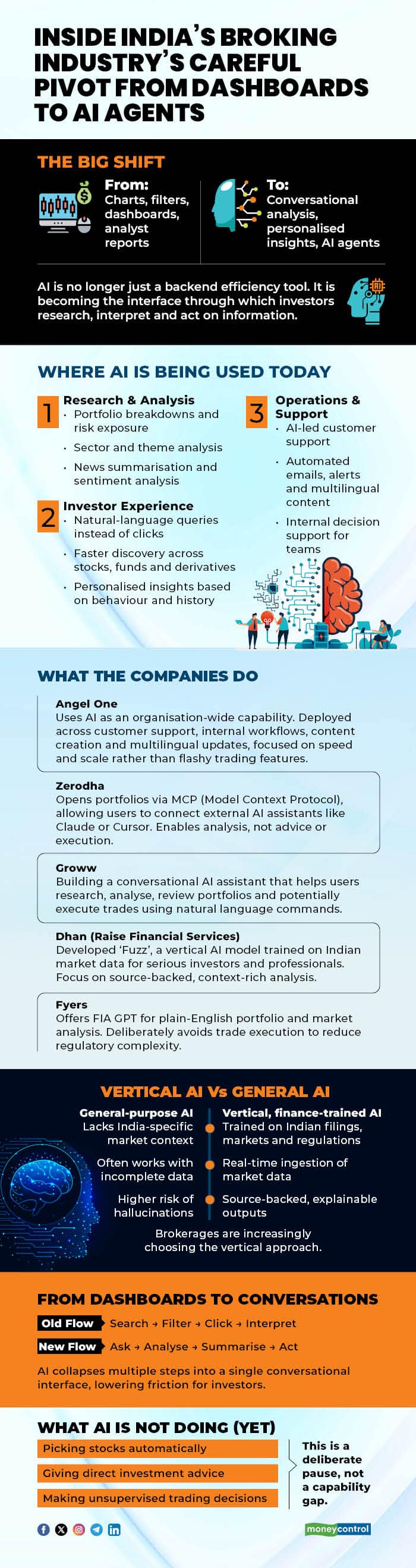
Alongside vertical models, a quieter architectural shift is underway. Model Context Protocol, or MCP, is emerging as a way for AI agents to securely interact with brokerage systems using a common set of rules.
This is where the idea of AI as an interface, rather than a feature, becomes clearer.
Zerodha has leaned into this approach by opening up its systems through MCP, allowing users to connect their portfolios to AI assistants like Claude, Cursor and Windsurf.
Instead of building a consumer-facing AI assistant inside its app, the brokerage has chosen to let users bring their own agents.
“AI tools have become so good that you don’t need a UI anymore,” Zerodha CEO Nithin Kamath wrote in a LinkedIn post in May, sharing early user feedback.
Screenshots posted by users showed complex portfolio analysis being generated through simple conversational prompts.
Power users echoed the sentiment.
“I can literally build my own personal finance manager with a few prompts,” one user wrote on X, while another described it as “one of the most quietly powerful things released by a brokerage in India”.
When investing turns conversational
For consumer-facing platforms, AI is also reshaping how investors interact with apps. Traditional broking interfaces rely on dashboards, filters and prescribed flows. AI promises to collapse much of that into conversation.
At Groww, investors who previewed the company’s upcoming AI assistant say it allows users to research, analyse, execute trades and review portfolios using natural language commands. The system analyses users’ historical behaviour and risk profiles and can suggest changes accordingly.
“We still need to go through a lot of steps,” one investor said. “A lot of things are going to move from clicks and browse to more of a conversational kind of thing.”
Unlike algorithmic trading, which requires coding, Groww’s system relies on plain language instructions. It can also execute trades under a mandate, a step beyond pure analysis.
Lowering friction without removing judgement
Not all brokers are moving towards execution. Some are deliberately stopping at analysis and discovery.
Fyers’ FIA GPT assistant, integrated with ChatGPT but trained on Indian market data, allows traders to analyse portfolio performance, interpret indicators and track market movements using plain English. Users can query chart patterns, sector exposure and options data without navigating multiple screens.
“We are not replacing human decisions,” said co-founder and CTO Yashas Khoday. “The aim is to reduce friction.”
By avoiding trade execution, Fyers has sidestepped regulatory complexity while still addressing a key pain point. “It is not about replacing human decisions but enhancing them by making data instantly accessible,” Khoday said.
"The real challenge is not where you invest but why you invest and whether you stay committed during volatility. Emotional judgement, empathy and accountability remain critical, and these are best delivered by a human advisor, with AI playing a supporting role," FinEdge's Gahlaut said.
Regulator’s PoV
More recently, SEBI has begun laying out how it expects AI to be used responsibly in capital markets. In a consultation paper released in July of 2025, the regulator proposed a set of high-level guiding principles for the responsible use of artificial intelligence and machine learning in Indian securities markets.
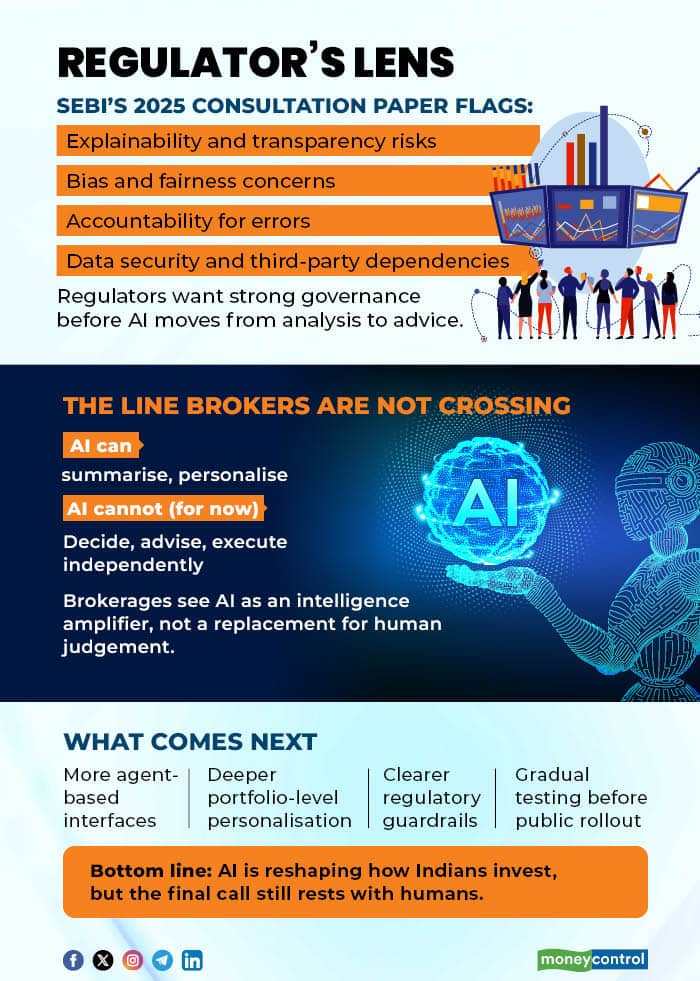
The paper acknowledges the rapid rise of AI, especially generative AI and large language models, across functions such as advisory support, risk management, surveillance, client identification, compliance and cybersecurity.
While recognising the efficiency and productivity gains from AI, SEBI flagged risks around fairness and bias, transparency and explainability, accountability, data security, third-party dependencies and operational resilience.
It said regulated entities must put in place strong governance, supervision and control frameworks to ensure AI systems do not undermine investor protection, market integrity or financial stability, signalling that as AI adoption deepens, regulatory expectations around oversight and responsibility will rise in parallel.
The line brokers are not crossing
Across platforms, one theme recurs. AI’s capabilities are advancing faster than regulatory clarity. Under current rules, AI systems cannot legally provide direct investment advice to retail investors without proper licensing and safeguards.
SEBI has shown openness to consultation, but explainability remains a challenge. Large models are probabilistic, not deterministic, and cannot always articulate why a particular conclusion was reached. In financial markets, that opacity matters.
There is also a behavioural risk. Easier access to analysis and execution could encourage overtrading or blind trust in machine outputs, especially among new investors.
Zerodha for example has drawn a clear boundary. It does not offer investment advice and does not hold an advisory licence. Its MCP implementation allows portfolio analysis, not recommendations or execution.
CTO Kailash Nadh has publicly cautioned against over-reliance on AI agents. When decision-making becomes concentrated inside opaque systems, he argues, accountability becomes harder to establish. “What about errors and failures with real-world implications that occur in the midst of AI orchestration across critical services?” he asked, raising questions around debugging, traceability and governance.
This is why, even as experimentation accelerates, brokerages are holding back at the last mile.
As Angel One’s Kenghe puts it, firms may test extensively behind the scenes, but public deployment is a different threshold altogether.
“We experiment internally, but nothing is production-ready,” he said, noting that regulators are still uncomfortable with unsupervised systems.
For now, AI in Indian broking is being asked to analyse, summarise and personalise, not to decide. How long that line holds will define the industry’s next phase.


Discover the latest Business News, Sensex, and Nifty updates. Obtain Personal Finance insights, tax queries, and expert opinions on Moneycontrol or download the Moneycontrol App to stay updated!
Find the best of Al News in one place, specially curated for you every weekend.
Stay on top of the latest tech trends and biggest startup news.






