






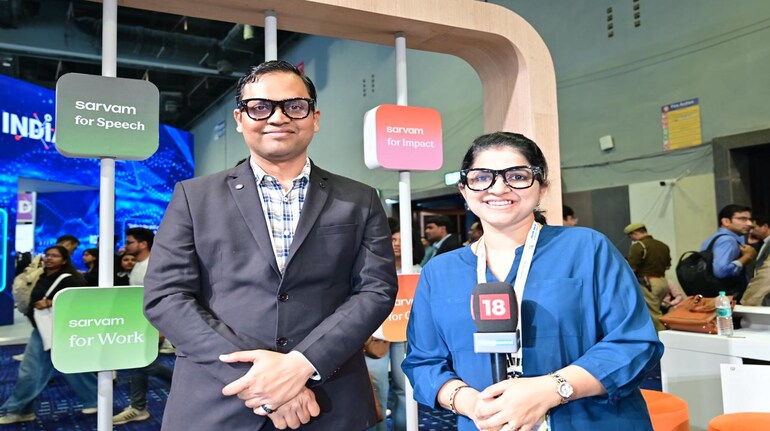

There are moments when a nation’s technological ambition shifts from aspiration to assertion. This week felt like one of them.
At the India AI Impact Summit, amid a sea of policymakers and founders, Sarvam AI stepped forward with a clear statement of intent under the IndiaAI Mission: unveiling 30B and 105B models, a suite of voice-based tools, and AI glasses 'Sarvam Kaze'.
For Cofounder Pratyush Kumar, the milestone is less about parameters and more about mindset.
For years, the industry asked if India could build foundational systems at all. That question, Kumar says, has been settled. The new frontier is harder: scaling real-world usage, building sustained R&D muscle, and proving that India can move beyond its reputation for "frugal innovation" to compete on raw performance.
That framing becomes especially relevant as the global conversation tilts toward smaller, highly efficient language models tailored to specific use cases. While such models have clear advantages, Kumar cautions against boxing India into a “small language model country” narrative.
Built by a lean 15-member team, Sarvam’s models are already benchmarking competitively in reasoning, math, and code with frontier global models.
In an interview with Moneycontrol, Kumar discusses overcoming skepticism, their ambition of ensuring AI reaches everyone in India, the role of government backing, open-source plans, and why India’s AI journey must be defined by long-term conviction over short-term hype.
Edited Excerpts:
You’ve released 30B, 105B and edge models under the IndiaAI Mission. Do you plan to build even larger models? And what will that require in terms of capital?
The government’s grant in lieu of stake in Sarvam was an important catalyst to train these models. In all of these things, belief gets created, and the next door opens, and the next thing happens.
Our ambition is to ensure that AI reaches everybody in India. At the same time, India should be seen as a builder and innovator in this space globally.
At the model sizes we have been training, we are comparing on different tasks, math, programming, reasoning, and showing they are doing very well competitively. But at the same time, we don’t want to mindlessly say we want to train a model that is 10 times bigger.
We want to do that in a very careful way, where you think about a strategy. What does the country need? What do we want to learn as an R&D team? And then scale up from there.
You mentioned this was built by a 15-member team. Can you elaborate?
There are various models we build, vision models, speech models, so there’s a larger team for model building. But the core LLM, the large language models, was actually built by a 15-member team.
There was a nice photo of them that I wanted to share. I also wanted to talk about how much blood, sweat and tears went into building it. Of course, we are celebrating it now, but it’s a two-year journey to build the muscle.
…There was also skepticism around your efforts. How did you view that?
It was very fair. The skepticism came because people didn’t understand our strategy, which was that we wanted to build this from the ground up in a company.
You don’t suddenly start running. You crawl, you walk, and then you run. If you look at a crawling baby and say, “Why are you not running a marathon?”. But I think it only shows that India has the hunger for doing bigger things.
We are digging our heels in and committing to building innovative experiences in India for decades to come.
How does your IndiaAI Mission work align with Sarvam’s VC-backed business model?
At Sarvam, we have two sides. We have the model-building effort, which is R&D-heavy and proves that we can be competitive globally.
And we have the product side, which creates returns on investment. In fact, we are already running a very successful voice AI platform, which today serves multiple million minutes a day across private companies. We are hoping that with the work we are doing, we will be able to unlock even the public sector for it.
We also have APIs. Multiple million APIs per day get served on the platform. We are going to scale up on that.
The recognition for what Sarvam is doing will only enhance our business side. But we are mindful that in this country, we often say we don’t spend enough on R&D.
For a startup like Sarvam, which is interested in pushing the frontier, we will invest in R&D. That is a commitment we will make, and we will have to keep that going forward while being mindful of the bets we make.
Will you need to raise another round?
Capital is required in this space. When we raise and how we raise, we’ll take a call on that. But it’s something we will definitely keep needing as we build.
Is AGI or superintelligence a north star for you?
Firstly, the problem statement is not well-defined with AGI. At least the way I look at it, and some others also agree, is that if 80% of the tasks we do can get automated 80% of the way, that itself is a very high bar to achieve.
Is this going to be achieved this year or next year? I don’t think anybody really knows. What we do know is that the technology is scaling up and getting effective very, very fast. At Sarvam, and there is intent in the name Sarvam, we wanted to reach everybody.
Our primary target is to build out the technology, show that we can do it, and then expand it to be reachable by everybody in the country, and do that efficiently. That is our current focus. We will make very carefully chosen bets on the next set of research frontiers we push towards.
Will your scale focus be enterprises and governance use cases?
Yes. We want to show value with AI, and that’s something we’ll do. But we’ll also build desirable experiences like this, which customers would want to use daily. We will be very mindful of not getting into efforts that just burn too much money for user acquisition. We believe this technology is good. The technology should be the product, not the user, and we’ll work with that value.
Will you release model weights as open source?
Yes, we’ll be releasing the model weights for our LLMs. A lot of hard work has gone into it, but there is a lot of value in getting feedback from people on how to improve these models, getting them to use it, try it, and fine-tune it. We would like to activate that ecosystem in the country, absorb that feedback, and improve our next set of models. So we will be open-sourcing it.
You’ve also spoken about the consumer-facing app, ‘Indus’. When will it go live?
I can’t tell you when it’s going live. The team is working on it. The goal is to make this concrete for people. You pick a model and launch it. What does that really mean? We want people to try it, give us feedback on what we should improve and how to use it. When it launches, I think we’ll let the team decide.
Won’t a consumer app increase your inference costs?
We’ll take it as it comes. We want people to experience this while being more business-to-business focused. That is our core DNA as a company. It’s time to celebrate what we are building and show people that this is a possibility.
How are you pricing your enterprise voice offerings compared to players like ElevenLabs?
I don’t want to comment on pricing. Pricing is available online. We are very competitively priced. It’s probably among the most affordable models out there. What’s also interesting is that we have end-to-end voice calling, where companies can run voice bots on our models on GPUs very securely without data privacy issues. Those are also very competitively priced in the market.
At the India AI Impact Summit, you unveiled the Sarvam glasses, Kaze. What exactly does it do? Give us more details on this?
There’s a continuous flow of people. There’s great love from everyone for the fact that India is building in the space of AI. These are glasses that, along with our friend Pawan, we have been designing and manufacturing in India. The goal is: the models that we are training, the models that are getting capable in Indian languages, how do you experience that as a consumer? And you’re able to do that with glasses like this. It has a speaker. It has microphones everywhere. It has cameras. It also comes with a ring, which you can use to control it and so on. The ring It has a button. You can tap, double tap. You can scroll and so on.
What was the thinking behind building this in this form factor?
The intention is to reduce the friction people have in accessing intelligence. You should be able to use it on the move. I’m sure you are a person on the move. Imagine having intelligence on the move. You’re able to ask questions and get them answered with devices like that, with models trained in India. That is the full-stack AI experience.
When will consumers be able to buy Kaze? And how are you thinking about commercialisation and scale?
Everything is a work in progress, but May is when we are going to get it into your hands. You’ll get one of the early ones. We will be out in the market with the price points. In fact, there’s a lot of interest online about it, “Hey, give me a book-my-glasses page.” We might consider doing that as well.
How will the pricing compare with competitors like Meta’s glasses?
We’re yet to reveal the price, but it will be affordable. The idea is to build something that is more accessible in India and also something that is a builder’s device, meaning that we will be able to build custom agents with the Sarvam platform and make it work on this. So depending on your role, you might like different experiences, and you’ll be able to do that with Sarvam Kaze.



Discover the latest Business News, Sensex, and Nifty updates. Obtain Personal Finance insights, tax queries, and expert opinions on Moneycontrol or download the Moneycontrol App to stay updated!
Find the best of Al News in one place, specially curated for you every weekend.
Stay on top of the latest tech trends and biggest startup news.







