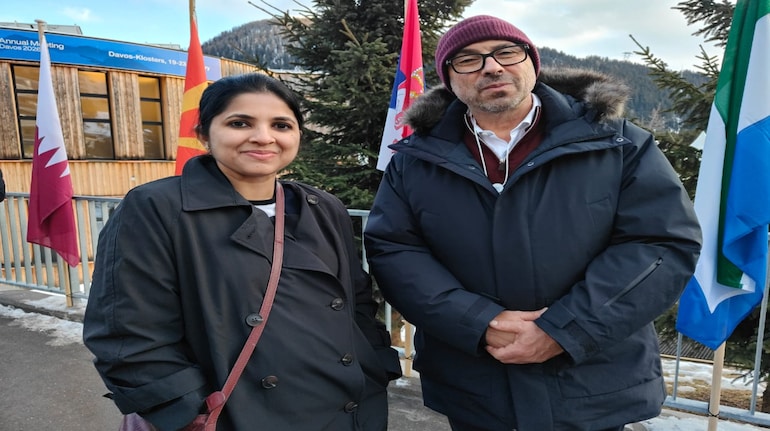

Cerebras CEO Andrew Feldman has said the belief that artificial intelligence (AI) is synonymous with Nvidia is now being challenged, as faster inference and alternative chip architectures reshape the global AI hardware market.
In an interview to Moneycontrol on the sidelines of the World Economic Forum (WEF) in Davos, Feldman also spoke about the growing importance of India in the global AI ecosystem, the company’s partnerships the debate around an AI bubble and why “only a fool would overlook India”. Edited excerpts of the interview:
The chip industry has seen rapid consolidation, big deals like your OpenAI partnership, Google’s TPUs gaining traction and competition from players such as Graphcore and Arm. How do you see the competitive landscape right now?
Well, remember, in our industry, we make AI with training, and we use AI through something called inference, and we’ve made useful AI now. And so the use of AI is going through the roof and what you’re seeing is a response to that: the deployment and the use of AI, something we call inference, is growing at an enormous rate. And what we do, our specialty, is making inference fast, and that part of the market is a really attractive part.
It’s for coding, it’s for agentic work, it’s for deep research, and these are some of the first and most important ways that AI is making an impact on the economy.
There’s growing talk of an AI bubble even as usage and revenues surge. Do you see any part of the AI ecosystem in bubble territory?
I think whenever people see a rapidly growing market, they talk about a bubble. That’s not our view. What we see is strong demand, and we see strong usefulness. That’s the key in trying to understand a bubble. Are people really using this? Is it creating economic value?
What we’re seeing in applications like coding is that it makes coders stronger. It enables them to write more code. It enables journalists like yourself to do deep research much quicker and so not only are people using AI, they’re using it more often.
People like my parents, who a year ago weren’t using it, now people in different demographics are using AI. They’re using it all the time and they’re using bigger and more sophisticated models. And so what’s happening is AI is diffusing throughout the entire economy, and that’s not a bubble. That’s the way a new technology moves through an economic system.
With the India AI Summit coming up and the country pushing large compute clusters under the India AI Mission, how do you view India as a destination for Cerebras?
As you know, we have a facility in Bengaluru. That’s right. And I think we’re nearly 100 people in that facility and this year, touch wood, we seek to increase substantially.
I think India has some of the best universities in the world, so they’ve got the human capital. I think they’re working really hard to build the data centres. Modern data centres are a prerequisite for these large deployments. You need large amounts of clean power. You need water in these data centers for cooling. And so I think those are prerequisites.
And then there’s the desire and the willingness to put up the capital. I think all of these things are present in India. And if they choose, India can be one of the global AI powerhouses. It takes work, it takes effort but I think there’s a commitment at the governmental level and that has to filter down to action.
Are you exploring partnerships in India across manufacturing, semiconductors or software?
Sure. We are seeking partnerships around the world. We have partnerships in India. We have partnerships throughout Southeast Asia in our manufacturing supply chain, and also partnerships for software.
I think India has a collection of some of the world’s leading software engineers and we’re seeing more and more interesting AI work come out of India. So our interest in the subcontinent is enormous. As a market, as a place to partner, as a place to deploy gear, I think one would be a fool to overlook India.
What will define the chip industry in 2026 and how challenged is Nvidia’s dominance?
I think we’ve already seen their dominance be challenged. We had Google’s TPU underpinning Gemini 3 and what we saw was the training of a foundation model entirely without Nvidia. And then we saw the rise of fast inference.
We saw Nvidia admit that they didn’t have a solution and they spent $20 billion in an acquisition to buy the number two player. They bought Grok. And so this was, you know, we’re the number one player, so that was okay by us.
Were you approached for an acquisition?
We don’t kiss and tell. We’re gentlemen.
What does this shift mean for the future of GPUs in AI?
I think it shows that there are definitely chinks in the armour. The GPU is not the only machine that can be used in AI. The mental moat for those who thought that AI equaled Nvidia has been crossed. What they admitted by buying a company for that amount of money is that there are things the GPU doesn’t do well and those are exactly the things we do well at Cerebris. And those are the things we believe are the fastest growing.
You’ve raised significant capital recently. Should we expect major financial milestones like an IPO?
I think all financial milestones follow from business milestones. I would love to share more but I can’t share all the details I’d like to. What I can say is that right now, when people use AI, they want it to be faster. They don’t want to wait. They want faster inference and that’s something we’re the best in the world at.
What AI tools do you personally rely on?
We’re big GPT users, even more so now. For vibe coding, it’s been a particularly fertile area. There are lots of really interesting ways to approach vibe coding.
There are also company-specific tools. I think you’re going to see an extraordinary collection of models, both open source and closed source, both for sale and for internal use this year. This is the year the world will see just a little bit of how AI can change the economy.
Can we expect more large partnerships like your deal with OpenAI?
We hope so.
Does partnering with OpenAI limit your ability to work with others?
No, of course not. It takes a great deal of work to build a big partnership. We built a big partnership with G42. They’ve been our strategic partner. Building partnerships is a muscle. It doesn’t come out of the blue. It takes trust and commitment. We’ve added a second major strategic partnership to our portfolio. We’ll digest this one, and then we’ll keep building.
What book are you reading this year?
Sapiens. I just finished it. It’s an old book. I’m behind. Really interesting. A sort of view on humankind. I think Yuval (Noah Harari) is also speaking here. I enjoyed it a great deal. It’s a view of the last 50,000 years of humankind in a nice way. You can organise it in your mind. I really enjoyed that.



Discover the latest Business News, Sensex, and Nifty updates. Obtain Personal Finance insights, tax queries, and expert opinions on Moneycontrol or download the Moneycontrol App to stay updated!
Find the best of Al News in one place, specially curated for you every weekend.
Stay on top of the latest tech trends and biggest startup news.