






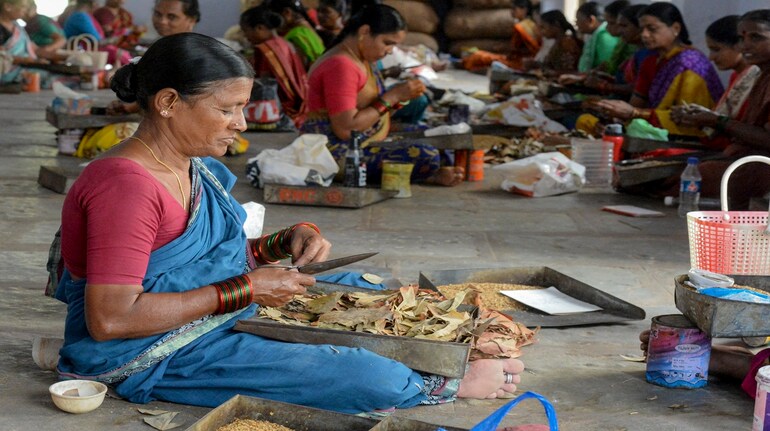

India’s fight against tobacco is failing because the government spends less than 0.07 percent of the Rs 72,788 crore it collects in tobacco taxes on helping people quit, while its policies target cigarettes even though 90 percent of Indians consume beedis and smokeless tobacco—products that escape taxes, evade enforcement and remain cheap enough to keep addiction entrenched, according to a new white paper released Wednesday by Civitas Consultancies Pvt. Ltd.
The report, “Assessing India’s Tobacco Control Framework,” argues that despite being the world’s second‑largest tobacco consumer, India continues to pursue a “cigarette‑first” approach that ignores consumption realities.
Cigarettes make up just 10 percent of total tobacco consumption, while beedis and smokeless tobacco account for 90 percent, yet remain comparatively under‑taxed and weakly regulated.
“India’s tobacco challenge cannot be solved with a narrow, cigarette‑first lens. Our consumption profile is fundamentally different — and policy must reflect that reality. When tobacco revenues are high, but investment in tobacco control is minimal, the result is weak cessation coverage, uneven implementation, and preventable disease burdens that fall hardest on the poor,” said Dr. D. Dhanuraj, Director at Civitas.
He added “a whole‑of‑government approach, anchored by a high‑level multisectoral council, can reconcile health goals with livelihoods, formalisation and enforcement. Incremental measures alone will not suffice.”
Chronic underfunding leaves cessation system ineffective
The report reveals that the National Tobacco Control Programme (NTCP) — India’s primary cessation and enforcement mechanism — is severely underfunded and underutilised. Only 38 percent of approved NTCP funds were used between 2015–16 and 2022–23, with substantial state‑level disparities. As a consequence, cessation remains limited in reach and weak in impact. Only 1.3 million individuals, less than 0.5 percent of tobacco users, accessed cessation services in 2019–20. Services remain largely urban‑centric and poorly integrated into primary care.
Programme monitoring is equally flawed
Instead of tracking verified quit rates or reductions in prevalence, NTCP success metrics rely on “activity‑based” indicators such as workshops conducted or posters displayed — a system that renders the programme “procedurally compliant but effectively weak,” the report says.
Beedi exemptions fuel massive shadow economy
A major structural flaw is the “cottage industry” exemption that allows unbranded beedis to bypass GST and compensation cess. Originally designed to protect small producers, the exemption now drives widespread tax evasion and high affordability of harmful tobacco forms.
Civitas estimates 125 billion beedi sticks — roughly 31 percent of all beedis — escape taxation every year, creating a sprawling shadow economy and enabling cheap access among low‑income groups.
The report argues this loophole directly undermines India’s health objectives while perpetuating informal, underpaid and unsafe work for the 45.7 million livelihoods linked to the tobacco supply chain.
Illicit trade and surrogate ads still rampant
Despite regulations, the market continues to adapt aggressively. The report highlights examples such as gutkha sachets hidden inside snack packets sold near schools, and surrogate advertising for tobacco brands during major sporting events, demonstrating persistent gaps in enforcement. Illicit trade thrives partly due to the absence of a nationwide track‑and‑trace system for all tobacco products, the authors note.
Civitas calls for high‑level overhaul
To address these systemic failures, the report recommends creating an Inter‑Ministerial Tobacco Sector Transformation Council under NITI Aayog or the Prime Minister’s Office, bringing together finance, labour, agriculture, trade and enforcement ministries. Cigarettes, beedis and smokeless tobacco need harmonised taxation to reduce down‑trading and substitution, the authors argue. The report additionally recommends removing exemptions that shield beedis and smokeless tobacco, shifting to outcome‑based cessation metrics, ring‑fencing 10 percent of tobacco tax revenue for cessation and alternative livelihood programmes and nationwide track‑and‑trace to combat illicit trade and revenue leakage.
The report concludes that India is trapped in a “development paradox,” where economic dependence on tobacco directly conflicts with public health goals. “We must move beyond symbolic bans and invest in modernising the sector and formalising livelihoods,” the authors warn.

Discover the latest Business News, Sensex, and Nifty updates. Obtain Personal Finance insights, tax queries, and expert opinions on Moneycontrol or download the Moneycontrol App to stay updated!
Find the best of Al News in one place, specially curated for you every weekend.
Stay on top of the latest tech trends and biggest startup news.





