
Landing one’s first job can be one of the most exciting events for young adults. The first pay cheque is really about freedom because now you can decide how and where you spend the money. And the best part? You don’t need your parents’ permission. But remember: with great powers come great responsibilities.
In the excitement of starting to build a lifestyle, we tend to forget that before we spend, we must save some. And preferably invest some as well. Conventional financial wisdom says: Earn, save, and then spend.
Saving is important because it gives you money to fund future expenses. Good financial planning tells us that it is better to spend out of our savings rather than spend our entire – or a good part of the – salary every month. And that is why just saving is not enough. You need to invest, too.
Investing means buying securities and assets with your savings so that you can earn an income and increase your capital. This income can come in the form of interest, dividend or even rent. Investing tops savings because, thanks to inflation or price rises, the value of your money declines, and over time, unless you allow your savings to earn returns, their value too will decline.
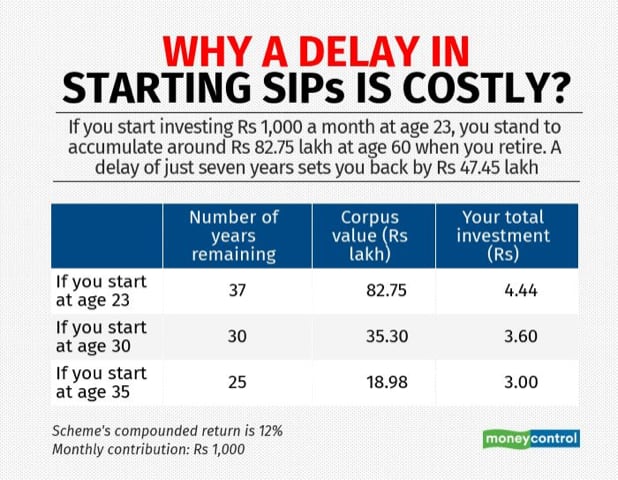
Starting earlyInvesting is the art of creating wealth by allowing your savings to deliver returns that beat inflation over time. Starting this journey early means –
· You have the benefit of accumulating savings for a longer period
· You gain from long-term compounding returns on savings
· You can invest small amounts
· You can expect more conservative returns rather than take undue risks
· You learn from making investment mistakes early, when the stakes are small
“It’s simple math: the compounding effect is created primarily by time and rate of return. While the rate of return is not in one’s hand, you can control how long money compounds by investing as early as possible and staying invested for as long as possible,” said Gaurav Rastogi, founder and CEO of Kuvera.in.
Investing Rs 5,000 for 20 years at an expected return of 10 percent will give you a sum of Rs 38.3 lakh at the end of the term. But if you had just started 10 years sooner, you would end up with Rs 1.1 crore. That is more than double the money by just starting early. You are not increasing the amount you invest or the returns you seek, but simply adding time to your investment.
Also read: Top performing Mutual Funds Scheme from MC30 Funds“In the long run, time works in favour of the investor and not market timing. Long-term investing success is predicated on discipline and consistency. How you allocate assets and how you invest continuously are important in making investing a habit,” said Nehal Mota, cofounder and CEO of Nehal Mota, Co-founder and CEO, Finnovate, a hybrid wealth tech platform.
Gaurav Karnik, a Mumbai-based advisor who works with startup founders, finds that many people are conservative when it comes to saving money but confident about taking high risks with investments.
“Many tech-based founders come from smaller towns and the priority once they start getting a salary post-round one of funding is to give back to their families and for that they understand the importance of saving. Once the surplus starts building, the focus shifts to taking some risk with investments but that is more in investing in other startups with the complete awareness that such investments are in the nature of go big or go home.”
Also read: Got your first job? Now here’s where you should put your moneyYoung startup founders understand that to multiply money, one has to take some risk. However, instead of the disciplined investing approach that smoothens out risk over time, the preference is to try out high-risk options while they are still young and have time on their side.
This approach requires an inherent ability to absorb risk, which can lead to having no returns at all. For those who don’t have the mettle to adopt this or are not in their early 20s with the advantage of time, it’s prudent to start with building an emergency fund and investing in a disciplined manner for future financial security.
Along with starting early, the discipline of saving regularly and investing your savings, creating balance in risk and returns, is the key to efficient long-term investing, and starting early with your first pay cheque or first fundraise is the icing on the cake.
While your wealth grows, your restraint in spending and behaviour with money also finds its foundation. Focusing only on spending can be dangerous as you may end up living from pay cheque to pay cheque. When the time comes to upgrade your lifestyle or an emergency strikes, instead of relying on savings, you will be forced to take a loan.
Taking on debt to fund your lifestyle or your emergencies is a dangerous cycle to start and you are at risk of doing it if you are unable to build the investing habit from your first pay cheque.
Also read: Got your first job? Here's how you can make tax-saving investmentsStarting your investing journey early helps you avoid a vicious circle of overspending and loans. However, it’s not always easy. Mota pointed out that many people prioritise home loans before investing.
“The answer lies in discipline. Set a target investment on a monthly basis and build a budget around it. Many hurdles to begin investing are addressed by simply plugging the spending leakages,” she said.
Rastogi said that overcoming behavioural hurdles is the key.
“For young earners, retirement is too far away to start thinking seriously about it,” he said.
It’s not just the salaried who need to focus on starting their investing journey early. As entrepreneurship takes root as a go-to choice, income will be uncertain and could even be irregular. In this scenario, saving and investing from the first cheque becomes imperative, although the stakes may vary.
Related reading: Six ways to protect your job in the current storm of layoffsDiscover the latest Business News, Sensex, and Nifty updates. Obtain Personal Finance insights, tax queries, and expert opinions on Moneycontrol or download the Moneycontrol App to stay updated!
Find the best of Al News in one place, specially curated for you every weekend.
Stay on top of the latest tech trends and biggest startup news.