

Your salary slip may soon look very different and possibly heavier. The government has proposed the Draft Income-tax Rules, 2026 to replace the six-decade-old 1962 rules, and the changes directly affect what finally lands in your bank account every month.
Higher HRA limits, realistic education and hostel allowances could significantly reduce taxable income for salaried employees, especially those using the old tax regime. The draft is open for public comments until February 22.
Here’s what may change in your take-home pay and how it impacts your salary planning.
HRA relief extended to more cities
The draft expands the list of cities eligible for 50 percent salary-based HRA exemption.
Apart from Mumbai, Delhi, Kolkata and Chennai, the proposed rules add Bengaluru, Hyderabad, Pune and Ahmedabad to the 50 percent category. All other cities will continue under the 40 percent cap.
Major boost to education and hostel allowances
The exemption for children’s education allowance is proposed to rise from Rs 100 per child per month to Rs 3,000 per child per month.
Similarly, hostel allowance exemption will increase from Rs 300 per month to Rs 9,000 per month per child, for up to two children.
The earlier limits had remained frozen for decades and were widely seen as outdated given current schooling cost
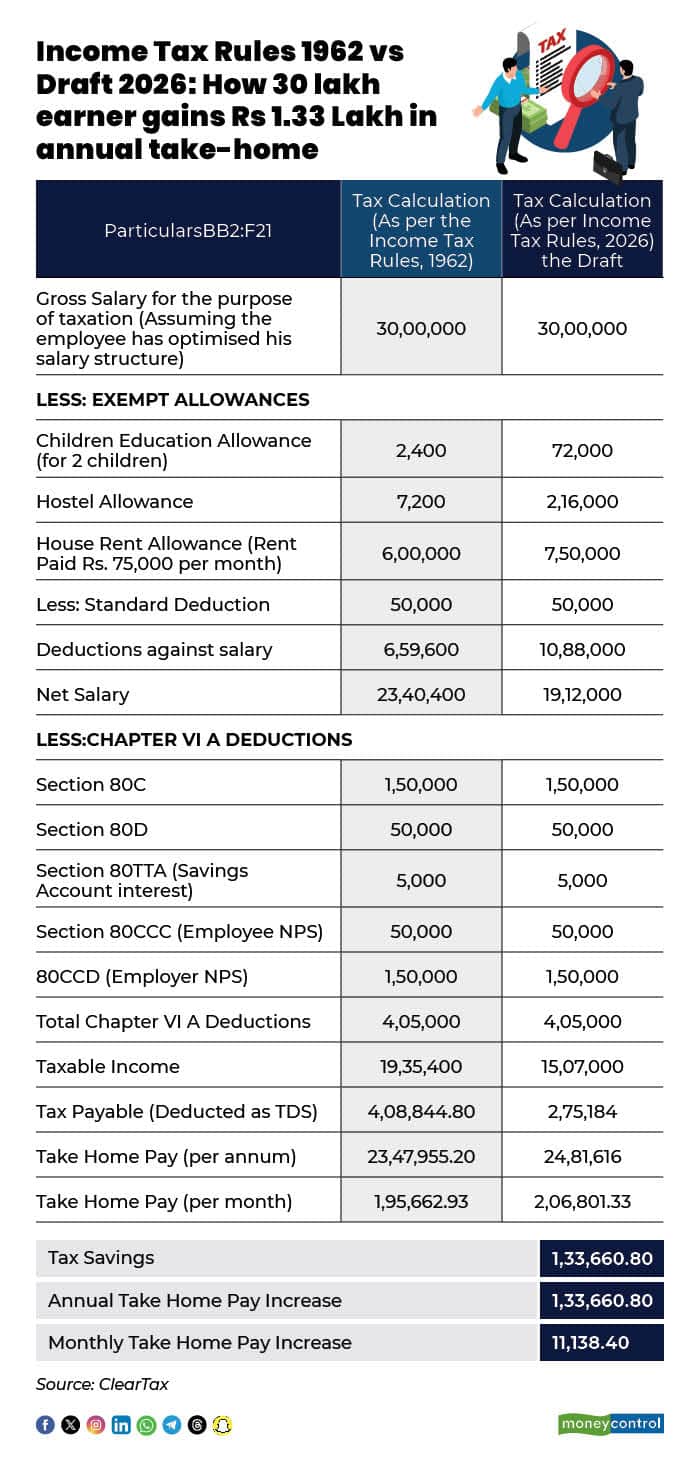
Let us understand with an example how the new rules will impact your salary.
Suppose Ramesh earns a gross salary of Rs 30 lakh a year under the Income Tax Rules, 1962, after factoring in exempt allowances such as Rs 2,400 for children education allowance, Rs 7,200 for hostel allowance, Rs 6 lakh as HRA (with Rs 75,000 monthly rent), and a standard deduction of Rs 50,000, his total deductions work out to Rs 6,59,600, leaving a net salary of Rs 23,40,400.
After claiming Rs 4,05,000 under Chapter VI-A (including Sections 80C, 80D, 80TTA, 80CCC and 80CCD), his taxable income is Rs 19,35,400, and the tax payable is Rs 4,08,844.80. This leaves him with an annual take-home pay of Rs 23,47,955.20 (Rs 1,95,662.93 per month).
Under the draft Income Tax Rules, 2026, however, higher exempt allowances, Rs 72,000 for children education, Rs 2,16,000 for hostel allowance and Rs 7,50,000 for HRA, raise total salary deductions to Rs 10,88,000, reducing taxable income to Rs 15,07,000.
With tax payable falling to Rs 2,75,184, Ramesh saves Rs 1,33,660.80 in tax annually. As a result, his annual take-home pay increases to Rs 24,81,616 (Rs 2,06,801.33 per month), reflecting a monthly gain of Rs 11,138.40 under the new rules.
Accordingly, under the Income Tax Act, 1962, the tax liability works out to Rs 4,08,845. Under the draft Income Tax Rules, 2026, it reduces to Rs 2,75,184. This is also lower than the tax payable under the New Tax Regime, which comes to Rs 4,75,800 even after claiming exemptions for children, education and house rent allowances.
Other changes under Draft Tax Rules, 2026
Motor car perquisite
One of the notable changes relates to company-provided vehicles. Under the current rules, valuation figures for mixed official and personal use had remained static for decades.
The draft proposes upward revision. For cars up to 1.6 litres where the employer bears fuel and maintenance costs, the taxable perquisite rises from Rs 1,800 per month (plus Rs 900 for driver) to Rs 5,000 per month (plus Rs 3,000 for driver). For larger engines, the perquisite increases from Rs 2,400 to Rs 7,000 per month, with chauffeur valuation tripling to Rs 3,000 per month.
Tax experts say this could significantly increase TDS for executives who opt for company-leased vehicles as part of their compensation.
Interest-free loan exemption raised tenfold
The draft rules increase the threshold for exempt employer-provided interest-free or concessional loans from Rs 20,000 to Rs 2 lakh.
The earlier exemption had become largely irrelevant due to inflation. The proposed revision offers relief to employees relying on small advances for emergencies, education, or medical needs.
Meal allowance limit
The per-meal exemption for employer-provided meals is proposed to increase from Rs 50 to Rs 200.
With food costs having risen sharply over the decades, the earlier limit had triggered frequent payroll disputes. The higher cap aligns the exemption with present-day urban expenses.
Festival gift exemption tripled
Annual tax-free exemption for gifts and vouchers is set to increase from Rs 5,000 to Rs 15,000.
Higher transport allowance cap
For employees working in transport systems such as railways, airlines and shipping, the exemption cap is proposed to increase from Rs 10,000 per month to Rs 25,000 per month, while retaining the 70 percent allowance rule.
“With the proposed changes in the Income Tax Rules, the taxpayers opting for the old regime have a better opportunity to save taxes through optimising their pay structure,” said Chandni Anandan, Tax Expert at ClearTax.
Discover the latest Business News, Sensex, and Nifty updates. Obtain Personal Finance insights, tax queries, and expert opinions on Moneycontrol or download the Moneycontrol App to stay updated!
Find the best of Al News in one place, specially curated for you every weekend.
Stay on top of the latest tech trends and biggest startup news.