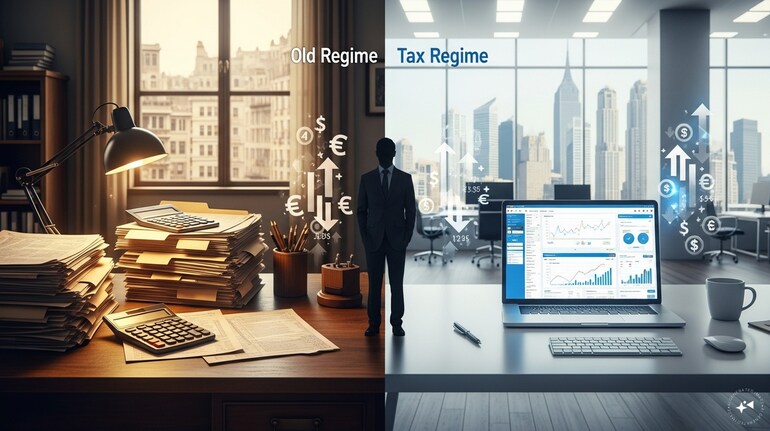

As Budget 2026 approaches, one question continues to surface among taxpayers: will the government finally scrap the old tax regime? With the new tax regime now the default option, and successive budgets steadily making it more attractive, discussions around the future of the old regime have only intensified.
The new tax regime offers lower slab rates, simpler compliance, and fewer exemptions. Over time, it has been positioned as the preferred system for India’s evolving tax base. Yet, despite this push, the old tax regime is still chosen by a meaningful section of taxpayers.
“There is a significant proportion still about 28 to 29 percent, that is still well invested under the old regime,” said Nitin Bajal, Executive Director at Deloitte India. That number tells even as most taxpayers migrate to the new regime for its simplicity, a meaningful minority continues to find real tax savings under the old framework.
The old tax regime remains relevant for taxpayers who actively use deductions such as House Rent Allowance (HRA), Section 80C investments, health insurance premiums under Section 80D, education loans, and home loan interest benefits. For higher-income salaried individuals with structured compensation, these deductions can materially reduce tax liability, something the new regime does not allow.

From a policy standpoint, however, scrapping the old regime is not as straightforward as it may appear. Over decades, the Indian tax system has encouraged household savings through tax-linked instruments like provident funds, insurance, and housing. A sudden withdrawal of the old regime could disrupt long-term financial planning for millions who have committed to these products based on stable tax assumptions.
Tax experts also point to repeated assurances from the government that the old regime will continue to coexist. “Based on repeated statements and clarifications from the Finance Ministry, there has been a consistent assurance that the old tax regime will not be abolished. In line with these assurances, it is reasonable to expect that the option to continue under the old tax regime will remain available for individuals who prefer it, even if only a few percentages of individuals are still opting for it,” says Neeraj Agarwala, Partner, Nangia & Co LLP.
This continuity also helps the government manage the transition to a simpler tax system without alienating taxpayers who are midway through long-term commitments. From a political and administrative perspective, offering choice reduces resistance and builds trust.
That said, the government’s intent to gradually nudge taxpayers towards the new regime is clear. By making the new regime the default, expanding standard deductions, and improving slab structures, the incentive to voluntarily shift has increased. Over time, this could naturally shrink the relevance of the old regime without formally abolishing it.
Even within the tax advisory community, the consensus is that Budget 2026 is unlikely to deliver a decisive break. “The old tax regime and new tax regime will continue to be available and the government may not phase out the old regime. We will have to wait for policy change and a clear signal for forecasting the scrapping of the old regime,” said Sudhakar Sethuraman, Partner, Deloitte India.
For now, the debate is less about whether the old regime will be scrapped and more about how long it will coexist alongside the new one.
Budget 2026 is expected to reinforce the government’s preference for simplicity and compliance, but without pulling the plug on a system that still works for nearly a third of taxpayers. For individuals, the message remains unchanged: evaluate both regimes carefully, because choice, at least for now, seems here to stay.
Discover the latest Business News, Sensex, and Nifty updates. Obtain Personal Finance insights, tax queries, and expert opinions on Moneycontrol or download the Moneycontrol App to stay updated!
Find the best of Al News in one place, specially curated for you every weekend.
Stay on top of the latest tech trends and biggest startup news.