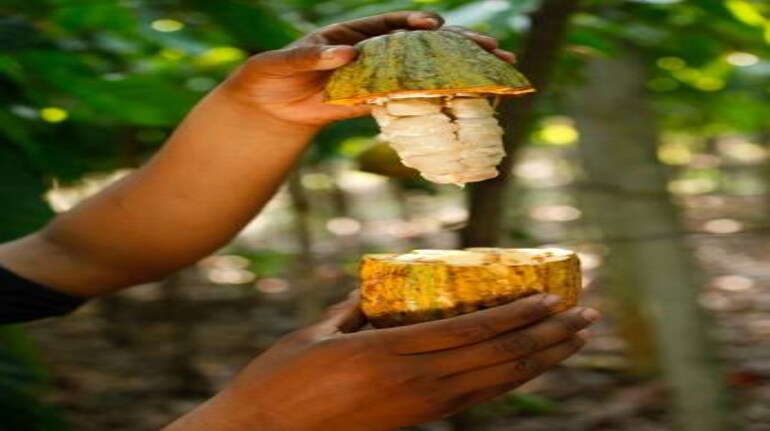
India figures high in the scheme of things of Ivory Coast (Cote d’Ivoire), the world’s largest producer of cocoa, as it plans to gradually cut down its dependency on Europe, develop its own processing facilities, and explore new markets to raise the income of farmers of the bean that is the lifeblood of the country’s economy.
India is not a big cocoa producer and its current connection with Ivory Coast is limited to the import of beans to feed the surging demand for cocoa products in the domestic market.
Despite churning out more cocoa than any other country (about 45 percent of the total global cocoa output of around 4.9 million tonnes), Ivory coast does not have much say in setting its price, which is decided in the New York and London exchanges. Besides, new regulations on deforestation have affected the country’s cocoa output by limiting the area under cultivation.
The Ivory Coast is now looking at the huge Indian market to boost the income of its cocoa farmers. At present, it sells cocoa to the large chocolate companies of Europe and the US through middlemen, which deprives the farmers of a fair price. It is against this backdrop that the country is looking to sell cocoa and products made from it directly in Asian markets, particularly India.
"We want to sell our cocoa and finished products in India. We have cocoa and Indians have the market. It will be a win-win situation," said Siaka Minayaha, Chairman of the Board of Directors, and Yves Brahima Kone, Managing Director, of the Coffee and Cocoa Council, the regulator of the two products in Ivory Coast.
The council is leading a delegation to India in November to talk and negotiate with the cocoa processors and producers for direct sales of its products. It will also meet government officials to discuss various trade issues, including import duty on cocoa beans. A chief concern of the Indian cocoa processing industry is the inverse duty structure: high duty on beans, while allowing duty-free import of finished cocoa products from several ASEAN countries under the free trade agreement.
Ivory Coast had aimed to increase its level of value addition in cocoa from 40 to 50 percent by 2020, when its output was 1.5 million tonnes. But plans were hit by the pandemic, and its production has now increased to 2.2 million tonnes.
The Society for Transformation of Cocoa (Ivory Coast), that promotes manufacture of cocoa products, has already made a beginning in cocoa processing in the country by producing 30,000 tonnes of cocoa liquor and 10,000 tonnes each of cocoa powder and cocoa butter a year, in an effort to raise value addition. It is in the process of expanding the capacity with two greenfield projects of 50,000 tonnes each at a cost of 300 million euros, with Chinese help.
Konan Theodore, General Manager of the Society, said that 85 percent of the cost of the projects will be met by a loan from China, while the rest will come from the Ivory Coast government. Its been agreed that China will get 40 percent share of the products from the projects for 15 years.
The country is also looking at a joint venture with India. "Indians are used to eating chocolates by big companies. They will get a taste of our chocolates when we sell it in the Indian market," Theodore told Moneycontrol.
The Coffee and Cocoa Council has trained and financed around 10 local units for cocoa and coffee processing. Viviane Kouame, 38, who has been trained in chocolate making in France and Italy, manages one such unit. She makes 5,000 bars a month, that includes dark, white, and milk chocolates. "I am the first certified African woman to make tree-to-bar chocolates," she says. She is currently negotiating a deal to export chocolates to South Africa.
Ivory Coast has capped its cocoa production at 2.2 million tonnes as supply has been exceeding demand. In 2022-23 (October to September), however, global cocoa prices spiked over 45 percent on-year to around $3,600-3,500 per tonne, due to heavy rain and floods in Ivory Coast, which led to a drop in production.
Even now, prices are hovering around $3,400 per tonne, and there is a possibility of erratic rains and El Nino impacting the cocoa crop in 2023-24 (October-September). Ivory Coast has raised the farmgate price, the minimum price for the farmers, by 11 percent to 1,000 CFA francs (Rs 133) per kg for the current season.
Climate change and deforestation have increased pest and disease problems such as black pod and swollen shoot virus in cocoa plantations in the country over the last few years. Ambroise N’Koh, a 70-year-old cocoa farmer, says swollen shoot virus is the `AIDS’ of cocoa. The disease spreads from the saliva of an insect that thrives on heat and light, which has increased with deforestation.
He has adopted organic cocoa farming, which, though expensive, provides him higher yield and income. Apart from organic cocoa, he also grows organic coffee, banana, and lemon and is keenly pursuing agro-forestry in his 50-hectare farm. "Coffee acts as a barrier against swollen shoot virus, which has forced many farmers to abandon cocoa and grow rubber and other crops," he said.
Other trade opportunitiesMore than cocoa, India has a deeper trade relationship with the country in cashew and rice.
As the world’s biggest producer of cashew, the west African nation is a large supplier of raw cashew to India for processing into kernels. Ivory Coast is also one of the top five importers of rice from India and has been hit hard by India’s recent ban on export of the grain. Of late, the country has also become a major exporter of technically specified rubber (TSR) to India.
"Ivory Coast imports $1 billion worth of rice from India. It also imports a lot of pharmaceuticals from us. Setting up a medical diagnostic centre in Ivory Coast can be explored. Besides, a collaboration with India is possible on seafood, which is one of the major export earners for our country," said Dr Rajesh Ranjan, the Indian Ambassador to Ivory Coast.
Indians are already engaged in cashew processing in Ivory Coast and the Exim Bank of India is helping the country to ramp up its rice milling capacities. Aboubakary Traore, Director of Valorisation Support of ADERIZ (the rice development agency of the country) said it is keen on joint ventures with Indian investors for increasing rice production and milling capacities.
"India can use Ivory Coast as a base for the export of rice to other west African countries," he said. The current ban on rice exports has raised the price of rice in Ivory Coast by 250 CFA francs to 800 CFA francs per kg.
Discover the latest Business News, Sensex, and Nifty updates. Obtain Personal Finance insights, tax queries, and expert opinions on Moneycontrol or download the Moneycontrol App to stay updated!
Find the best of Al News in one place, specially curated for you every weekend.
Stay on top of the latest tech trends and biggest startup news.